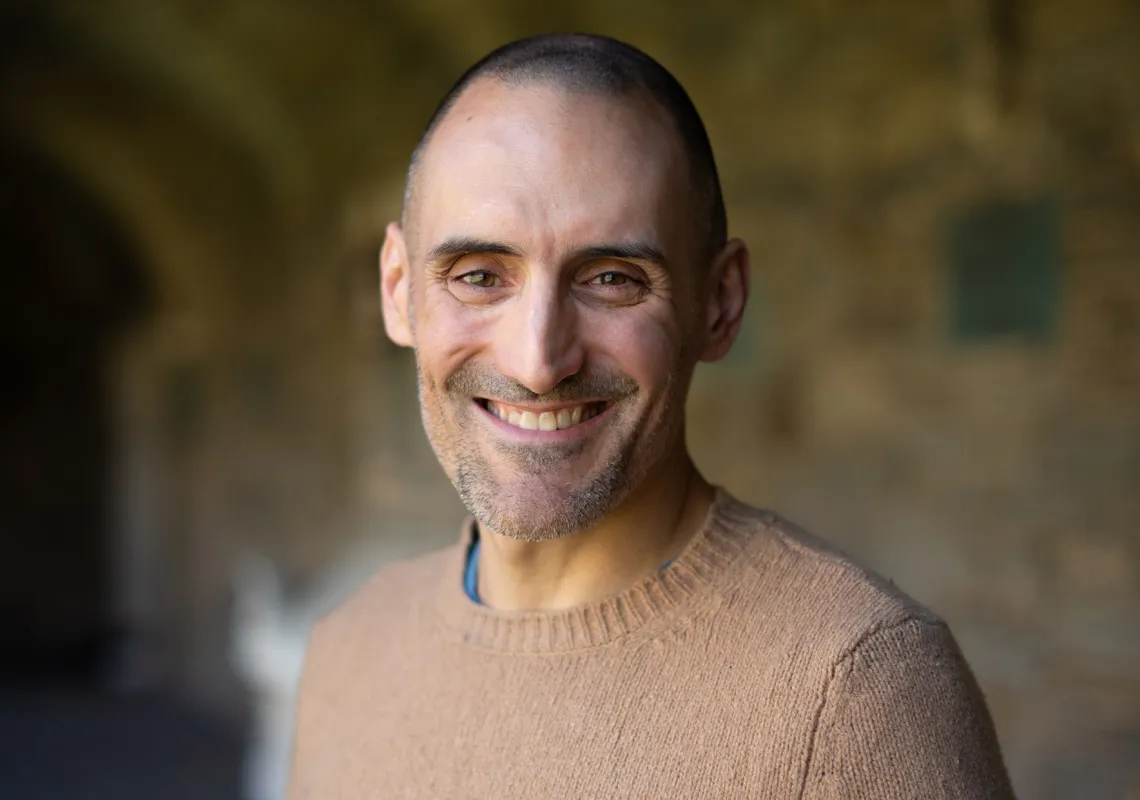
New Faculty: Monica Chander Feels at Home
With Students and Streptomyces coelicolor
Last year, when Assistant Professor of Biology Monica Chander learned that Bryn Mawr was looking for a biochemist, she was pretty sure she felt the hand of fate giving her a nudge. For Chander, a graduate of Mt. Holyoke, a job at a small liberal-arts college for women fits her professional aspirations as perfectly as an alpha-2 receptor fits an adrenaline molecule.
As a doctoral student at the University of Connecticut Health Center, Chander enjoyed the rare opportunities she got to work with undergraduates. She was fascinated by the research she did as a postdoctoral fellow at the Harvard School of Public Health, but she missed introducing students to the marvels of biochemistry. She expressed her interest in teaching to her undergraduate adviser when she ran into her at a professional conference, and the conversation eventually led Chander to a temporary appointment at Mt. Holyoke.
"When I was ready to go on the job market, a lot of liberal-arts colleges were advertising for biochemists. And then this job opened up at Bryn Mawr, and it was pretty much of a no-brainer that this was where I wanted to be."
Now Chander can start her own research program to unlock the mysteries of how the body heals itself and share her excitement about her work with bright, curious young women. Life is good.
Chander's lab is working with a protein produced by a bacterium called Streptomyces coelicolor, the organism that, as Chander says, "makes earth smell like earth." She worked with a similar protein in E. Coli bacteria at Harvard, where she and her colleagues learned how the protein combats damage done to the E. Coli cell by a particular type of free radical.
"Free radicals are highly reactive molecules that can arise normally from biological processes or can be introduced by environmental factors. Because they react easily with other chemicals, they can change the chemical structure of molecules inside the cell so that they don't function properly. Cancer and all sorts of other diseases are now being linked to damage done by free radicals."
The protein Chander studied senses the presence of an oxygen-derived free radical and responds by initiating a cascade of chemical reactions.
"These reactions not only neutralize the free radicals, but actually repair damage that has already been done by them," Chander explains.
Chander and her colleagues teased out the complex mechanisms that produce these effects, increasing scientists' understanding of how organisms protect themselves against the ill effects of oxidative stress. Her new research will pursue the same goal with a different organism.
"Similar proteins are present in a whole bunch of organisms," she says. "But there are differences in the bacterium that lead me to believe that things are not going to work exactly the same way. So I don't even know that this other protein is going to be doing the same thing in this other bacterium — but that's why you do the research. You find out."
In the meantime, Chander is teaching two sections of introductory biology and a biochemistry course, and she's delighted with her students.
"I don't know for sure if it's the effect of being at a women's college, but they have a wonderful sense of confidence. They're very vocal and not at all afraid to ask questions. I'm teaching students at every level — from first-years to seniors — and I have no trouble getting them to participate in class.
"Having shared the experience of going to a women's college makes teaching here really special for me. I feel a strong connection to my students, and when they really get it, when they grasp a new concept and get excited about it, I love being there. And they challenge me; I definitely feel intellectually engaged by them, which is all a teacher could ask for, right?"
<Back to Bryn Mawr Now 10/25/2007
Next story>>
|