
On the Cutting Edge
From PCOS to Paxlovid, alumnae/i research has real-world results.
At Bryn Mawr College, undergraduate students, in partnership with faculty, learn to ask bold questions; to forge a work ethic grounded not only in persistence but also integrity and humanity; and to pursue answers through hands-on research — all part of a strong foundation for further study and research-focused careers in academia or industry.

“There is a teaching component,” retired chemistry professor Sharon Burgmayer said in a 2025 article. “There is a team aspect, not unlike team sports, where research members rely on others’ support and success. There is research’s problem-solving, puzzle aspect: how to resolve experimental problems or interpret data. And there is even a psychological component: how to deal with failed experiments or uninterpretable results, as those are juxtaposed to the thrill of success.”
Here, four alums in health research fields share, in their own words, the real-life impact of their groundbreaking research and how Bryn Mawr nurtured their interest.
MELANIE G. CREE ’99
Professor of Pediatric Endocrinology, University of Colorado, Anschutz
RESEARCH: I work with teenagers with polycystic ovary syndrome (PCOS), a condition of too much testosterone. It’s the leading cause of infertility in the United States. In teenagers, they don’t have regular periods, can gain weight very quickly, and have a hard time losing weight. They can also grow beards, lose their hair like men, and get really severe acne. These girls have really high rates of early cardiometabolic disease. Pre-diabetes is very common. I’m testing and developing new treatment options for girls and women with PCOS.
INSPIRATION: I’ve always been interested in women’s health and women’s issues, even back in high school. The decision to go to Bryn Mawr was very intentional, for the all-women aspect of it. I went on and got my M.D./Ph.D. In my rotation for medical school, I really liked obstetrics and gynecology and thought I would be an ob-gyn. I had my daughter and realized to do the kind of research and training that I wanted to do would be almost impossible with children. The other way to take care of women, which also supports a lot of research, is through endocrinology.
IMPACT: In 2023, I finished the first semaglutide trial with a pill [Type 2 diabetes drug Rybelsus] of PCOS in the world. We showed that it lowered liver fat and the risk of pre-diabetes. These girls lost weight, and there was a trend for their periods to get better. Right now, I run a clinical trial using [weight-loss drug] Wegovy in adolescents and young women with PCOS to see if it helps restore ovulation. It’s true clinical translational science.
I’m an adviser for our patient organization, PCOS Challenge, doing patient educational sessions and working on patient education materials. And I’m leading a 21-center, retrospective database study. We have 1,200 girls in it. It’s the first-ever really good, solid description of PCOS of girls in the United States.
MOTIVATION: This condition is under-researched, underfunded. We know people don’t listen to female patients. They need a voice . . . There’s the opportunity to really impact change of clinical care.
THE BRYN MAWR DIFFERENCE: Being a double science major and playing soccer, I really learned to work hard and manage my time. I was so inspired by the chemistry faculty. They were getting grants; they had a family. They shared stories about their kids. They really showed me that was possible for a scientist. I hadn’t had that model before.
JISUN LEE ’06
Senior Principal Scientist and Lab Head in Internal Medicine, Medicinal Chemistry, Pfizer Pharmaceuticals, Groton, Conn.
RESEARCH: We’re at the forefront of drug discovery, identifying compounds that may potentially be used for therapeutics. That process can take up to decades.
Obviously, there are unique cases, like the Paxlovid [antiviral COVID-19 treatment] case, where we were able to accelerate the process due to the social need aspect. I was part of a small-molecule drug discovery group. It was a crazy time.
As part of Pfizer’s internal medicine department, my area of focus is cardiometabolic diseases. My expertise is small-molecule drug discovery, and the ultimate goal is to discover an oral pill for these diseases.
INSPIRATION: Initially, I went to Bryn Mawr for political science. My parents are both scientists, and while I liked
science, I thought I wanted to do something different. It was the professors I met in the Chemistry Department that really drew me in, the passion they showed. That’s why I declared my major for chemistry sophomore year.
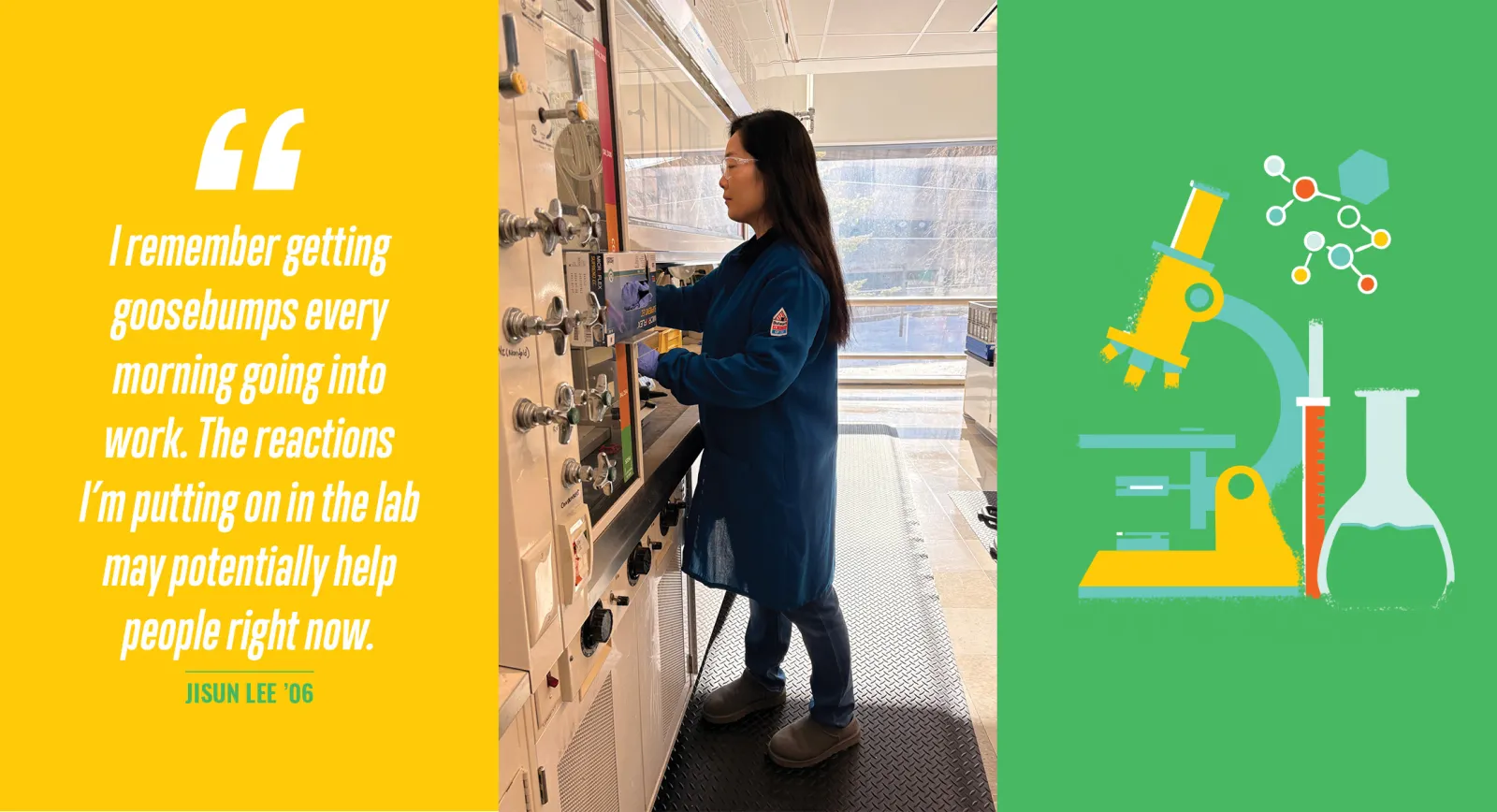
IMPACT: The Paxlovid example is probably something that rarely happens in a medicinal chemist’s career. I remember getting goosebumps every morning going into work. The reactions I’m putting on in the lab may potentially help people right now.
CHALLENGES: Since the process of drug discovery in the lab to going into the market can take a long time, staying motivated every day is a challenge that many medicinal chemists have. I try to focus on the “small wins” — like when a reaction that I set up yesterday worked really well — to keep motivated and try to remind myself that what we do in the lab may lead to breakthroughs in patients’ lives, just as it did for Paxlovid.
THE BRYN MAWR DIFFERENCE: Bryn Mawr encourages students to excel by competing with yourself and not necessarily with your peers. All the professors instilled that in me. I still carry that mindset even now. It helps in a collaborative environment, too. You don’t want to be always looking over your shoulder and pitted against someone else.
BRIELLE C. STARK ’12
Associate Professor, Speech, Language and Hearing Sciences, the NEURoscience of Adult Language Lab, Indiana University, Bloomington, and Ph.D. Program Director
Author, The New Ways We Talk: A Story about a Parent’s Aphasia for Young Children
RESEARCH: My research program mostly focuses on aphasia, a language disorder that impacts about 2 million [in North America], twice as many as Parkinson’s or MS. It’s most commonly caused by a left hemisphere stroke. It’s essentially impacting people’s abilities to communicate and participate in life.
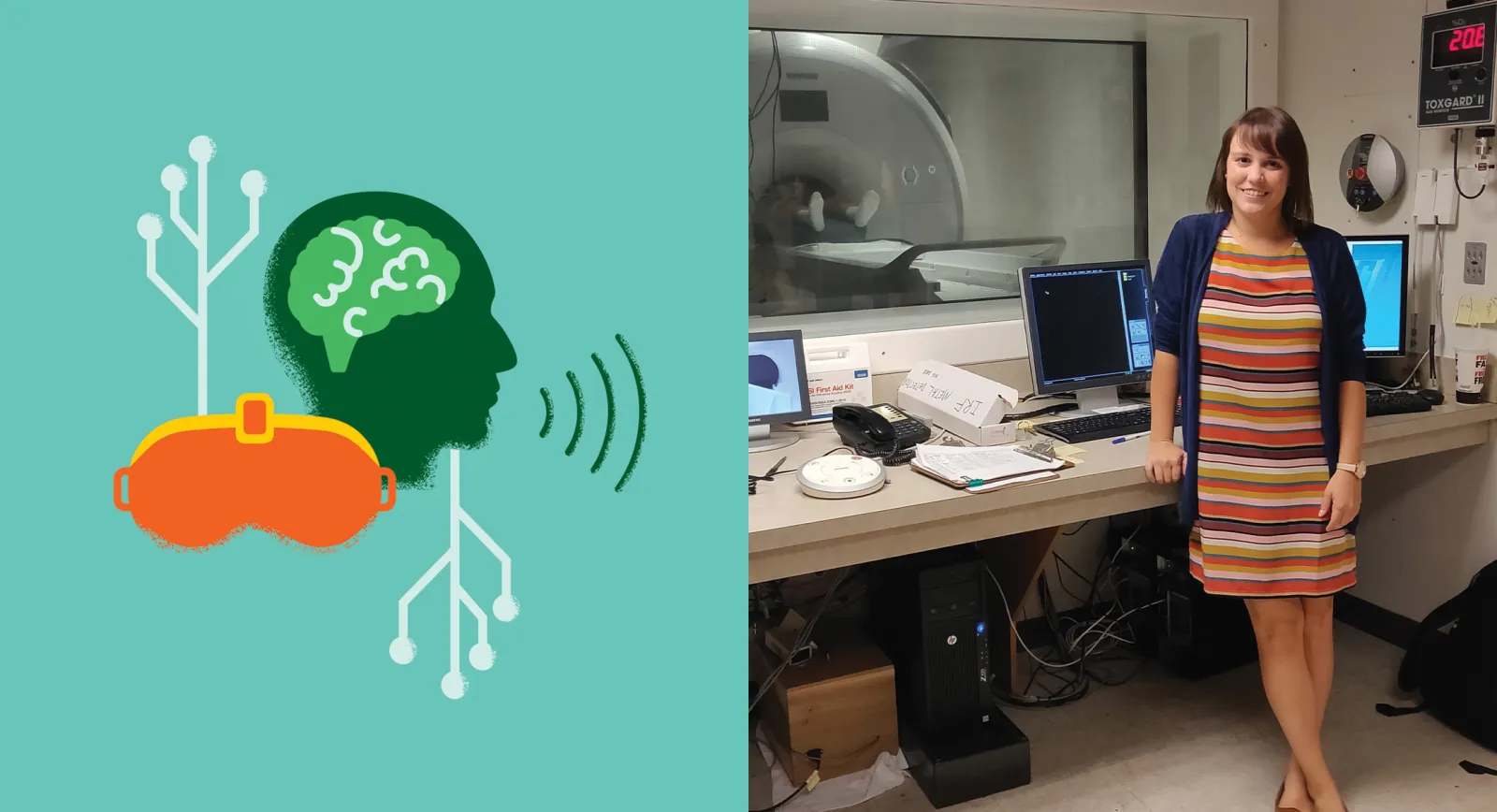
My research looks at natural language elements that are being broken down, how that maps back to brain damage, and how we can assess treatment of language needs. I was recently on a Fulbright to Australia, and we’re looking at virtual reality for studying how people use language functionally, putting people in different situations that are low stress and seeing how language comes across.
INSPIRATION: I was convinced I wanted to be pre-med for a long time. When I was in college, my uncle had a massive stroke. I saw firsthand the importance of rehabilitation professionals, thinking long term, educating the family. I pivoted to be more on the research side.
IMPACT: Language in use, storytelling, and conversation is really hard to measure and quantify in terms of therapy. We’ve been working with some computer scientists to streamline machine learning and AI tools that might help. We feed in a transcript and have it automatically analyze not just the linguistic part, like nouns and verbs, but the high-level information — what we might call informativeness. How much sense are they making? We hope to roll out a tool this year as an app.
MOTIVATION: I’ve had one-on-one talks with people with aphasia. We do a lot of co-design, which is asking people with aphasia what they want. For instance, ‘what do you think is a major issue you’ve seen affecting yourself or other people in your position, and how might we address it?’ That’s super motivating for me.
THE BRYN MAWR DIFFERENCE: Bryn Mawr made me confident enough to go after Cambridge. (Stark was a Gates Cambridge Trust Scholar, earning her Ph.D. in clinical neuroscience from Cambridge University.) Bryn Mawr really trained me to have a good work ethic and how to speak up.
MAIRA KARAN ’17
Postdoctoral Research Fellow, Zeitzer Circadian Sleep Lab, Stanford University, Palo Alto, Calif.
RESEARCH: More recently, my work has focused on sleep and circadian rhythms in teenagers and how sleep patterns and daily routines shape mood, stress, and functioning.
INSPIRATION: I can remember being an adolescent and having so many different changes and experiences. When I went on to Bryn Mawr, I worked with an amazing mentor [Associate Professor of Psychology Heejung Park, now at Scripps College] whose work was focused on adolescents and young adults. Interestingly, she was also studying sleep in that period of life. I became very interested in sleep. It’s such a modifiable health factor.
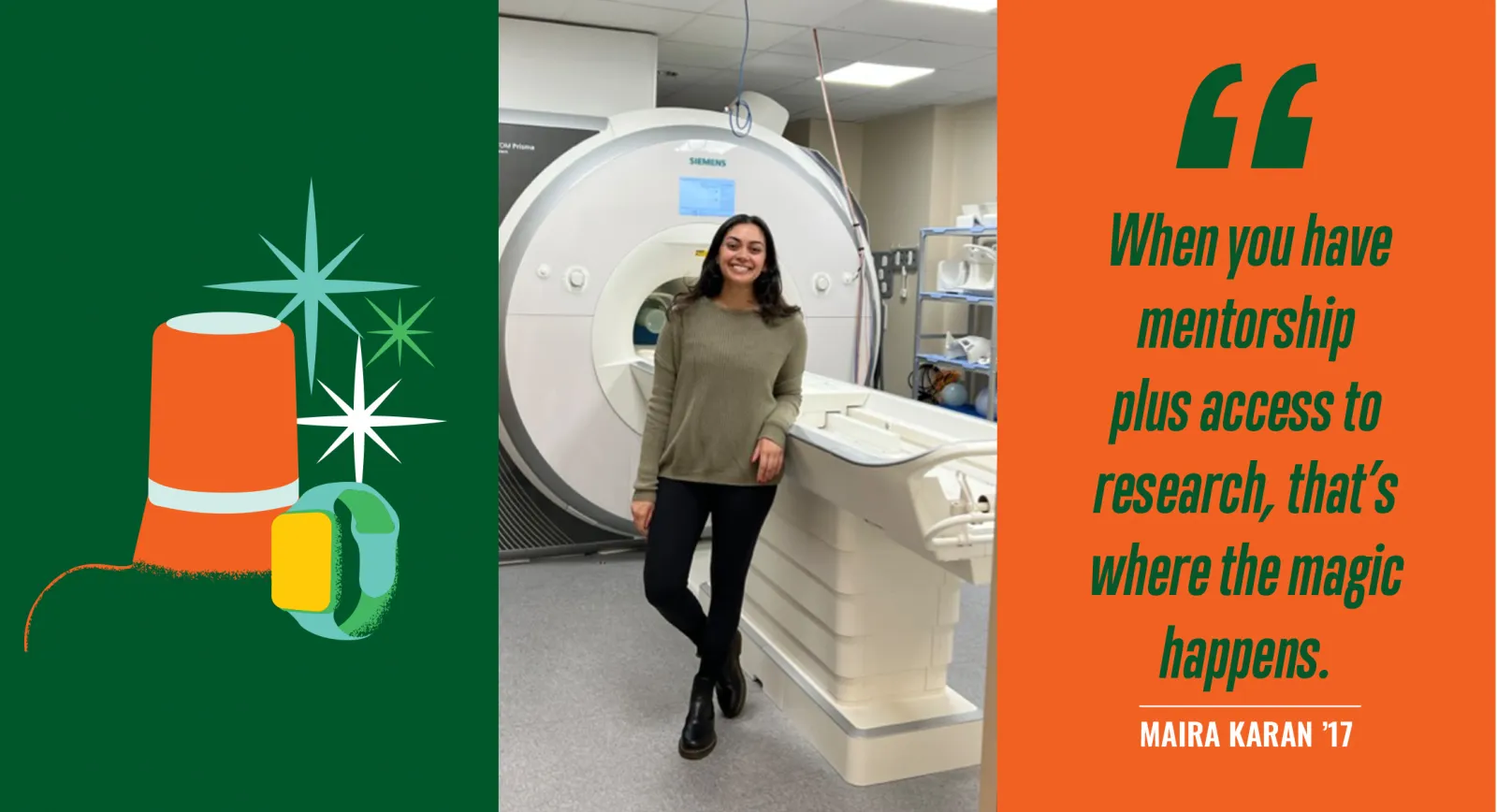
IMPACT: At the start of the study, we plug in a very small, portable lamp that looks like a beacon. It’s very bright. The light therapy is timed specifically to early in the morning, right before teenagers wake up. This flash therapy is shifting the circadian rhythm by basically putting the kids on Colorado time, even though they’re living in California. So, it’s easier for them to wake up in the morning and easier for them to go to sleep at an earlier time in the evening. We see reports of way less sleepiness, way less drowsiness.
This is a product that people could eventually buy on the market.
THE BRYN MAWR DIFFERENCE: People there saw potential in me really early, way before I ever thought I had potential. Bryn Mawr normalized intellectual ambition and the idea that you can take on big questions and do it with precision and heart.
One of the biggest strengths of Bryn Mawr is not only are there incredibly brilliant researchers who are our professors, but they are also wonderful, wonderful mentors. When you have mentorship plus access to research, that’s where the magic happens.
Published on: 03/06/2026