
In Memoriam: Richard Stephens Ellis
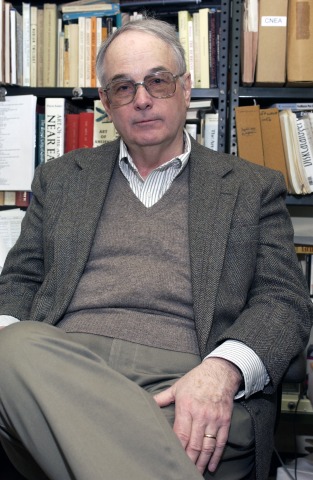
Professor Emeritus of Classical and Near Eastern Archaeology Richard “Dick” Stephens Ellis (1934–2025)
Professor Emeritus of Classical and Near Eastern Archaeology Richard Stephens Ellis, affectionately known as Dick, passed away peacefully on Oct. 12, 2025, at the age of 90. Ellis’ life was a testament to a perpetually curious mind and a gentle, empathetic spirit.
Ellis earned his undergraduate degree in history at Wabash College, followed by a master’s in Near Eastern Archaeology at the University of Chicago, after which he was drafted into the U.S. Army and served in Germany as part of the U.S. Signal Corps during the Berlin crises of 1961–62.
Ellis returned to the University of Chicago to complete his Ph.D. in Near Eastern Archaeology. While there, he took a course in Biblical Hebrew, where he met his future wife, Ria. They wed in 1964 and were happily married for more than 60 years.
He became a faculty member at Yale University, and then at Bryn Mawr, where for 30 years he shared his knowledge and interests with countless students in the Classical and Near Eastern Archeology Department.
Ellis’ career was defined both by scholarship and by active participation in excavations in Iraq, Turkey, and other locales across the Middle East. Peers recognized his work as meticulous and astute, and it became deeply influential. In 2010, on the 40th anniversary of the publication of his dissertation Foundation Deposits in Ancient Mesopotamia, scholars from multiple fields published a collection of 20 articles inspired by and honoring his pathbreaking work and long-term multidisciplinary impact.
After retiring and becoming an emeritus professor in 2003, Ellis continued to work in Near Eastern archaeology and accompanied his wife Ria on her professional travels to India, Mongolia, China, Thailand, Yemen, and various Western European countries. The opportunity to travel during retirement allowed him to pursue his passion of photography.
Fellow Professor Emeritus of Classical and Near Eastern Archaeology Jim Wright remembers Ellis’ “deep and wide reading and international engagement … His knowledge was encyclopedic and his analytical understanding of the issues … utterly reliable.” Wright also remembers Ellis’ kindness, generosity, and conviviality. “When our first child was about to be born, we didn’t have a car, so he lent me his to take [my wife] Mary to the hospital. His basement became my place for woodworking when I decided to craft furniture for our house. The parties he and Ria held at their spacious home in Ardmore were a central meeting place for faculty from the tri-state area.”
Ellis’ former students, some of whom went on to careers in archaeology themselves, have equally fond memories. “I still think of him and talk to my kids about how my love for archeology started in his class,” writes Stacy Safrin ’95. Sara Orel ’84 remembers, “I loved him dearly as a teacher and mentor; he was so supportive, such a wonderful teacher, and so very gracious and generous … We were so lucky to be taught by him and the other faculty at Bryn Mawr in archaeology. They were lovely, caring, inspiring teachers, as well as fantastic scholars.”
Former graduate student Andrew Cohen, M.A. ’91, Ph.D. ’01, recalls, “The first time I walked into his office as a first-year grad student, I noticed it was dominated by a large library table full of slides, papers, [and] equipment … As the semester went on, I realized that he was making much of his own teaching materials because available publications did not illustrate what he wanted to convey. Dick’s charts, diagrams, graphs, and photos taught me … that to be a great communicator, one should be able to synthesize information and tailor it to an audience. That is a lesson that I carried long after graduate school.”
Those who knew Ellis personally, professionally, and academically recognized him as a quiet, gentle man, a gregarious host, and a thoughtful observer whose curiosity about the world was informed by a fundamental interest in people and how they live their lives. Ellis will be missed, but his teaching and the memories he created will remain alive with friends, family, and his academic community at and beyond Bryn Mawr.
Thanks to Matt Ruben for authoring this remembrance, with contributions from Astrid Lindenlauf.
Published on: 03/02/2026