

Every other year, the Graduate Group in Archaeology, Classics, and History of Art hosts the Bryn Mawr College Biennial Graduate Group Symposium, planned and organized entirely by students, with the goal of facilitating interdisciplinary scholarship.
This year's fifteenth biennial symposium, titled "Consumption: From Cannibalism to Capitalism," was held on campus at the end of March and was organized by four current students in the Classics Department at the Graduate School of Arts and Sciences: Mary Anna Ball, Erica Collin, Seth Levin, and Izzy Martin.
"Through this experience, I was able to connect with graduate students from other institutions and work to provide them a space to share ideas and collaborate on ideas across many scholarly disciplines. Planning the conference allowed me to give back to the wonderful graduate program at Bryn Mawr," says Collin.
"I am so thankful for opportunities like planning the Biennial Symposium because they allow me glimpses into different aspects of the world of academics that you don't see in the classroom alone," Martin adds. "Planning a conference is a ton of work, but you really get to know all the wonderful faculty and staff members at Bryn Mawr on a deeper level, and it is so rewarding to build new relationships with people and realize how much support you have here."
This Year's Presenters from the Bi-Co
Cem Almurat
Originally from Istanbul, Turkey, Almurat is now a second-year graduate student in the Department of Classical and Near Eastern Archaeology. His research primarily focuses on the gradual development of urban armature in Roman-era settlements in Anatolia, with particular attention to urban planning and the reciprocal relationships between urban centers and their hinterlands/countryside. Almurat feels honored and blessed to be part of the deep-rooted academic tradition at Bryn Mawr and its history as a pioneering institution in Anatolian archaeology. He loves exploring and studying the marvelous collections at Canaday and Carpenter Libraries, as well as the natural beauty of the campus.

Symposium Topic: "The Bishop and the Pawn: Civilian Life under Sieges in Byzantium's Eastern Frontier"
Long-lasting and bloody sieges that took place in modern-day Southeastern Turkey during consecutive military campaigns between the Byzantines and Sassanids in the course of the fourth century CE triggered some unpleasant and dark realities of survival among the dwellers of cities. Although there is a thin line between exaggeration, dramatization, and reality in historical accounts, Almurat's presentation aimed to scrutinize primary sources from various genres to observe how contemporary accounts from different backgrounds depicted civilian life and their endurance during sieges.

Study Archaeology at Bryn Mawr
The Department offers students the opportunity to study the ancient cultures of the Mediterranean and the Near East and to explore the interconnected histories and cultures of these areas. The curriculum, which stresses both breadth and depth of study, has prepared students for successful careers in a variety of fields, including teaching, research, publishing, and work in museums and foundations.
Avery Barnett (HC '26)
Barnett is a math and classics double-major from Northern Virginia. Her research interests are animal transformations and cannibalism in folklore and ancient literature, with her classics thesis analyzing metamorphosis in imperial Roman literature through the lens of disability studies. Outside of the bulk of her classics coursework at Bryn Mawr, one of her favorite parts of the College is being involved in the dance community, including the dance departments and student dance groups.

Symposium Topic: "Cannibalistic Hospitality in Imperialist Travel Narratives"
The paper discusses how depictions of cannibalism in imperialist narratives dehumanize indigenous people and justify further imperialist violence. In particular, the paper compares the dynamics of hospitality and hostility in three texts: the Odyssey, a 16th-century travelogue set in Brazil, and the 2005 horror film Hostel.
Study Classics at Bryn Mawr
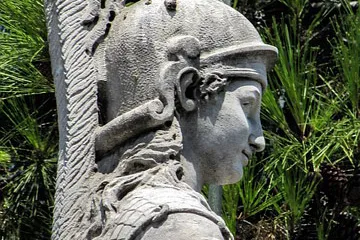
From its earliest days, Bryn Mawr has had an international reputation in classical languages. It was among the first institutions to offer doctorates in classical philology to women in the United States. Today, the College is home to a lively community of graduate students, both women and men, who are interested in various aspects of the civilizations of ancient Greece and Rome.
Maggie North
North is a third-year graduate student in History of Art, specializing in modern and contemporary American art, with particular emphasis on materiality, feminist theory, and transnational histories. Last month, she presented her paper on Manuel Maples Arce’s 1921 manifesto, situating the work within a broader network of art-historical referents. Originally from New Hampshire, North was inspired by Bryn Mawr's long history of educating women to the highest degree and excited by the prospect of learning from current faculty members. North has thrived in Bryn Mawr's relatively small graduate program, where the close relationships between faculty, staff, and students help make her feel supported, encouraged, and challenged by professors and peers alike.

Symposium Topic: "Digesting the 'Strident Pill': Rereading Manuel Maples Arce’s Manifesto"

Studying History of Art at Bryn Mawr
The curriculum in History of Art immerses students in the study of visual culture. Structured by a set of evolving disciplinary concerns, students learn to interpret the visual through methodologies dedicated to the historical, the material, the critical, and the theoretical.
An exhibition, titled Voracious: Cycles of Consumption, opened in tandem with the symposium and was also organized by graduate students — Ph.D. candidate in Greek, Latin, and Classical Studies Devin Lawson, M.A. candidate in Classical and Near Eastern Archaeology Marguerite Packard, and Ph.D. student in History of Art Yuzhu Wang. Using materials from the College's Special Collections, the exhibit focuses on the theme of consumption and considers the cyclical nature of consumption, as well as the gastronomical pleasures of eating, alongside the simultaneous and subconscious pains of extracting, digesting, and depleting natural and cultural resources.
"The process was collaborative and experimental, requiring insights and care from all three departments represented in the graduate group and members of Special Collections," says Lawson, of the experience working on the exhibition committee. "At each stage, Bryn Mawr's curator of Art and Artifacts, Carrie Robbins, challenged us to be curious and think outside the box. We learned to turn things that might have been challenges or obstacles into opportunities for freedom and creativity."
The exhibition is on display circling the Cloisters on the first floor of Old Library through May 31, 2026. An exhibition guide with a map of the exhibition can be found under the stairs to the Great Hall.