
Horse Power
Anastasia C. Curwood ’96 has long been interested in how horses represent power. Six years ago, she co-founded a nonprofit organization to empower riders of color.
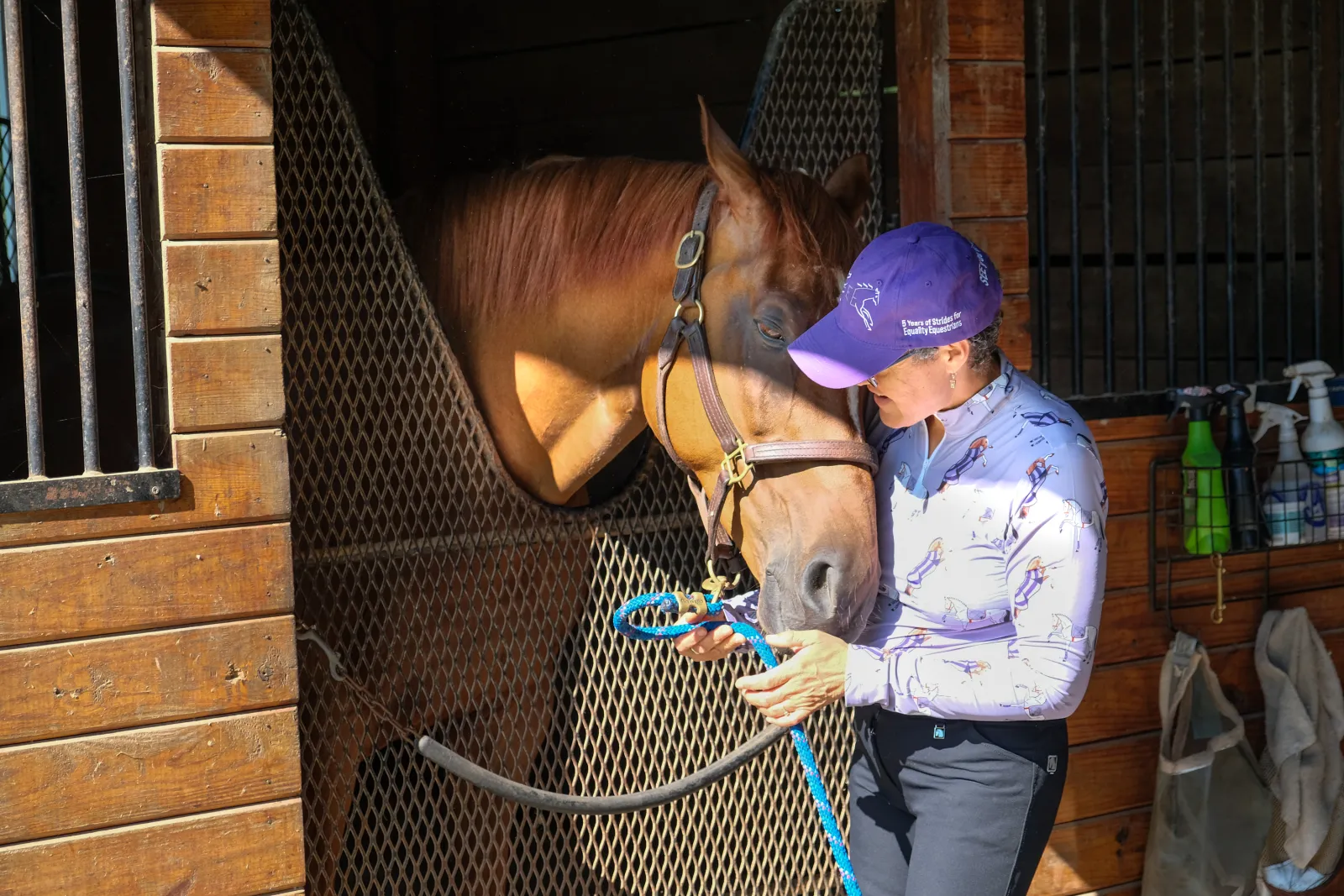
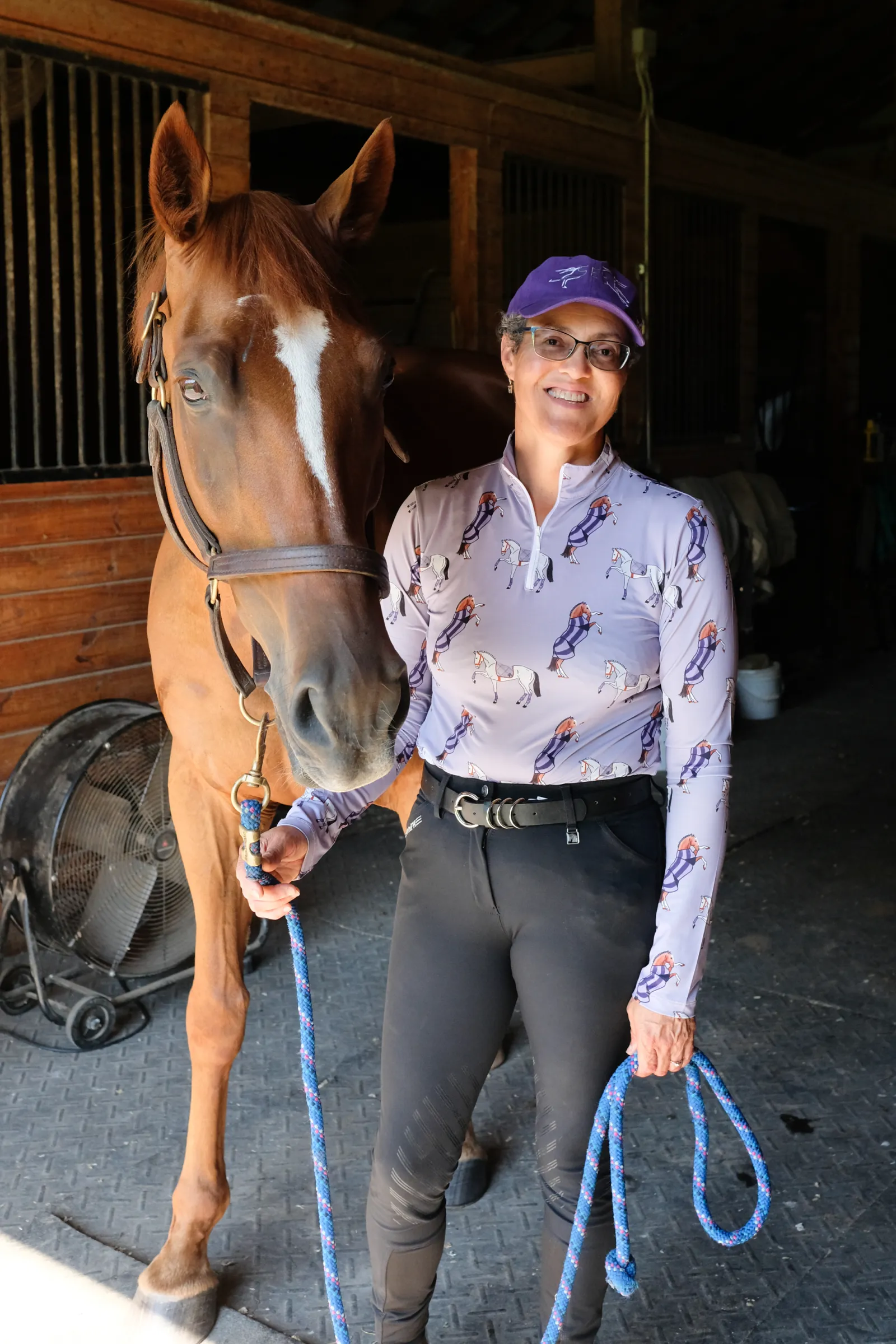
Prince, a freshly brushed chestnut horse, is being bribed with carrots and peppermints to pose for photos with Anastasia C. Curwood ’96.
“Did she describe him as a 1,200-pound golden retriever?” asks Carol Skricki, Curwood’s wife. “That’s how I describe him. Always nudging in your pockets.”
Curwood is a professor and chair of the history department at the University of Kentucky (UK). Joining UK in 2014 was a great professional opportunity, but after growing up in Boston, going to school at Bryn Mawr and Princeton, and teaching in Atlanta, it also offered a unique personal opportunity: “Living in Kentucky is the first time I’ve been able to have the horses with me,” Curwood says. “It’s really special to have them right behind the house.”
Living in Kentucky, Curwood learned more about the influence Black people have long had in the equine industry. In 2020, she wrote an essay about that history and her relationship with it for an equestrian publication, Eventing USA.
“It is not a surprise that enslaved people fed, watered, mucked, groomed, and did all of the other care that horses need in the years before Emancipation in 1865,” Curwood wrote. “And nor is it a surprise that Black people have done the same jobs since. However, I did not know that Black Americans were the talent in the horse business, too.”
Her article was written in the months following the murder of George Floyd, when, she says, “for a quick moment there, people were acknowledging histories of Blackness, of race in general.”
Curwood wrote about how — long before she ever heard of famous Black jockeys such as Isaac Murphy and Oliver Lewis, who rode Aristides to victory in the first Kentucky Derby — she began riding as a horse-crazy girl growing up outside Boston. Curwood’s father connected her to lessons through another Black father, whose daughter rode. That girl was the only other person of color Curwood encountered in riding for years afterward.
It seemed to Curwood that the only people talking about racism in the equestrian world were other riders of color. Eventing USA asked Curwood if she knew of any white equine professionals who would be willing to share their thoughts about racism in the horse business. She introduced them to her friend and ally of 25 years, Heather Gillette, who was more than happy to talk.
“People of color worked for white people who had horses,” says Gillette, a rider, trainer, and teacher. “That’s how it was when we were growing up, for the generation before me . . . as soon as it became an industry where you could make money, the Black folk were pushed out.”
Gillette told Curwood, we need to do something. That is how Strides for Equality Equestrians (SEE) was born.
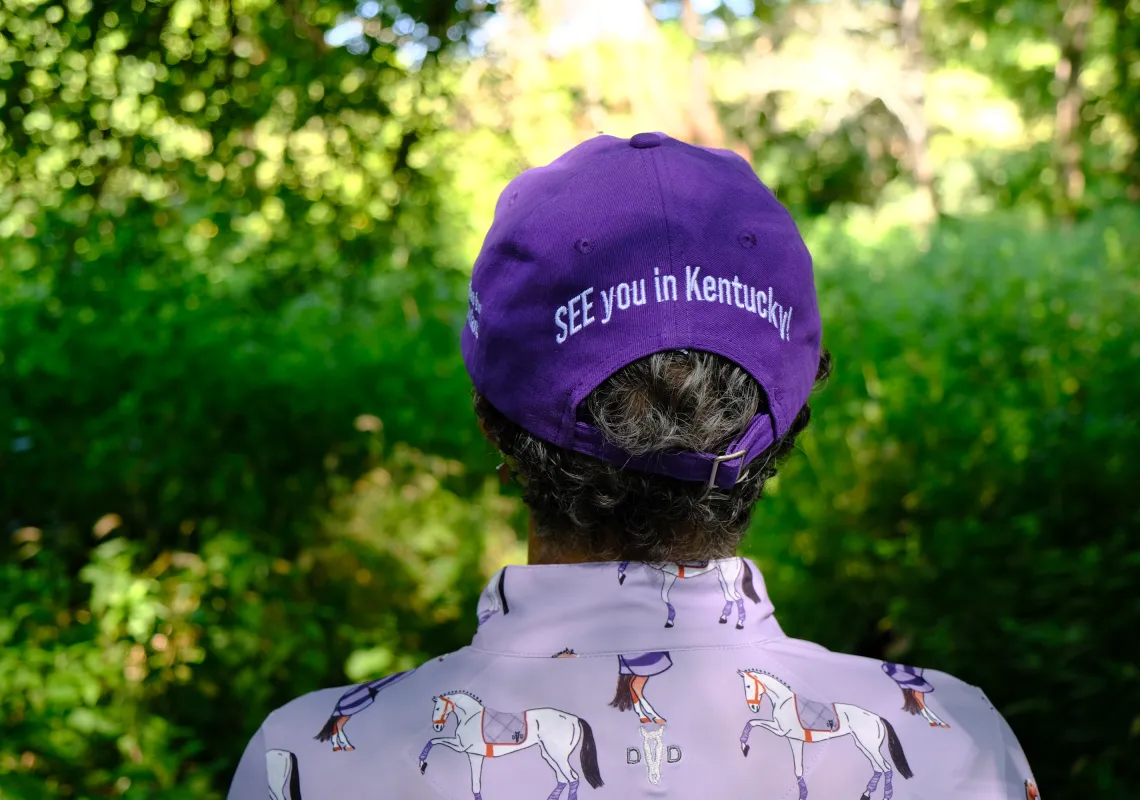
SEE was founded by Curwood and Gillette to promote allyship and visibility in equestrian sports and the equine industry. SEE provides scholarships and opportunities to anyone who cares about increasing diversity in equestrian sport, and gives equestrians of all ages the opportunity to find community and gain skills through their camps. SEE interviews BIPOC (Black, Indigenous, and People of Color) professionals in equine fields for their website to demonstrate the range of career opportunities, including equine vets, massage therapists, and even accessory designers.
Early on, an angel donor came to SEE and offered to sponsor training on their farm in Virginia. They offered to cover horse transportation, travel, lessons — everything. It was a generous offer, but not necessarily a practical one.
“There are more equestrians of color than you would think,” Curwood says. “The ones who would be able to drop everything for two or three months and go train intensively at this place was finite.”
SEE pivoted to annual camps at the Virginia farm and invited equestrians and their horses to spend a week riding and learning from trainers, farriers (hoof specialists), and saddle fitters. The organization works with access programs and donors to provide financial support and scholarships.
“When we get a community of people of color, it means we can look out for each other more.”
Another donor expressed a desire to bring the camp experience to the Midwest, which launched this summer at a farm in Kansas. Ruby Vandiver, a 19-year-old equestrian, came with her horse Lefty.
“In this society, most people who ride horses are white, so I do feel like when we get a community of people of color, it means we can look out for each other more,” she says.
Vandiver doesn’t remember what made her decide to take up riding at age 5; it just feels to her like it’s always been part of her life. She found out about the camp the same way many of the others did — when her mom sent her the application.
For Vandiver, camp was fun, and she enjoyed learning more about horses and meeting new friends who shared that interest. But on a deeper level, making friends who could relate to each other’s experiences and share their thoughts and feelings freely was invaluable.
“We’ve been keeping in touch, and we’re always rooting for each other,” Vandiver says.
The camps are open to people of any age, so although many attendees, like Vandiver, are in their teens, adults can also come live their horse-riding dreams, too.
“It’s unbelievably fulfilling to watch people find that community,” Gillette says.
Even now, equestrians of color, we represent a confrontation or contestation of power.
Curwood never considered a career as an equestrian or in the equine industry; growing up, she was always interested in history and writing, and she began pursuing her academic future as a Mellon Mays Fellow at Bryn Mawr.
“That Mellon Fellowship built a community of students of color interested in going into the academy . . . that was really instrumental for me in terms of my academic career,” she says. “So, if I had had something like that for my equestrian career, who knows?”
Eventing comprises the equestrian sports of dressage, cross country, and show jumping, sometimes referred to as the triathlon of the horse world. Curwood competes in dressage, which requires the horse and rider to perform a series of precise movements. “It is very Bryn Mawr,” she says. “Like other Bryn Mawr women, I’m competitive with myself. I hold myself to very high standards.”
“Also, I like ribbons,” she adds. “You get a lot of ribbons in dressage.”
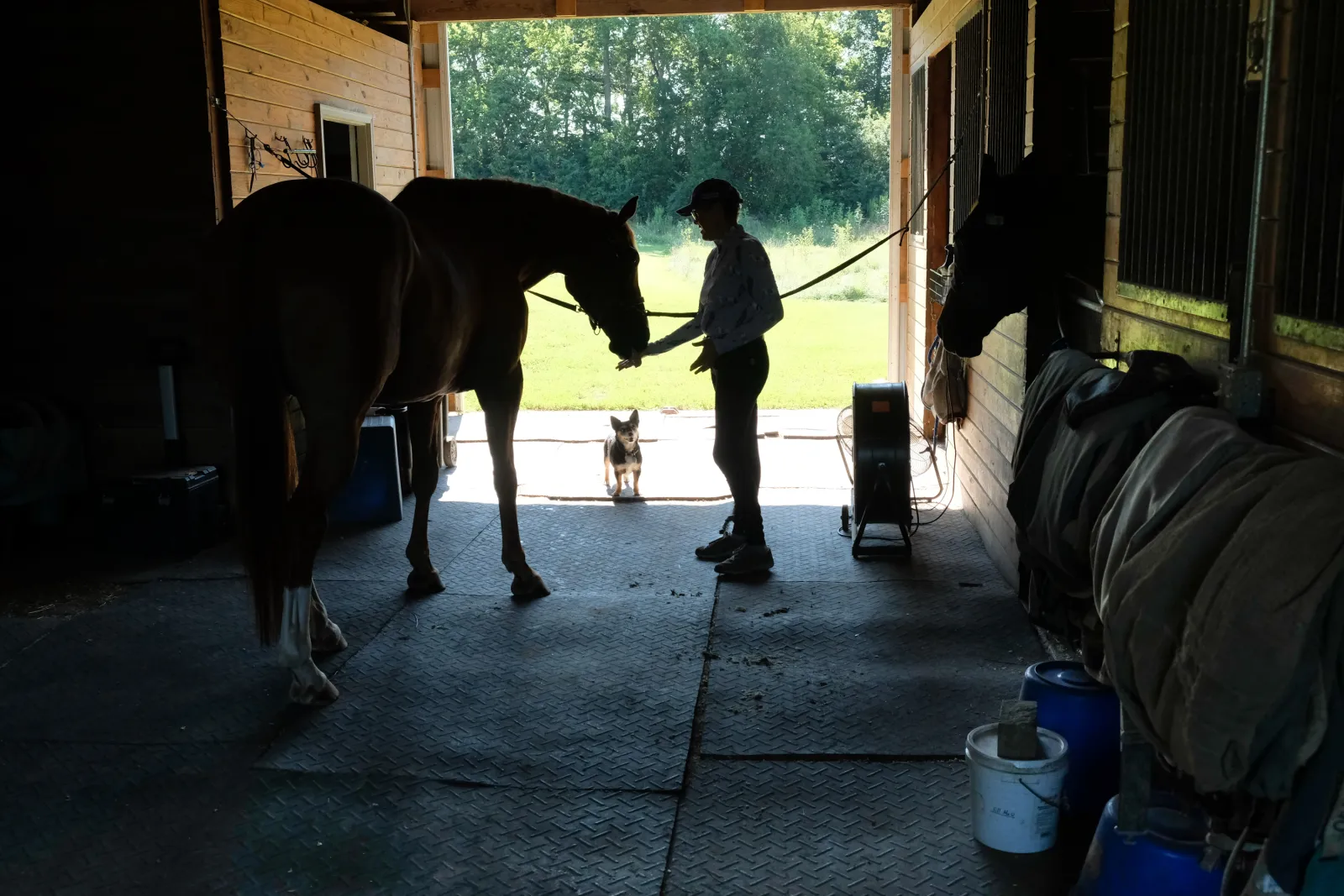
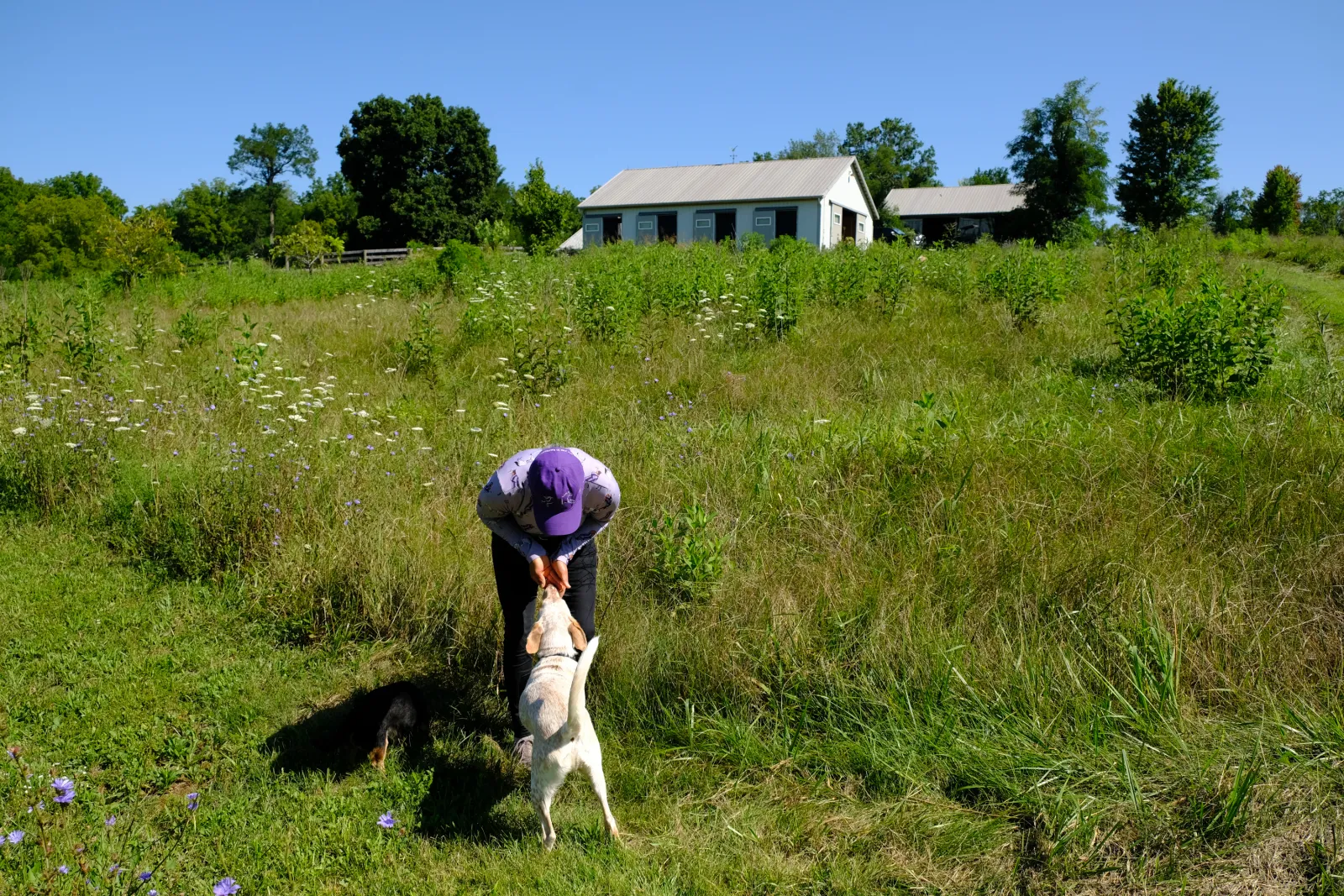
Ribbons adorn the walls of her and Skricki’s house on a 101-acre farm outside Lexington, an expansive stretch of conserved land with trails where Curwood can ride the horses. Prince shares the barn with two boarder horses and their neighbor’s horse Theo, while Curwood’s other horse, Glen, a member of the 2016 Olympic team, lives with the next-door neighbor. (Glen doesn’t like being part of a herd, Curwood says.)
Curwood has found ways to combine her profession with her passions. She is the author of two books, Shirley Chisholm: Champion of Black Feminist Power Politics and Stormy Weather: Middle-Class African American Marriages Between the Two World Wars. She was instrumental in a project to highlight the contributions of African Americans in the industry for the International Museum of the Horse.
The history, the horses — it’s all a return to her roots. Through her research, Curwood learned she had ancestors who were enslaved in Kentucky and a great-great-grandparent who had worked as a clocker at a racetrack.
“What I always say about horses is, horses are power,” Curwood says. “You find horses, you’ve found where people hold power. Even now, equestrians of color, we represent a confrontation or contestation of power.”
With SEE, she says, “We are asking people, ‘Hey, do you want to participate in empowering folks?’”
Published on: 10/18/2026