

Endowed Lecture Series: Chemistry's Yan Kung on Better Understanding Enzymes
Associate Professor Yan Kung
W. Alton Jones Professorship in Chemistry
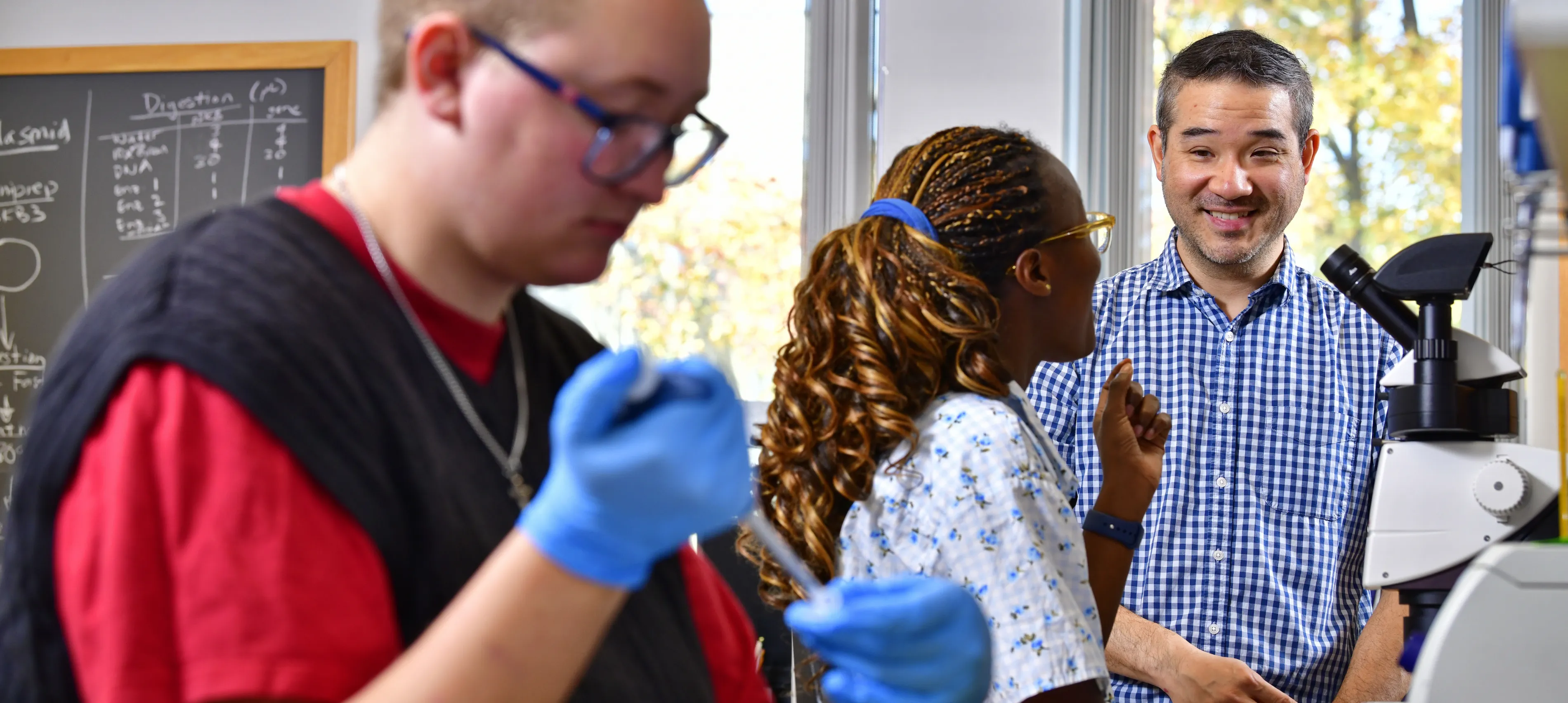
In honor of receiving the W. Alton Jones Professorship in Chemistry, Associate Professor Yan Kung will give a lecture about his research on Tuesday, Nov. 17.
“It really took me by surprise,” says Kung of receiving the professorship. “It means a lot because it shows that there's recognition from the college that the research that I do and the work that I've done is seen and is valued, and especially the work that I do with students.”
Kung’s research uses X-ray crystallography to determine the three-dimensional structure of enzymes down to the level of atoms to gain insights into how they function, binding substrate molecules and catalyzing the reactions that turn them into other molecular forms. X-ray crystallography is the same technique that generated the data that Watson and Crick employed to discern the structure of DNA in 1953.
Kung's interest in science began in childhood, when he enjoyed reading books “that teach you about the world and about biology and about how things work.” That curiosity continued through college and graduate school, eventually leading him to study biochemistry and chemistry. Today, his research focuses on the structure of proteins, particularly enzymes involved in a process called the mevalonate pathway, and how their structures determine their function.
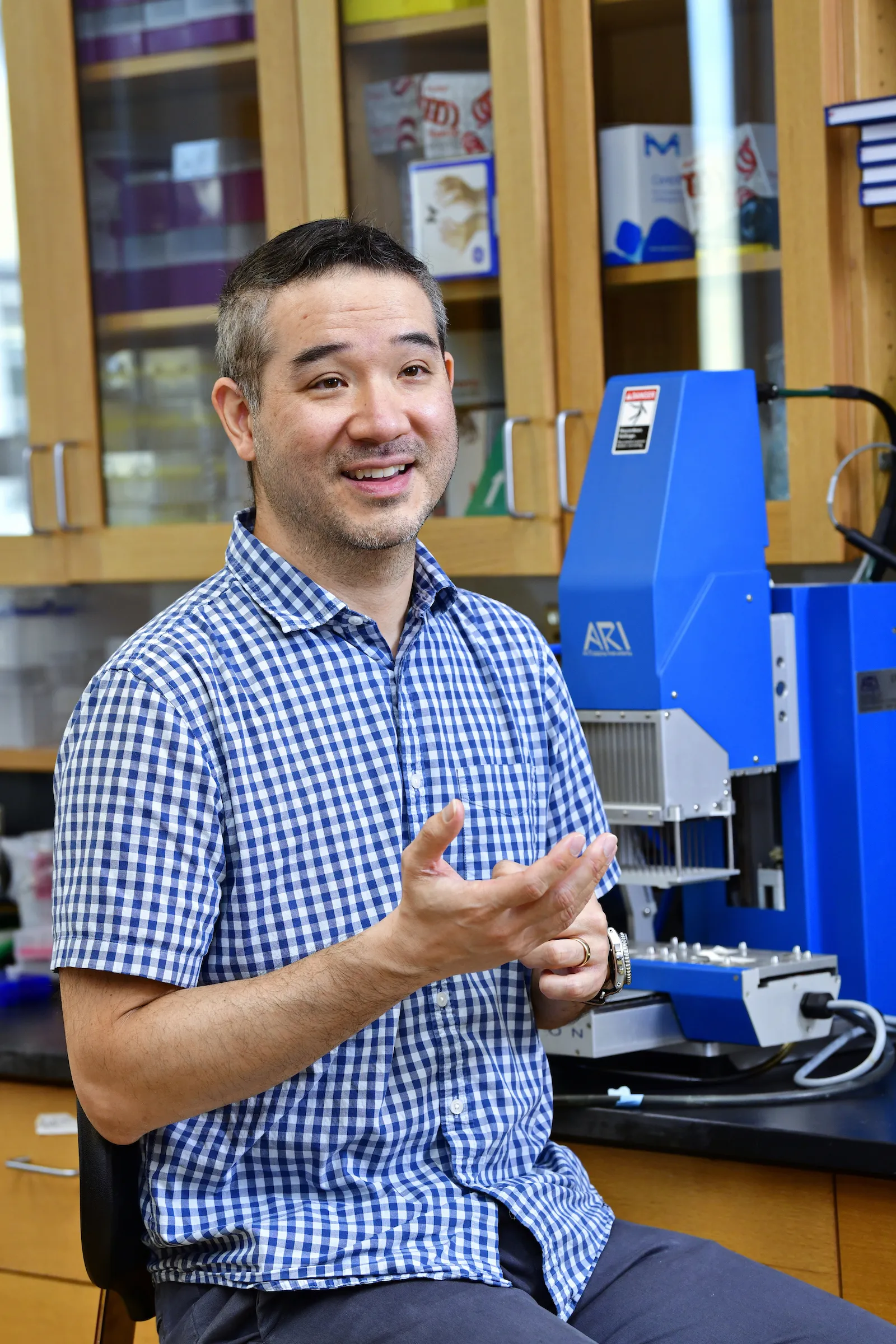
The mevalonate pathway helps cells produce the building blocks for a variety of important substances, including cholesterol, steroids, and certain fuels. It is also the pathway targeted by statins, medications widely used to lower LDL, or “bad,” cholesterol. These drugs work by blocking one of the enzymes involved in the process.
Kung’s classroom teaching ranges from general chemistry to advanced biochemistry as well as a laboratory course. His research laboratory is also an active teaching space, hosting three to six students at a time who stay for one to three years. Now in his fourteenth year at Bryn Mawr, Kung has mentored dozens of students in his lab, many of whom have co-authored papers in professional journals.
Boatemaa Sarpong ’27 is new to the lab this fall. At the start of the semester, Kung spent a lot of time with her and the lab’s other new students, detailing exactly what his research entails and how to perform testing.
“Then he allowed us to do it on our own,” and encouraged them to help each other before turning to him, she says.
After graduation, Sarpong plans to pursue a master’s degree in public health and then go to medical school.
"Working in the lab has helped to sharpen my critical thinking and problem-solving skills," she says. "As I’m pursuing my M.P.H. and eventually a medical degree, having the ability to identify issues and implement effective solutions is an important skill to have."
If all goes well after she graduates from Bryn Mawr, Sarpong will join a host of former lab students who have gone on to earn advanced degrees, start their own labs, or go to medical school.
Raining Huo ‘21 is a combined M.D./Ph.D. candidate at Emory University who joined the Kung lab as a first-year student before she had ever taken a biochemistry course.
"Dr. Kung is an amazing teacher and mentor. When I first joined the Kung Lab, Dr. Kung spent a lot of time teaching me basic biochemistry and experimental methods," she says. "He was incredibly patient and encouraging. I also took his advanced biochemistry course in Fall 2020, and it was easily one of the best classes I've taken at Bryn Mawr. What I learned in that class has helped me all the way from the MCAT to my recent Ph.D. qualifying exam.”
In addition to his mentorship in the lab and classroom, Kung helped Huo with her application for a Goldwater Scholarship.
“I’m so grateful for Dr. Kung’s guidance when I was applying for scholarships and graduate programs. He is truly devoted to helping his students succeed. In the future, I hope to become a mentor like him.” says Huo.
Having the opportunity to interact with and mentor undergraduate students while also conducting research is why Kung chose to teach at Bryn Mawr, he says.
While his graduate and postdoctoral work was at two large research institutions, Massachusetts Institute of Technology and Lawrence Berkeley National Laboratory in California, respectively, as an undergraduate he attended Colby College in Maine, graduating summa cum laude and Phi Beta Kappa.
"I had that liberal arts college experience myself, and that was so important for me to figure out what it was that I wanted to do,” Kung says. “So, it was really exciting to me, the idea that I could be part of that on the faculty side. I want to make sure that when my students graduate from Bryn Mawr and leave the lab, they can start thinking for themselves as scientists."
Chemistry at Bryn Mawr
The chemistry department aims to train you to be a successful scientist. You will learn to understand and explain chemical reactions, structures, and behaviors. We believe that applying chemistry provides practical solutions to real-world problems.