

NSF-Funded $1.5M NV Microscope and New Labs Expand Bryn Mawr's Quantum Center
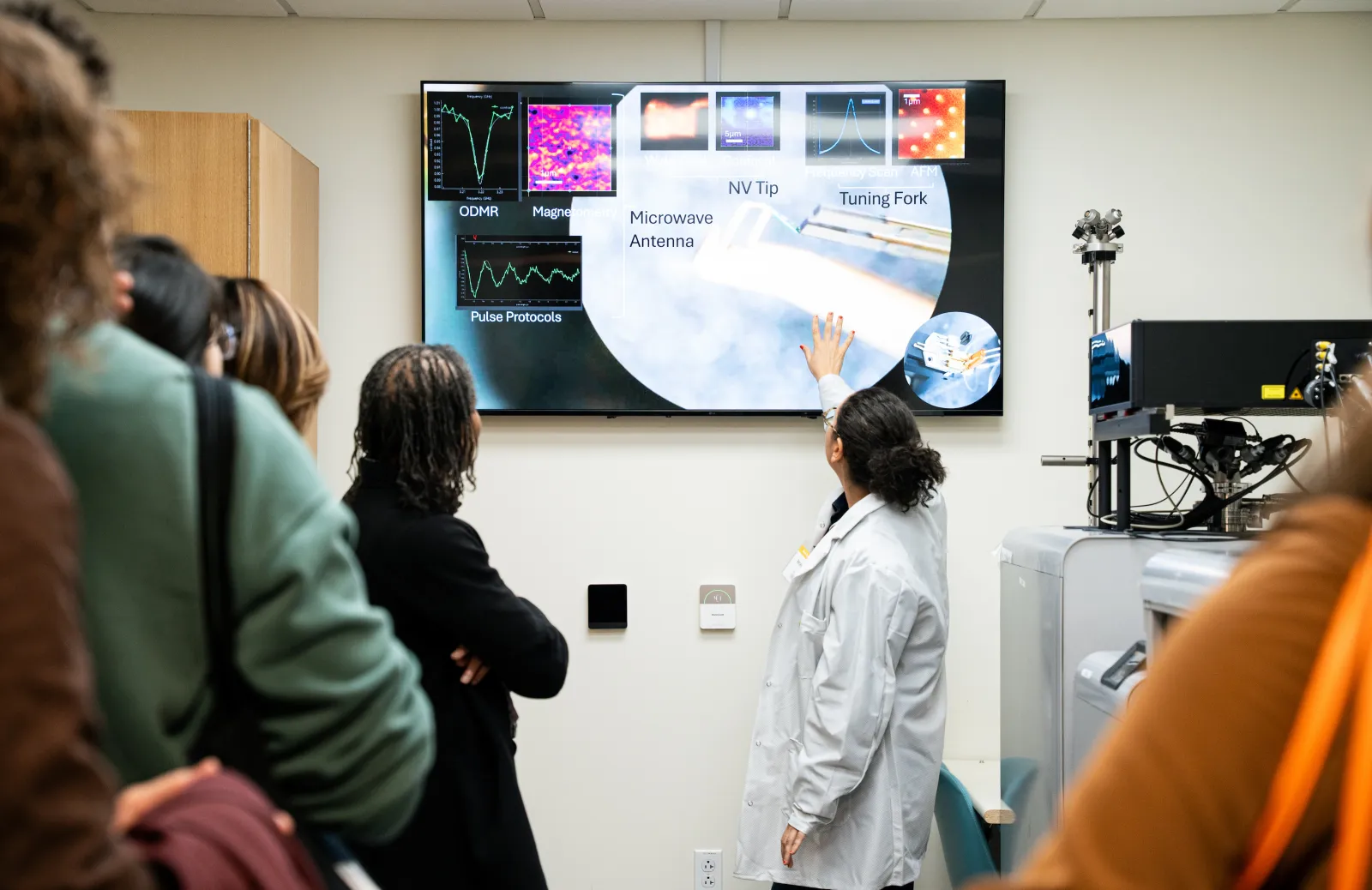
The establishment of Bryn Mawr’s Quantum Materials, Sensing and Education Center (QMSEC) as a hub of quantum information science research took a big step forward recently with the installation of a scanning NV microscope and the official opening of two new quantum sensing laboratories.
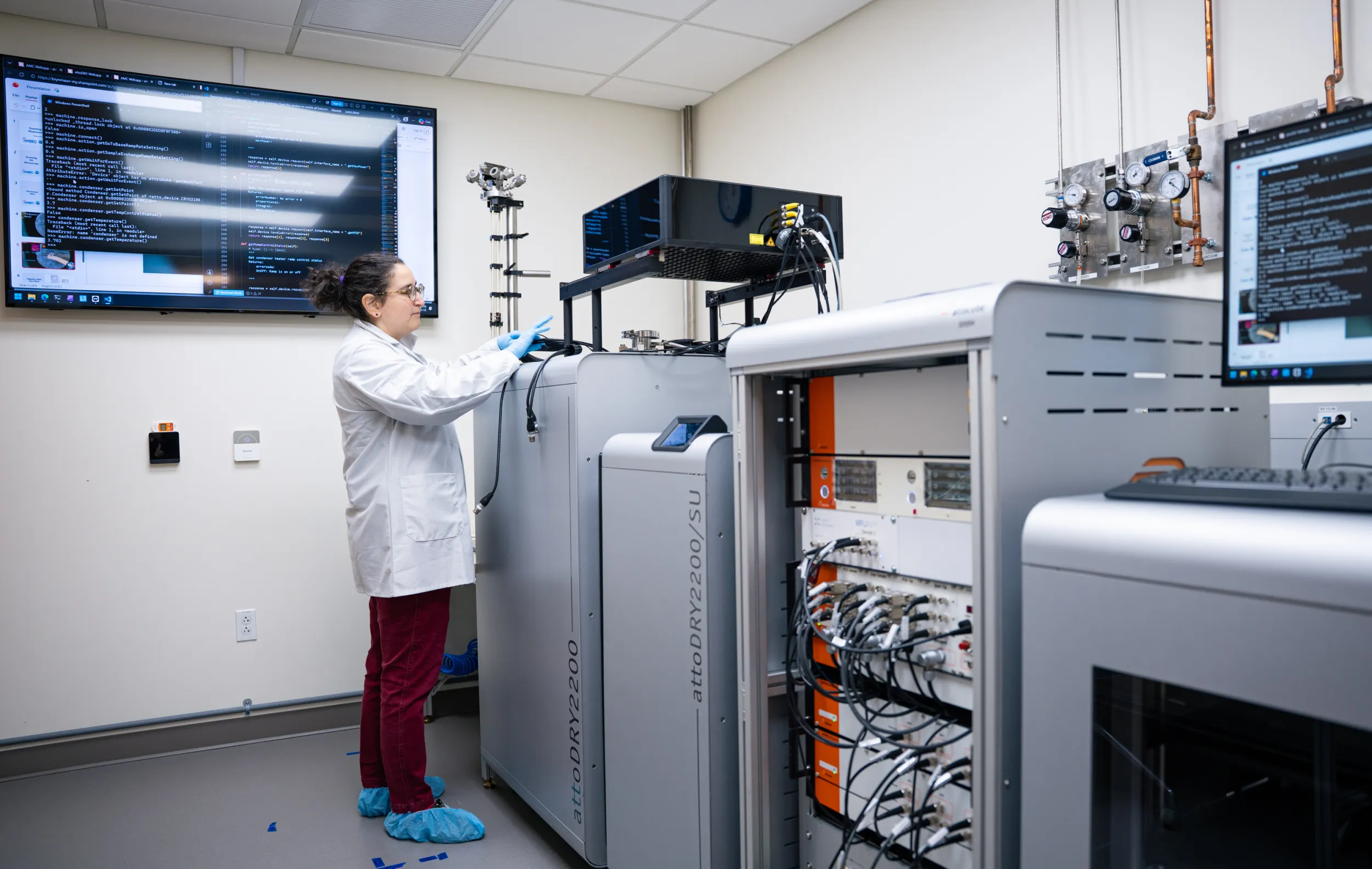
The $1.5 million, National Science Foundation-funded scanning nitrogen-vacancy magnetometer (SNVM) is the first commissioned commercial SNVM system in the United States capable of operating from 1.8 Kelvin all the way to room temperature while applying a vector magnetic field of up to one tesla (a unit of measure of magnetic strength) in any direction and nine teslas in the vertical direction.
The instrument will give researchers at Bryn Mawr and elsewhere new ways to explore quantum and magnetic phenomena across an extraordinary range of temperature and field conditions. By detecting and mapping tiny magnetic fields at very small scales, researchers can better understand the underlying physics of these materials — a step toward developing new quantum materials and advancing the emerging field of quantum information science.
“Although these atomic-scale magnetic tornadoes are far too small to see with the naked eye, they may hold the key to future advances in quantum information storage” — Professor of Physics May Cheng
Professor of Physics May Cheng, who leads QMSEC along with Professor of Physics Michael Noel, and her collaborators will use the new instrument to study quantum materials, including thin films and tiny magnetic disks fabricated at Bryn Mawr, as well as high-quality crystals grown by researchers at Johns Hopkins University.
These materials are designed to host structures called skyrmions and merons: “magnetic tornadoes” at the atomic scale that scientists are investigating for their potential applications in quantum computing and information storage. The scanning NV microscope will allow researchers to image these structures at extremely small scales, helping them understand how they form and behave and how their properties might be controlled.
“Although these atomic-scale magnetic tornadoes are far too small to see with the naked eye, they may hold the key to future advances in quantum information storage,” Cheng says. “The new microscope will allow us to observe these tiny magnetic structures and learn how to control them.”
"Major scientific endeavors truly take a village, and Bryn Mawr’s commitment to research and student opportunities helped turn our Center's vision into reality," says Cheng.
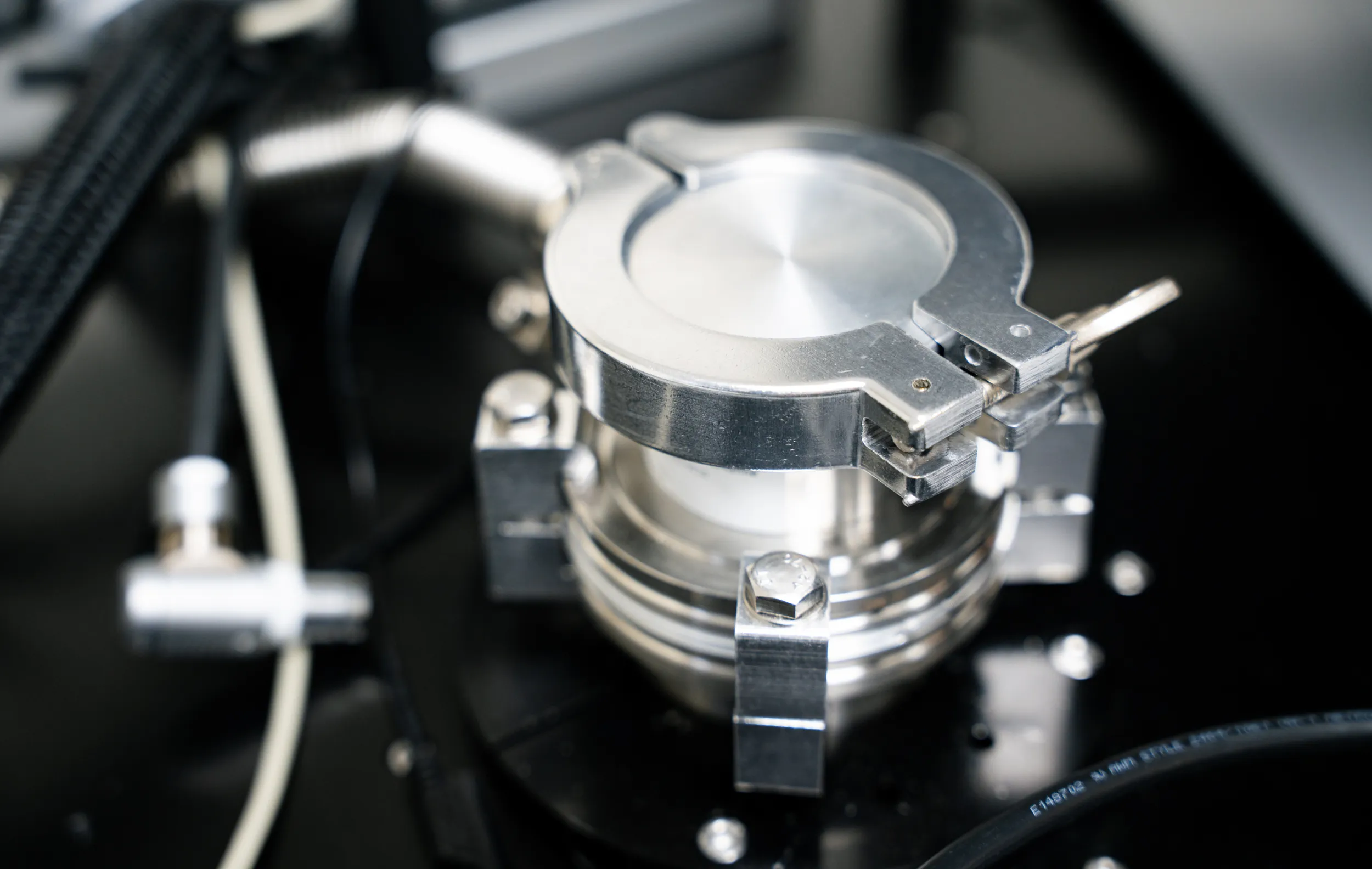
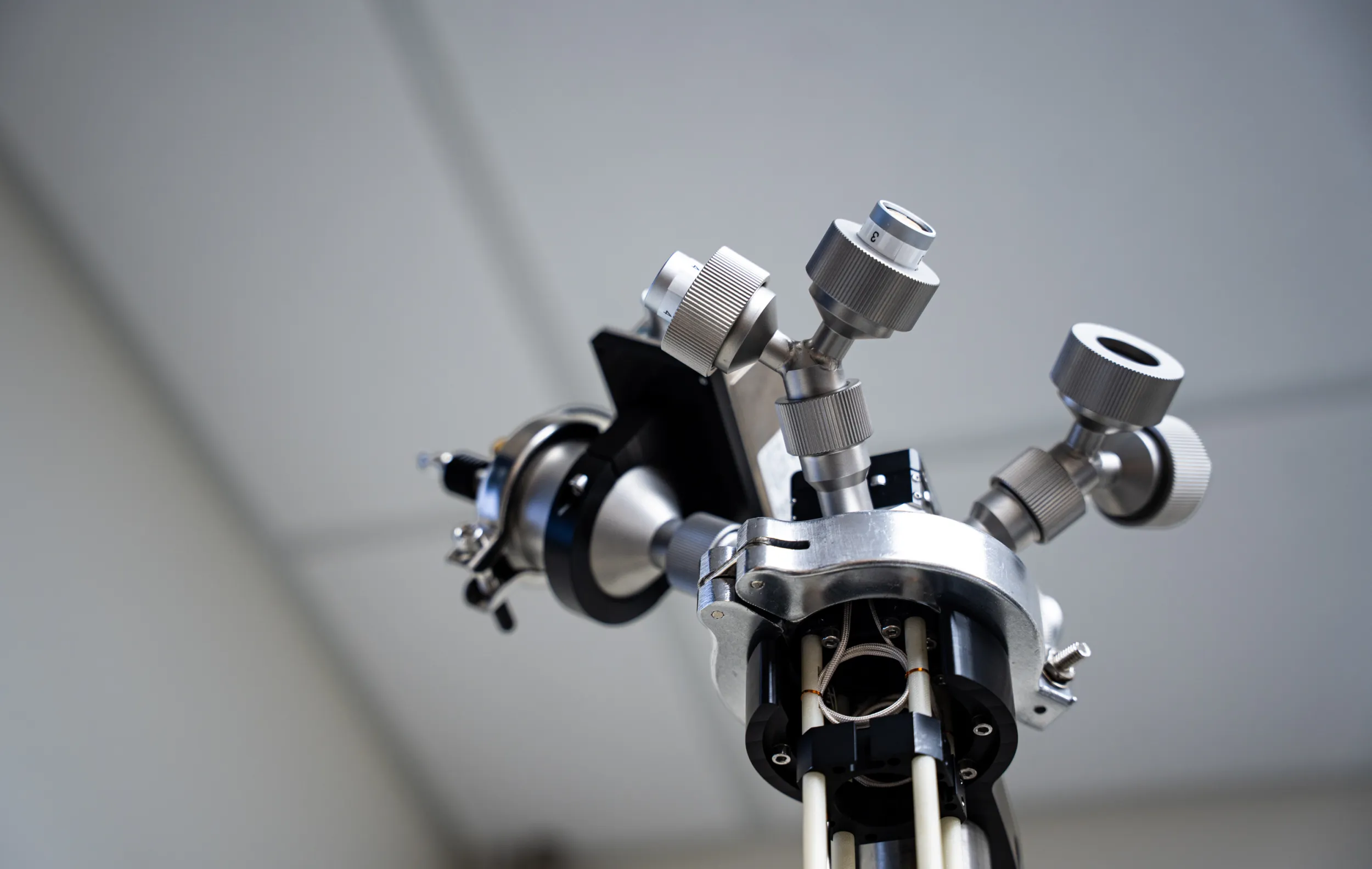
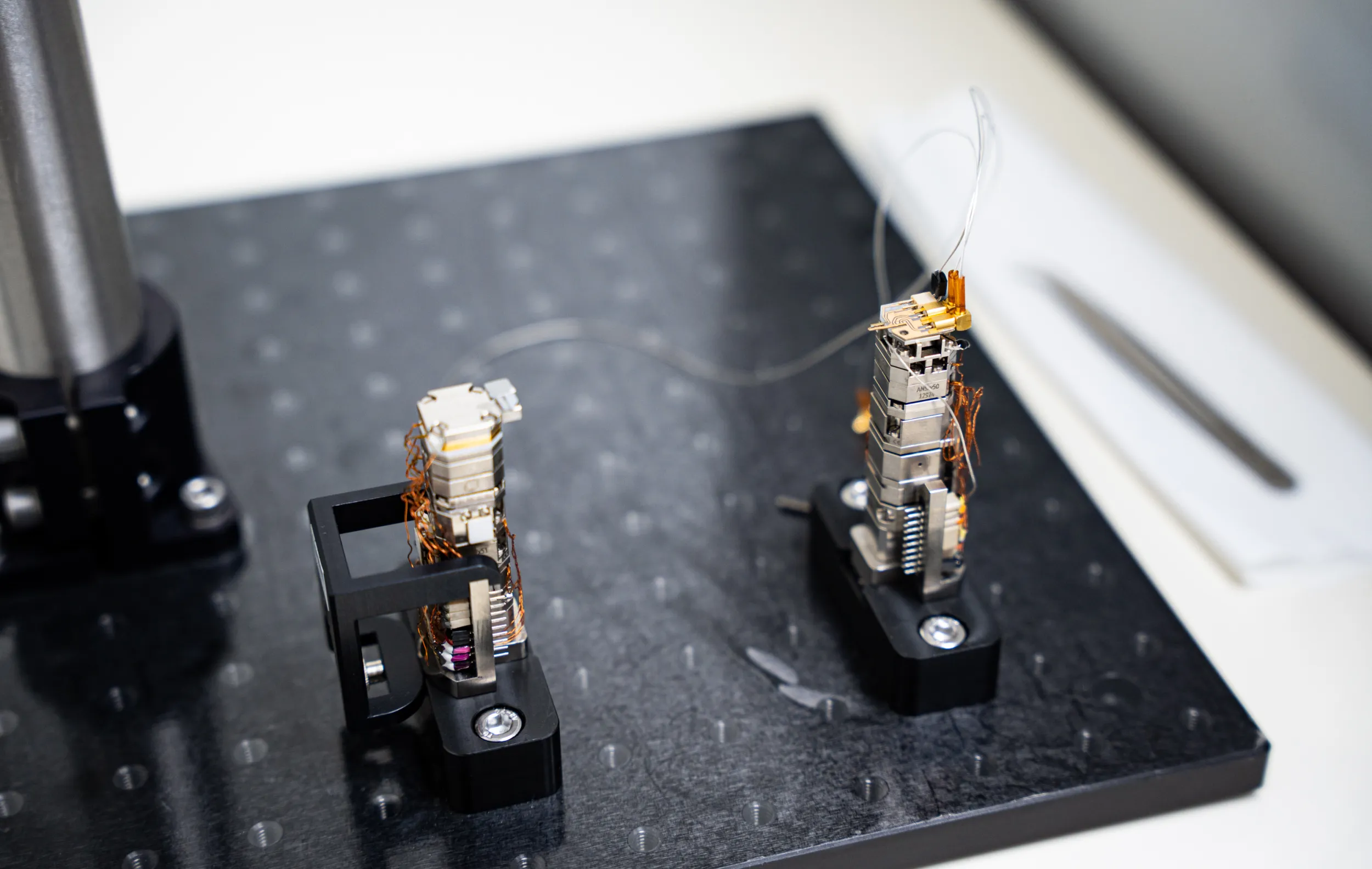
A second instrument, known as a quantum diamond microscope (QDM), complements the SNVM by producing near-instantaneous widefield magnetic images but at coarser resolution.
“The SNVM scans samples using an atom-sized quantum defect, or NV center, in the tip of a very small diamond, and so it achieves tens of nanometer resolution,” Assistant Professor Don Fahey explains. “The QDM uses more than a trillion NV centers spread over a millimeter-sized diamond to get the entire image at once, but its resolution is limited to the wavelength of light, about one hundred times worse.”
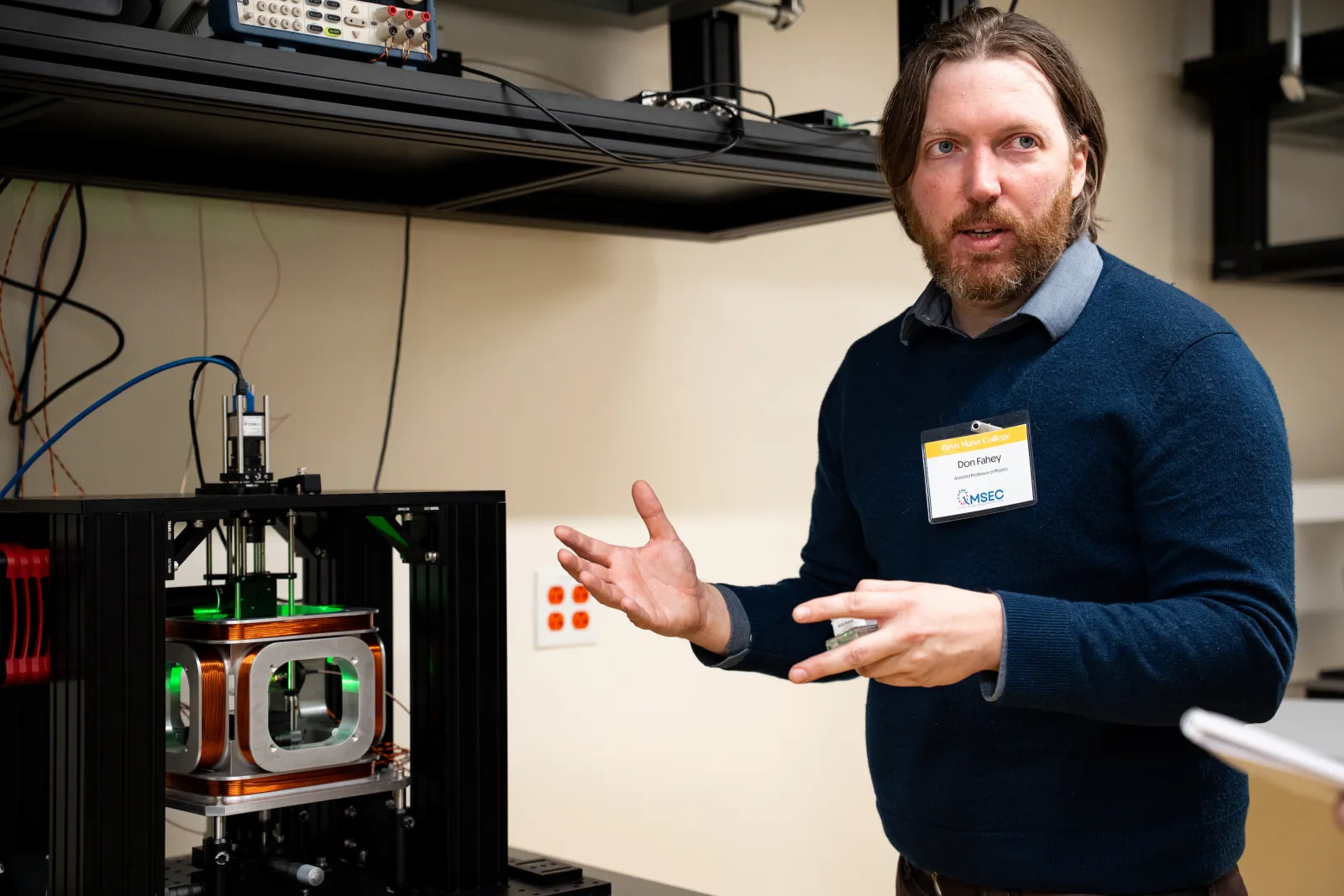
Both instruments represent relatively recent advances in microscopy. Although scientists have been building and using them in specialized laboratories for more than a decade, their recent commercial availability is helping make the technology accessible to more researchers and accelerating work in the field, Fahey says.
Fahey is also collaborating with Professor of Geology Arlo Weil and other researchers to use quantum diamond microscopy to study the magnetic properties of rocks and better understand how mountain ranges are formed.
Traditionally, researchers have measured the magnetic properties of an entire rock sample, producing an overall picture that can reveal important information but obscure differences among the individual mineral grains that make up the sample. Magnetic microscopy offers a way to examine those grains more closely, revealing their magnetic properties and orientations.
That detail matters because rocks can preserve magnetic signatures of the Earth's magnetic field from millions of years ago. Their mineral grains can also retain evidence of the physical forces and geological processes they have experienced. Being able to see those magnetic properties individually could help researchers better understand how rocks were formed and deformed and, ultimately, reconstruct the history of mountain ranges and other geological formations, Weil says.
"Previously, we've had optical microscopes, which allow us to see the structure of things, and they’ve changed our world and are incredibly important," Fahey says. "But now we've unlocked this new form of microscopy — magnetic microscopy — which allows us to see information that’s encoded right there; we just can’t see it with our eyes."
Beyond rock magnetism studies, the QDM could help quantum materials researchers identify areas of interest more quickly before examining them more closely with the SNVM.
The quantum diamond microscope in Fahey's lab also represents an important educational opportunity.
Madeline Rehwinkel '27, a student researcher in the lab, spent the 2025–26 academic year constructing the instrument and testing its performance. Fahey provided the design, and Rehwinkel put it together. She then tested the microscope’s spatial resolution and magnetic-field sensitivity, or the smallest magnetic field it could detect.
"It was sort of like putting together a LEGO set but if you only had a 3D model of the finished set to look at," Rehwinkel says.
For Rehwinkel, who had previously worked on theoretical and computational physics projects, building a scientific instrument was an entirely new experience. The project gave her hands-on experience with quantum sensing and optics, fields she hopes to pursue in graduate school.
In addition to Bryn Mawr’s researchers, QMSEC researchers from the University of Pennsylvania, Johns Hopkins University, Colorado State University, and Ursinus College, as well as collaborators from the University at Buffalo, the University of Nebraska-Lincoln, the University of Delaware, and other partner institutions will be using the scanning NV microscope in their work, with many coming to campus to directly use the equipment.
Physics at Bryn Mawr
The Physics major incorporates a wide variety of subject areas, including atomic and molecular physics, condensed matter physics and nanomaterials, plasma physics, biophysics, and string theory. Our professors run a robust research program that teaches students the skills needed to navigate future careers in science, where women are heavily underrepresented.