All News

From Campus Woods to Caribbean Coasts, Tom Mozdzer Inspires Field Scientists

December 10, 2025

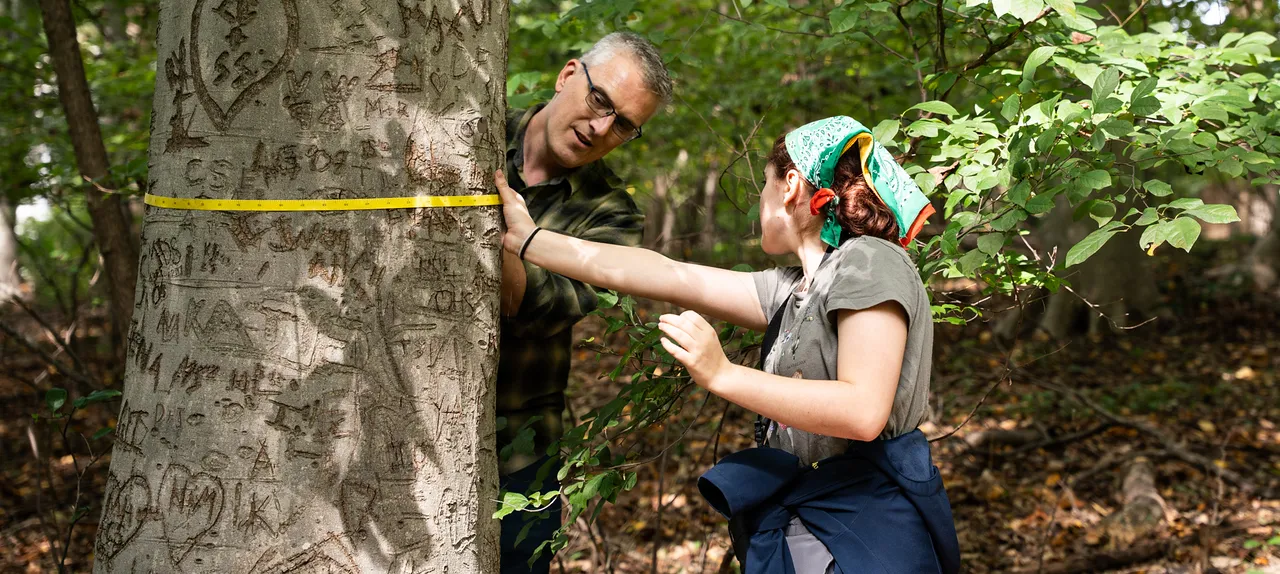
📍Morris Woods, Bryn Mawr

Students in Ecology 202 recently went into Morris Woods for research. Pictured: Liza Roseman '28 measures a tree with Professor Mozdzer.

a student and professor measuring a tree

Since his days as a Boy Scout in the Polish Scouting Organization growing up in the town of Shelton in southwestern Connecticut, Professor of Biology Thomas Mozdzer has always loved spending time outdoors in nature.

When it came time for college, Mozdzer thought his future was a career in medicine, but he still heard the call of the wild.

“I had this idea of being a doctor working near the Appalachian Trail or in the mountains of Vermont,” Mozdzer recalls.

Mozdzer volunteered, shadowed doctors, and participated in research at Bridgeport Hospital, and even taught an MCAT class as an undergraduate student. “I didn’t find the joy of being in a hospital setting," he says, "but I fell in love with research and field science.”

While majoring in biology at Fairfield University, Mozdzer worked in the lab of Randy Chambers, now a professor at William & Mary, and found his true calling as a researcher of coastal ecosystems.

“As a student, Tom was the quintessential go-getter," Chambers says. "When he saw an opportunity, he stepped up and took it. He took the offer to work in my lab, conducted field and lab experiments on native and invasive marsh plants, and ended up as an undergraduate co-author on a 1998 paper that continues to be cited every year in the literature.”

In addition to his work with Chambers, Mozdzer did research as an REU at the Grice Marine Lab at the College of Charleston, and as a student intern at the University of Georgia Marine Institute while an undergraduate student.

“I grew up near the coast, so I was always drawn to the coastal environment,” Mozdzer says.

After graduating from Fairfield, Mozdzer spent a year as a Fulbright Scholar at Jagiellonian University’s Institute of Environmental Studies in Krakow, Poland.

There, Mozdzer conducted research using beetles to look at their resistance in various populations to pollution from metal smelters.

His Fulbright research showed how long-term pollution can drive evolutionary changes in organisms, but those changes come with trade-offs. For example, while beetles from polluted environments may evolve ways to tolerate toxic metals, that tolerance comes at a cost of slower growth and reduced survival. The research is similar to Mozdzer’s current work, except nearly two decades later, his subject is studying rapid evolution in plants.

“I think we raised thousands of beetles to the F2 generation, and I was like, ‘Oh my gosh, I can’t wait to get back to plants,” he says.

After completing his graduate studies (M.S. & Ph.D.) at the University of Virginia in Environmental Sciences, and a postdoc at the Smithsonian Environmental Research Center as the Secretary’s Distinguished Research Fellow, Mozdzer came to Bryn Mawr as an assistant professor in 2012.


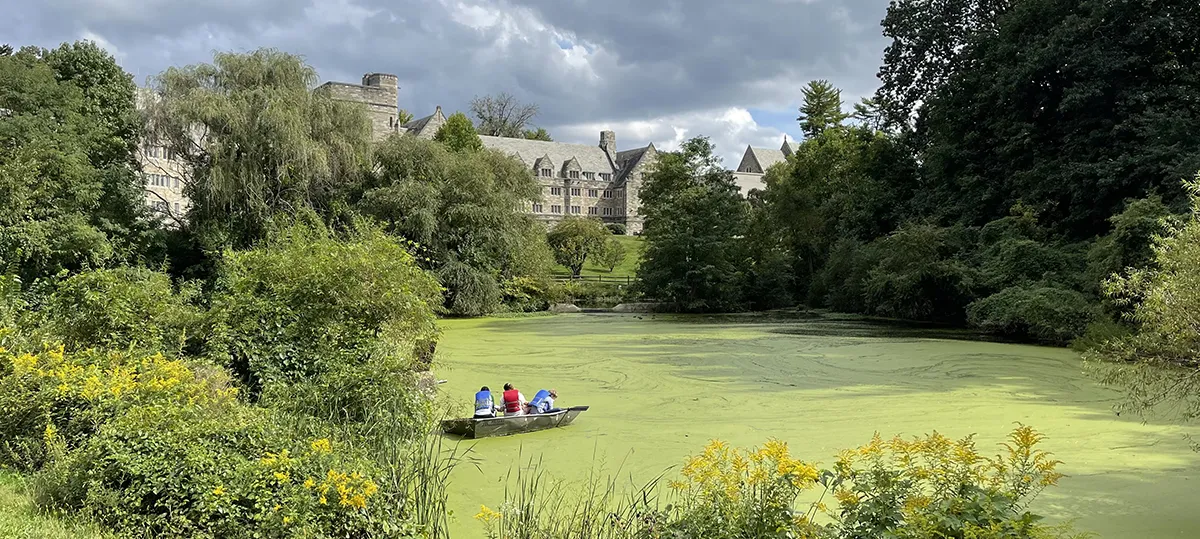
📍Lake Vickers, Bryn Mawr

Sophia Vines '23, Ceanne Lyon HC '23, and Faith Mayhew '24 do research in 2021 on Lake Vickers.

""

Over the last 13 years, Mozdzer has guided hundreds of students to learn to conduct research in the field both on campus and at his external field sites

In the Ecology class that he teaches every year, Mozdzer uses Bryn Mawr’s campus as a living laboratory. Each week, students study various ecosystems and key ecological concepts in Mill Creek, Morris Woods, and on Lake Vickers, going out in a boat to measure its health and fundamental limnological processes.

Student researchers have also joined Mozdzer on the coast of Belize as part of a 360° course cluster, at the Smithsonian Environmental Research Center in Maryland, at the Plum Island Ecosystems LTER in Massachusetts, and the John Heinz National Wildlife Refuge at Tinnacum in Pennsylvania.

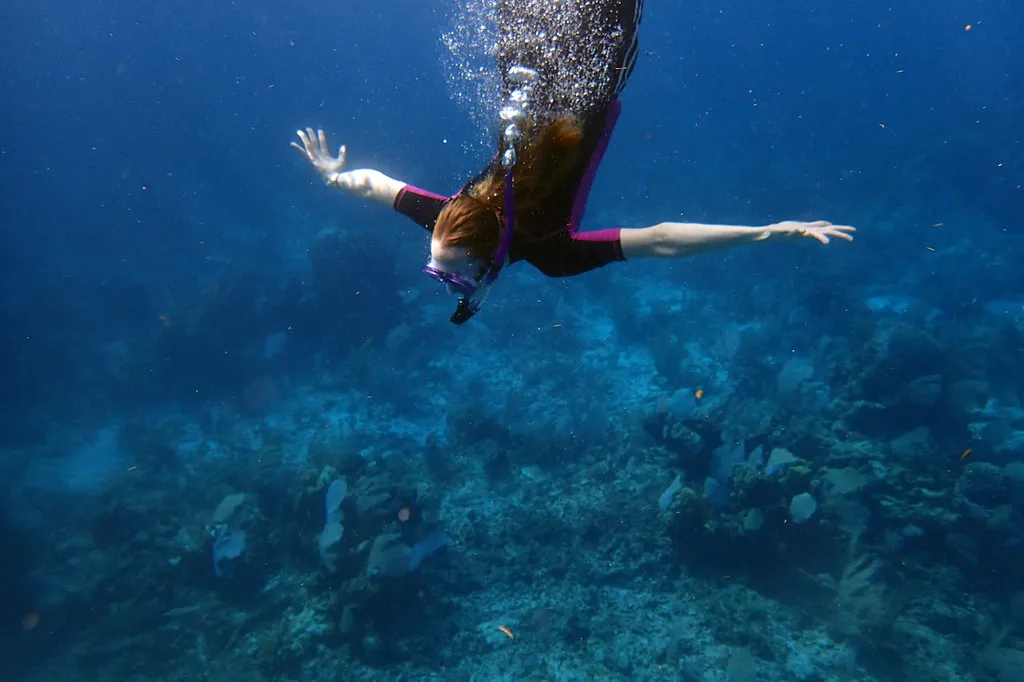
a student diving in the ocean
A student exploring reefs in Belize in 2015.

In total, 48 Bryn Mawr and Haverford College students have done field research with Mozdzer, and 17 undergraduate students have co-authored a publication with him. His students have gone on to attend some of the nation's top graduate programs and careers in academia, government service, industry, and nonprofits.

Among them is Emily Geoghegan '17, who is currently an air pollution specialist at the California Air Resources Board.

“Field work during my time at Bryn Mawr fundamentally changed how I think as a scientist,” says Geoghegan. “When I started college, I was set on the pre-med path. But once I joined Dr. Mozdzer's lab, I quickly realized my real passion was in ecological and environmental science. Working under Dr. Mozdzer's guidance, I got hands-on experience with cutting-edge research that gave me the confidence to eventually pursue graduate work in soils and biogeochemistry.”


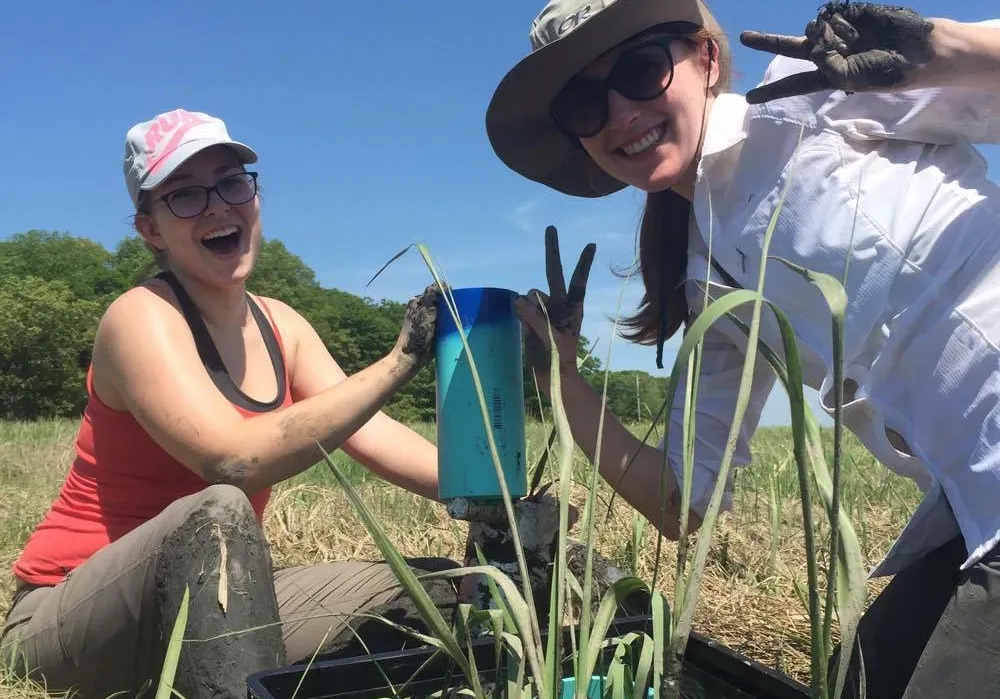
📍Plum Island, Mass.

"Field work during my time at Bryn Mawr fundamentally changed how I think as a scientist...Working under Dr. Mozdzer's guidance, I got hands-on experience with cutting-edge research that gave me the confidence to eventually pursue graduate work in soils and biogeochemistry.”

Emily Geoghegan '17 (right), Air Pollution Specialist, California Air Resources Board. Pictured with Geoghegan is Paige Weber '18.

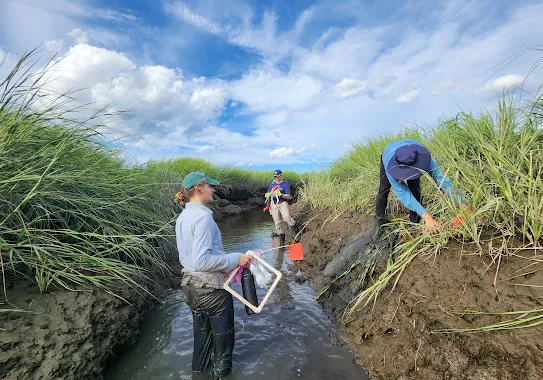
students doing field research

Geoghegan recalls long days spent knee-deep in mud at her wetland study sites, working alongside fellow students, and pivoting on the fly when problems inevitably popped up. 

“Those early field work experiences were some of the most important parts of my education," she says. "They completely redirected my career in a way that I never expected."

After Bryn Mawr, Geoghegan continued conducting fieldwork throughout graduate school and eventually narrowed her research interests to biogeochemistry and soil science. She earned a master's from Villanova University, another from U.C. Davis, and her Ph.D. from Cornell University. 

“Through all of it, I kept coming back to the foundations I built while working in Dr. Mozdzer's lab — how to set up study sites, take good measurements, and always think about the bigger ecological picture," she says. "Those skills shaped how I approached every challenge I faced in the field."

📍Smithsonian Environmental Research Center, Maryland

“You can study as much as you want on paper, but getting the chance to be out in nature and see these beautiful ecosystems makes the science so much more exciting."

Skylar Livengood '24, master's student at Villanova University.

students doing field work in a marsh

Skylar Livengood ’24 is a master’s student at Villanova University studying the impacts of nutrient enrichment and climate change on the range expansion of mangroves in north Florida.

After taking an intro to biology class Mozdzer taught, she reached out to see if she could join his lab.

“I’m so glad I did, because Tom’s guidance has changed the trajectory of my career as a scientist,” she says. 

With Mozdzer’s support, Livengood interned at the Smithsonian Environmental Research Center over two summers in 2022 and 2023. In 2023, she also did a week of research at Plum Island as part of the TIDE project. She was also a student in the Coasts in Transition 360° and traveled to Belize where she did research on mangrove ecosystems

“You can study as much as you want on paper, but getting the chance to be out in nature and see these beautiful ecosystems makes the science so much more exciting,” Livengood says.

In spring 2026, Mozdzer will be teaching Biological Exploration II and Ecological Restoration & Sustainability. For more on Mozdzer’s research, visit his lab site. For even more photos, check out the lab’s Facebook page.