When it comes to faculty research, Bryn Mawr punches well above its weight for a small liberal arts college. In 2024 alone, its faculty produced more than 200 scholarly works, including 145 journal articles, and Washington Monthly ranked the college number one among liberal arts colleges for research expenditures. Recently, Bryn Mawr also earned “Research College” designation in the Carnegie Classification of Institutions of Higher Education.
Increasing access to this prolific knowledge production was a key motivating factor for Camilla MacKay, director of library research, instruction, and patron services and scholarly communications librarian, when she launched Bryn Mawr’s digital open access repository and partnered with art history professor Alicia Walker to develop a faculty policy.
The policy, which was voted on by faculty in 2013, requires them to grant the college the right to include the content of their scholarly work in the college’s online repository. As MacKay explains, institutional repositories such as Bryn Mawr’s use a process called “green” open access, where researchers self-archive the text of their papers — the post-peer-review but pre-publication version of the article, often called a “postprint.” Links to the final journal-formatted publisher’s PDFs are included, though those may live behind a paywall.
While green open access, says MacKay, is “a little less perfect” than “gold” open access, where authors pay a substantial fee to have their articles available for free on a journal platform, “our users are still getting the intellectual content of the article and it’s a pretty low-impact way for us to make that scholarship available.”
In addition to scholarly articles, the repository also contains conference papers, audio and video files, and publications about the college.
The digital archive enables users — including those with no connection to Bryn Mawr — to freely access the community’s scholarly output, organized by department and academic program. The repository software also tracks research activity on the site, highlighting stats such as the top 10 downloads of all time, the “Paper of the Day” — recently a review of Ann Komarom’s Soviet Samizdat: Imagining a New Society by Tim Harte, professor in the Department of Russian — and, in real time, which papers are being downloaded in which corners of the globe.
“My primary interest is the advantage this gives to people who are not at institutions like Bryn Mawr,” says MacKay. “As a college, we’re able to subscribe to most of the academic content that our faculty, staff, and students need, but that’s not necessarily the case in other parts of the world or for people who don’t have any association with an institution or library.” Having this repository, she says, “means that researchers all over the world can read the scholarship.”
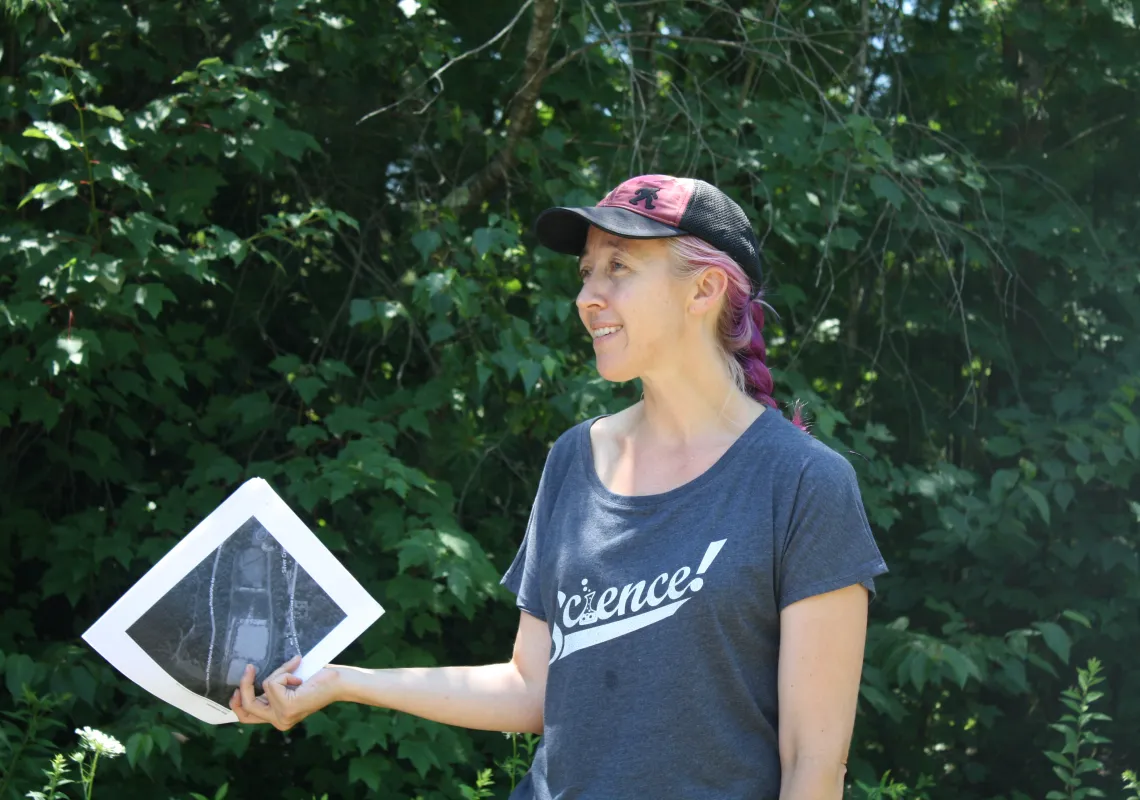
Within academia, notes Selby Hearth, an associate professor of geology, “we’re highly privileged, and we don't always realize how expensive knowledge can be to access if you don’t have that library login.” It’s an unfair situation, she says, and in her field, the earth sciences, it’s becoming increasingly important to make knowledge available.