NSF Mid-Career Grant Supports New Research Direction on Reefs in Crisis
January 20, 2026
With support from a National Science Foundation Mid-Career Advancement Grant, Associate Professor of Geology Pedro Marenco is using the fossil record to better understand the future of reefs.
Mid-Career Grants are designed to support faculty members at a pivotal stage in their careers, allowing them to dedicate the time necessary to develop new research directions.
“This program is really about helping people move forward,” says Marenco. “It’s aimed at scholars who are established, but who want to make a meaningful shift in their work and need time to do it well.”
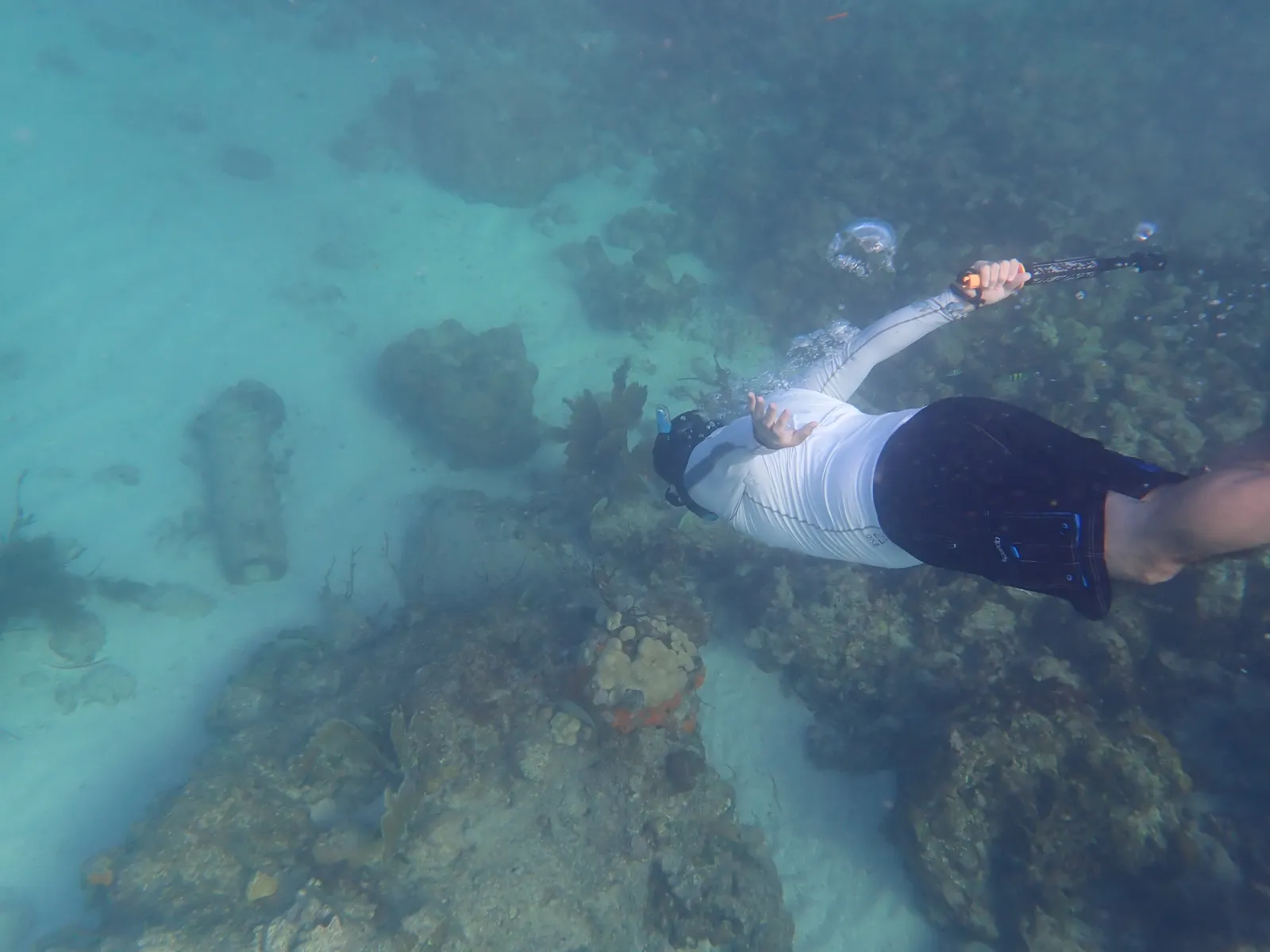
Pedro Marenco conducts research on coral off the coast of Florida.
Marenco’s earlier research focused on the geochemistry of ancient rocks to reconstruct long-term changes in ocean environments and how those changes impacted life. Increasingly, however, his attention has turned to reefs, both ancient and modern.
Today’s reefs were primarily built by corals, organisms that struggle to survive as waters warm. In many places affected by climate change, hard coral has stopped growing, and instead, soft coral, algae, sponges, and microbial communities are flourishing.
“It might be beautiful if you’re snorkeling, but the fear is that it’s not adding hard reef material that protects the shore,” says Marenco.
However, the modern era is not the only time in the Earth’s history that ocean temperatures have risen, and the fossil record shows that in the past microbial communities were able to build reefs that functioned in many of the same ways as today’s coral, raising the critical question: could something similar happen again?
Answering that question required moving beyond fossil reefs and beginning to study modern reef systems directly.
As part of his research, Marenco led undergraduate students on two research trips to Utah and one to the Florida Keys last semester. In Utah, students studied fossil reefs formed approximately 480 million years ago, when the region was submerged beneath a warm, shallow sea. In the Florida Keys, Marenco and his students have documented modern reef environments using video and photography, creating detailed 3D models that can be directly compared with fossil structures.
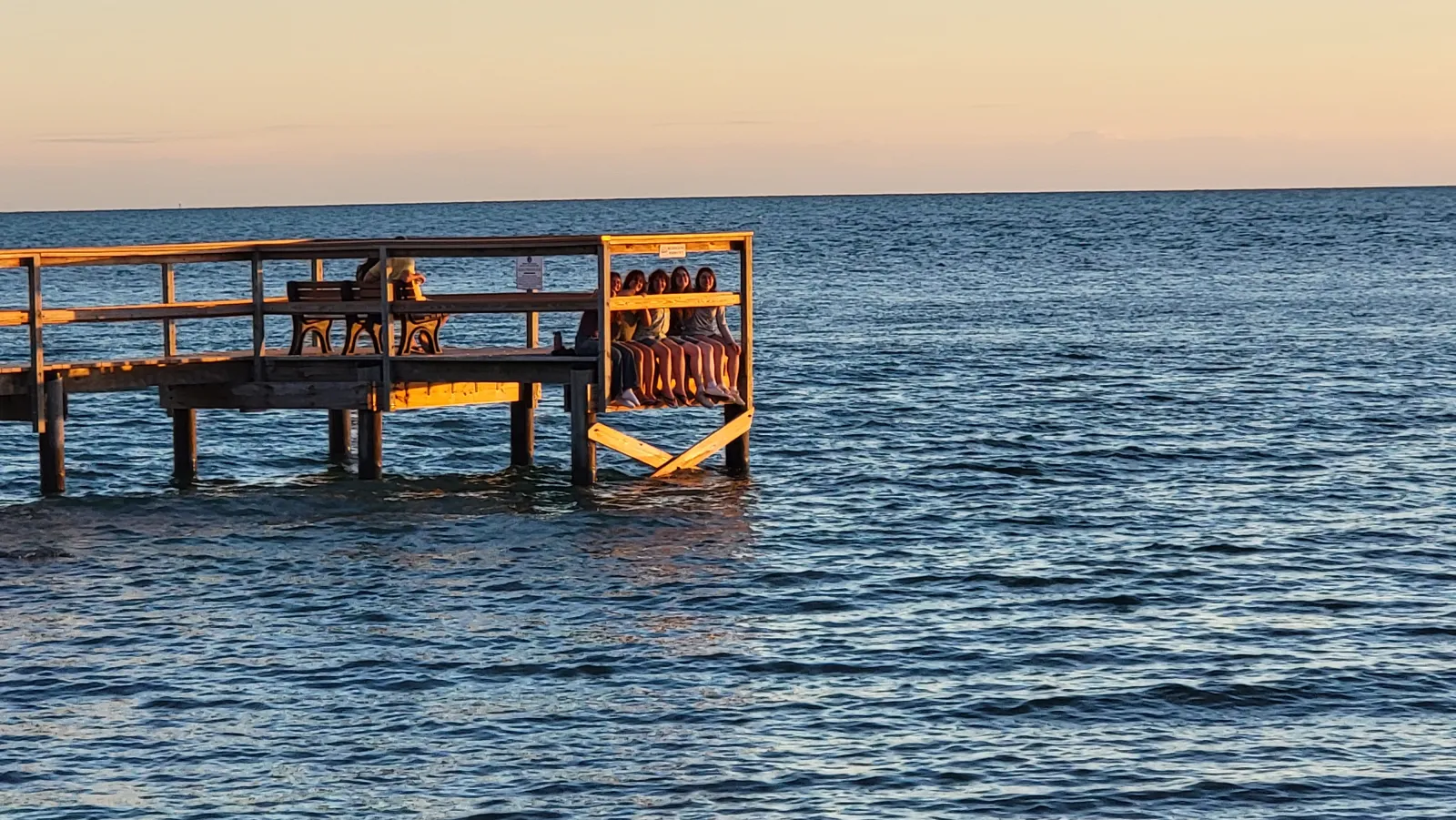
Students relax after a day of research.
Lucy Dellera '28, was among the students on the Florida trip, an experience she found so impactful that she decided to add a biology major to her geology major.
"The trip showed me what doing field work as a geologist would actually be like," says Dellera, "It also made me realize that I have a huge interest in not only geology, but all marine science and research. Studying the reef systems made me realize that I love seeing where life and deep time intersect, and when I got back, I decided to pursue a double major."
Serena Liventals '26, Miya Matsumune '26, and Sofie Prieto '26 are all finishing up their senior theses this spring using data gathered on the trips to Utah and Florida.
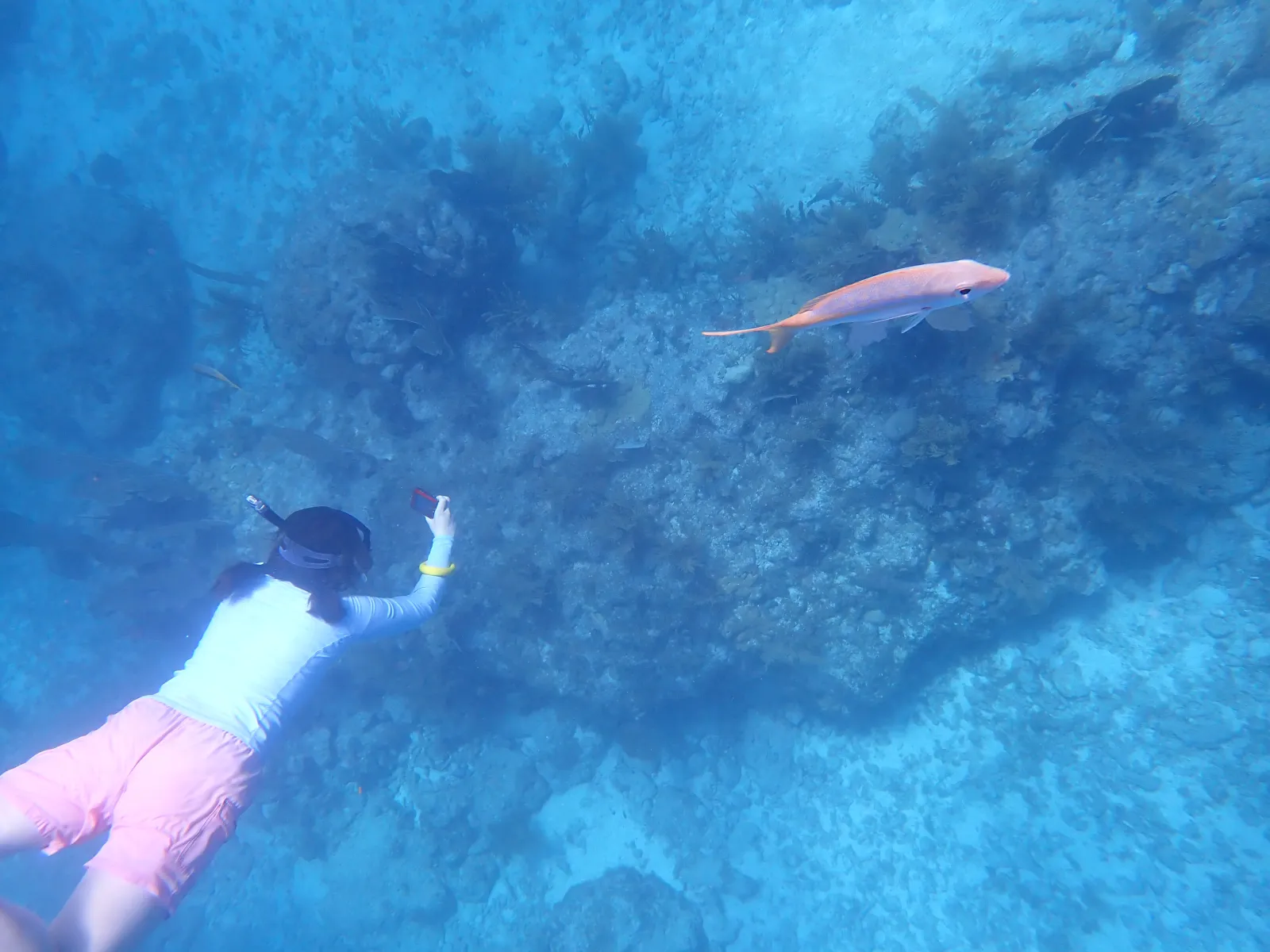
Miya Matsummune '26 photographs a coral reef off the coast of Florida.
For her thesis, Livental aims to create 3D models of corals using photogrammetric software to collect spatial data and compare them with fossilized reefs in Utah.
Prieto's research is on the paleoecology of Utah fossil reefs, and went on the Florida trip to compare the fossil and modern reefs.
"Spending so much time in the field has given me a huge head start in many of my geology classes and has prepared me for graduate school," says Prieto." I plan to continue studying geology, and both the Utah and Florida trips solidified my interest in shallow marine systems."
Matsumune's thesis research on the ecology of Florida Keys patch reefs relies on the underwater photography she did at the Florida reef.
There was only one problem – she had never even snorkeled, let alone taken photos while doing it.
"I was nervous that I would become seasick and not be able to take good photos, especially because the sea was choppy on the day we went out to collect data," she says. "Pedro and Katherine [Geology faculty member Katherine Marenco] consistently reminded me to prioritize my own health and that we could find an alternative if I became sick. I appreciated this deeply, and I was able to collect the data I needed!"
The research has already led to an article in the journal Geobiology that gives scientists a better understanding of microbial fabrics in ancient reefs. Future research will build on this work, aiming to develop a better understanding of the role of microbial activity in the formation of small reef structures in the fossil record and the present.
Geology at Bryn Mawr
Bryn Mawr's Department of Geology offers courses and research opportunities in areas that include invertebrate paleontology, sedimentology, mineralogy and petrology, structural geology, tectonics, and geophysics.