

A Course With Big Questions
What makes one Jewish? Is it a matter of religion, ethnicity, race, nationality, culture, or kinship? Must a Jew be religious? Must a Jew be a Zionist? Can a Jewish person be anti-Semitic? Can one choose to be Jewish or not?
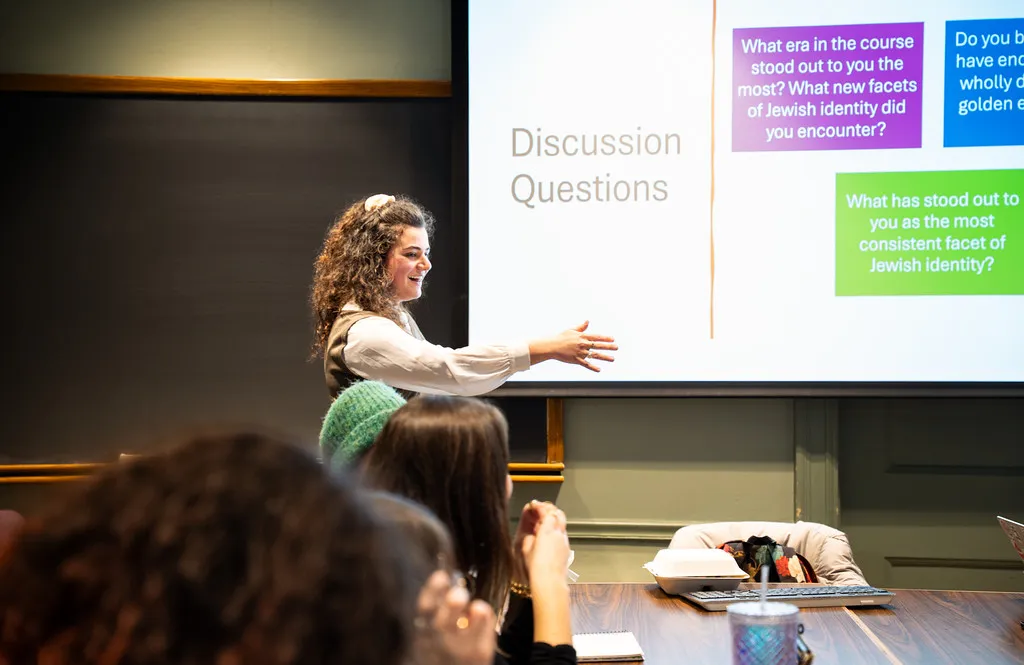
These are some of the questions Alexandra (Sasha) Zborovsky asked students to examine in her class, Histories of Jewish Identity, last semester.
“So, it has a big goal, and it has a lot to do. And to be perfectly frank, a course can be taught on any one of the units present in the course in itself,” says Zborovsky, “But my primary goal was to introduce the students to the fact that Jewishness, Judaism, are not these stable identities. They are identities that, even in a particular moment, have various modes.”
The course was structured so that each week focused on a different form of Jewish identity. For instance, week one was called "Being a Jewish Community" and looked at how, during the medieval period, Jewishness was a community identity. Each Jew lived in their own community, and each community had its own laws and internal taxation.
As the course progressed, Zborovsky and her students examined how interactions with other faiths, the rise of nation-states, Zionism, and other factors shaped and reshaped Jewish identity.
Learning to Think Like Historians
As much as possible, they also tried to examine Jewish identity from a multitude of sources and even the most repugnant of perspectives.
When reading about the Holocaust, students read testimonials and fiction by Holocaust survivors along with sections from Hitler’s Mein Kampf.
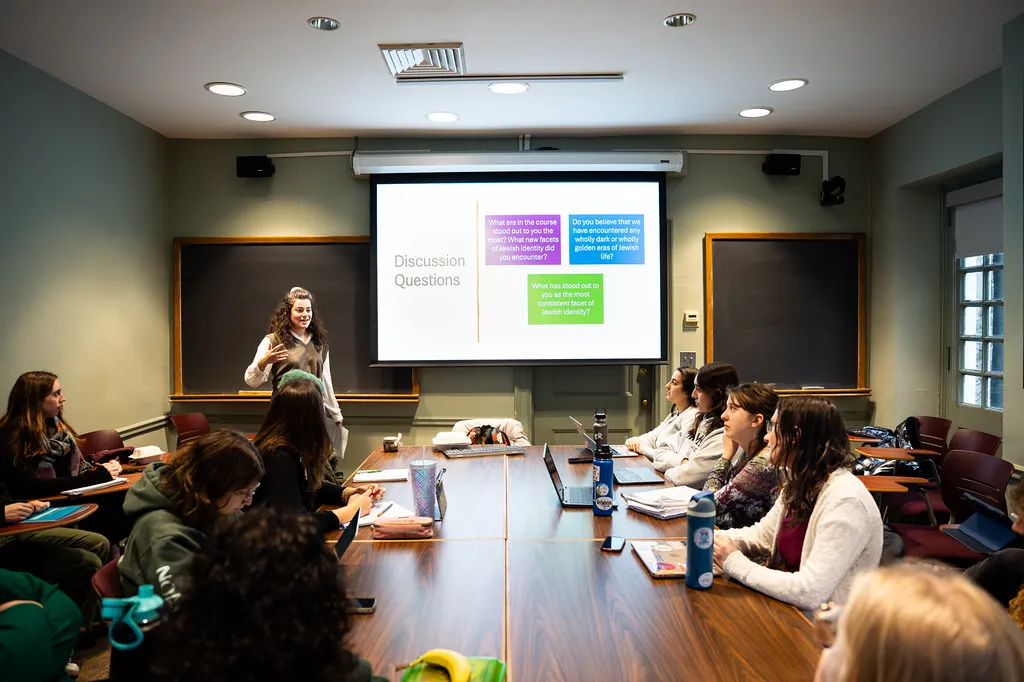
“I made it very clear to the students that when we enter the classroom, we are all historians,” says Zborovsky. “You have to try to leave your emotions and passions at the door and immerse yourself instead in the sources of the past.”
If first-year student Maya Pitch '29 is any indication, Zborovsky clearly accomplished her goal.
Pitch wrote a 10-page paper on the Azerbaijani Mountain Jew community.
“I had never written such a long, in-depth paper before…I became an expert on a topic very few people have even heard of,” she says. “This class allowed me to feel like a proper historian. Professor Zborovsky didn't only feel like a professor of Jewish history. She felt like a professor of the practice of history.”
While most of the course was dedicated to the past, there was no way Zborovsky and her students could ignore the ongoing conflict in Israel and Gaza.
“I hope that students had developed enough trust in me as an instructor, and enough trust in the sources that I assigned to them, that the arguments that they constructed did not draw on what they had seen on social media or even on campus but instead from the voices of Israelis and Palestinians who had, on the ground, experienced the events that we were discussing,” she says.
Another point Zborovsky stresses in the class, relevant to the present day, is that even with a full understanding of various perspectives, events can mean different things to different groups.
One Event, Many Meanings
To drive the point home, Zborovsky teaches students about the Khmelnytsky Massacres of 1648, or, if you’re Ukrainian, the Khmelnytsky Uprising.
The Khmelnytsky Massacres in the context of Jewish history were when Ukrainian Cossacks living within the Polish-Lithuanian Commonwealth under the leadership of Bogdan Khmelnytskyi murdered thousands, even tens of thousands, of Jews.
In Ukrainian history, the Khmelnytsky Massacre is called the Khmelnytsky Uprising because it was the first time Ukrainians revolted against their Polish landlords, who often took complete advantage of them, and it established them as a non-subjugated people in the Polish-Lithuanian Commonwealth.
The reason so many Jews were killed and even sold into slavery is that Jews overwhelmingly represented Polish landlords, and most Ukrainians had never encountered the Polish landlords themselves; they had only encountered the Jewish lessees. Although the Jews were also subjugated by Polish landlords, for Ukrainian peasants, Jews became the face of not only religious heresy, but the economic subjugation they encountered, explains Zborovsky.
“So I established pretty early on in the course how the same event can mean something very beautiful to one people, and very traumatic to another people,” she says. “Both stories are true. There's no falsehood in either one.”
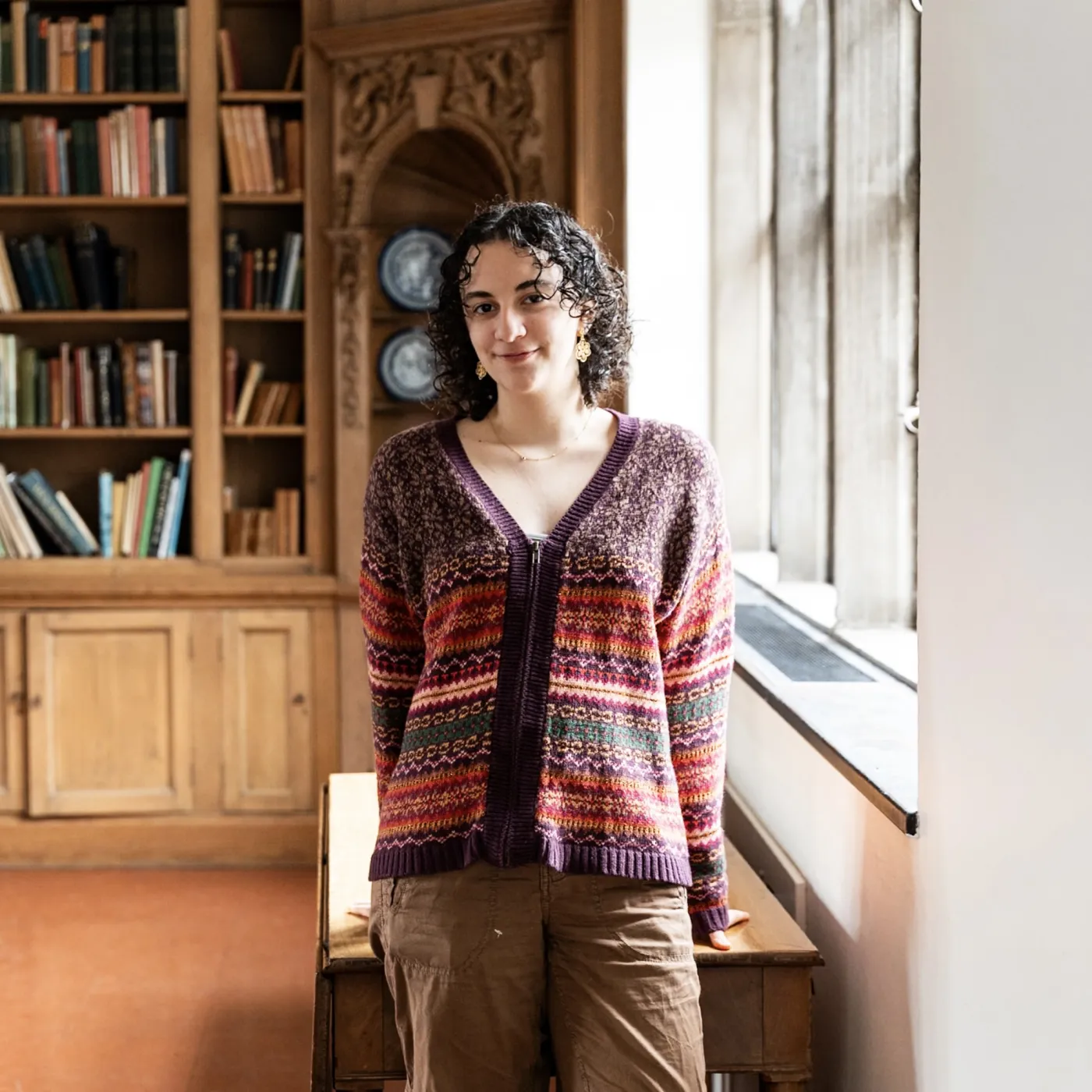
Maya Pitch
Freshman, Silver Spring, MD
“When I envisioned a liberal arts environment, I envisioned a spirited, engaged professor who is just as excited to be there and learn as the students. I envisioned a room full of hands in the air because every student has something to say. I envisioned discussion, complexity, and original ideas. I envisioned holistic teaching that covers topics often excluded from the history books. This course delivered majorly on all these points.”
Imagining the Historian of 2150
For their final assignment, students were asked to imagine themselves as historians in the year 2150. They read pieces from the websites of AIPAC, J-Street, Jewish Voice for Peace, Standing Together, American Jewish Committee, the IHRA definition of anti-Semitism, the Jerusalem Definition of anti-Semitism, the Antisemitism on Campus report by Brandeis, and a lecture from Omer Bartov. The very last things they are assigned are a New York Times piece about West Bank settler violence and the Oct. 7 artwork of Zoya Cherkassky.
“My task as a historian is to teach my students how to analyze things for themselves, and how to look at a collection of evidence and come to their own conclusion, not how to repeat what I or someone else has said,” says Zborovsky.
Lori Ackerman '27, a political science major studying abroad in Morocco this semester, was among the students in Zborovsky’s class.
“Before this class, I was more likely to make generalizations about any number of concepts, which is fairly common for undergraduates in the social sciences who are so focused on classifying groups of people and beliefs,” says Ackerman. “Professor Zborovsky challenged us to openly and curiously engage with the full spectrum of Jewish identity.”
For Pitch, Histories of Jewish Identity was everything she was looking for in choosing to attend a liberal arts college.
“When I envisioned a liberal arts environment, I envisioned a spirited, engaged professor who is just as excited to be there and learn as the students,” she says. “I envisioned a room full of hands in the air because every student has something to say. I envisioned discussion, complexity, and original ideas. I envisioned holistic teaching that covers topics often excluded from the history books. This course delivered majorly on all these points.”
From One Course to a Broader Vision
Bryn Mawr and Haverford students may have more opportunities to study Jewish history in the coming semesters. A group of 18 Bi-Co faculty members has received an internal grant to develop a formal Bi-Co Jewish Studies program.
Bryn Mawr currently offers a program in Hebrew and Judaic Studies that has consistently offered Elementary Hebrew Language instruction; however, it doesn’t have any dedicated faculty or allow students to earn a minor.
The proposed program would address both issues and facilitate partnerships with other area programs, Jewish museums, organizations, and related non-profits and NGOs. In addition, most courses in Jewish Studies will also contribute to the College’s new Power, Inequity and Justice requirement.
“Given the dramatic rise in global antisemitism, it is more important than ever to ensure that our students have opportunities to learn about the Jewish experience through a scholarly lens,” says Associate Professor of Political Science Marissa Golden, who is leading the project for Bryn Mawr.
Golden adds that she plans to engage student voices in the conceptualization and planning of the program’s curriculum
“The Bi-Co Collaboration Grant affords us a unique opportunity to engage with students as we envision what a Bi-Co program might look like,” says Golden. “We plan to conduct a series of focus groups with current students, as well as with alumnae, to ensure that the program we build is academically rigorous, intellectually transformative, and takes full advantage of the unique resources available to us in the greater Philadelphia region.”
The Steering Committee for the Hebrew & Judaic Studies program has identified a number of extant Bi-Co courses that can be cross-listed with the program. For example, Professor of History of Art Lisa Saltzman is currently teaching the course Visual Culture and the Holocaust, and Haverford Professor of Spanish Ariana Huberman is currently teaching Writing the Jewish Trajectories in Latin America. Thanks to generous support from the Korn Fund and the President's Office, Hebrew & Judaic Studies will be offering two new courses in Academic Year 2026-2027.