

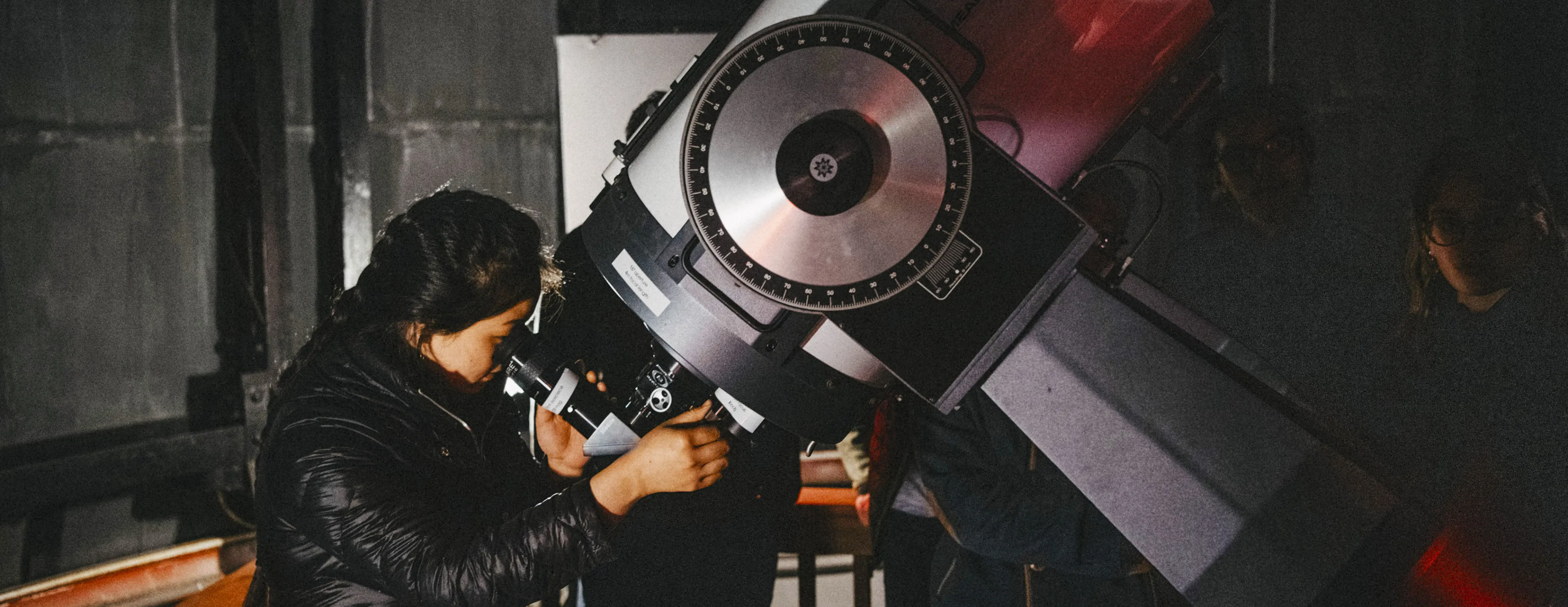
Astronomy and Astrophysics
Why Study Astronomy or Astrophysics in the Bi-College Consortium?
The Physics Department at Bryn Mawr and the Physics and Astronomy Department at Haverford offer you the opportunity to major in either Astronomy or Astrophysics. Astronomy and Astrophysics use physics to study the nature and behavior of planets, stars, galaxies, and the universe itself. While the major and minor are centered at Haverford, you can take courses at either school to fulfill degree requirements.
Courses of Study
You have the the opportunity to major or minor in Astronomy or Astrophysics at Haverford College.

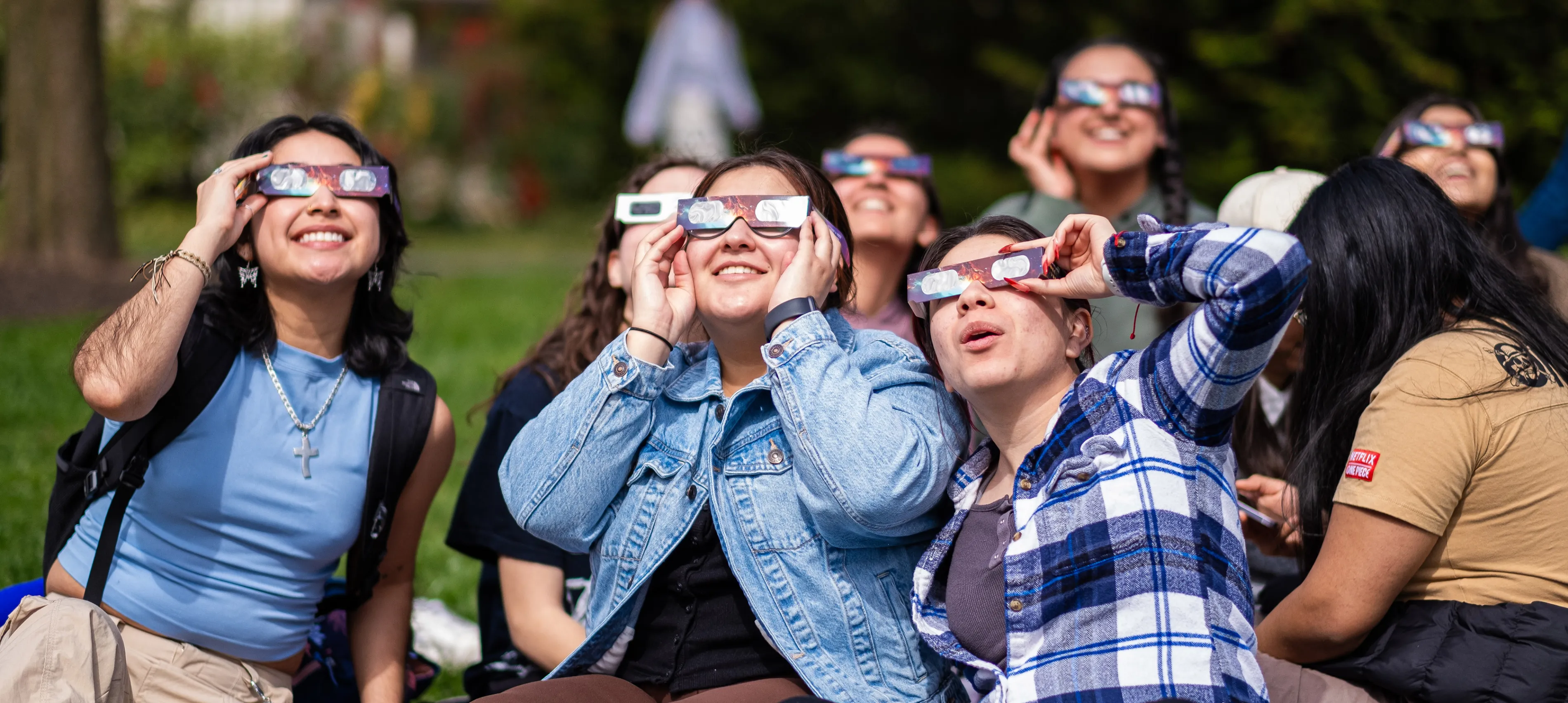
Manolya Yatman '26"One of my greatest areas of wonder growing up was the very beginning of the Universe. As an astrophysics major, I’ve also been very interested in studying the stars."
Course Highlights
PHYS B101 Introductory Physics I Physics 1 is an algebra-based introductory sequence intended primarily for students on the pre-health professions track. Emphasis is on developing an understanding of how we study the universe, the ideas that have arisen from that study, and on problem solving. Topics are taken from among Newtonian kinematics and dynamics, relativity, gravitation, fluid mechanics, waves and sound, electricity and magnetism, electrical circuits, light and optics, quantum mechanics, and atomic and nuclear physics.
PHYS B214 Introduction to Quantum Mechanics
This course presents an introduction to the principles governing systems at the atomic scale and below. Topics include the experimental basis of quantum mechanics, wave-particle duality, Schrödinger's equation and its solutions, and the time dependence of quantum states. Recent developments, such as paradoxes calling attention to the counter-intuitive aspects of quantum physics, will be discussed. Additional topics may be included at the discretion of the instructor. The laboratory involves quantum mechanics, solid state physics, and optics experiments.
Faculty Spotlight

Evan J. Arena
Lecturer and Lab Coordinator of Physics
Professor Arena sees his role as a physicist and a lecturer as giving everyone the opportunity to learn about this exciting and fascinating domain of science. He firmly believes that studying physics should be a fulfilling experience for all his students. As a researcher, he specializes in cosmology and astrophysics. His work lets us better understand the statistical distribution of matter in the Universe and the theories of gravity that guide its evolution through time.
A Stellar Future
How astrophysics and astronomy grads are lighting their paths

Tonima Tasnim Ananna '13"The women at Bryn Mawr were fiercely feminist, articulate, opinionated and independent. It really helped me grow a lot.”
Opportunities in Astrophysics and Astronomy
Research
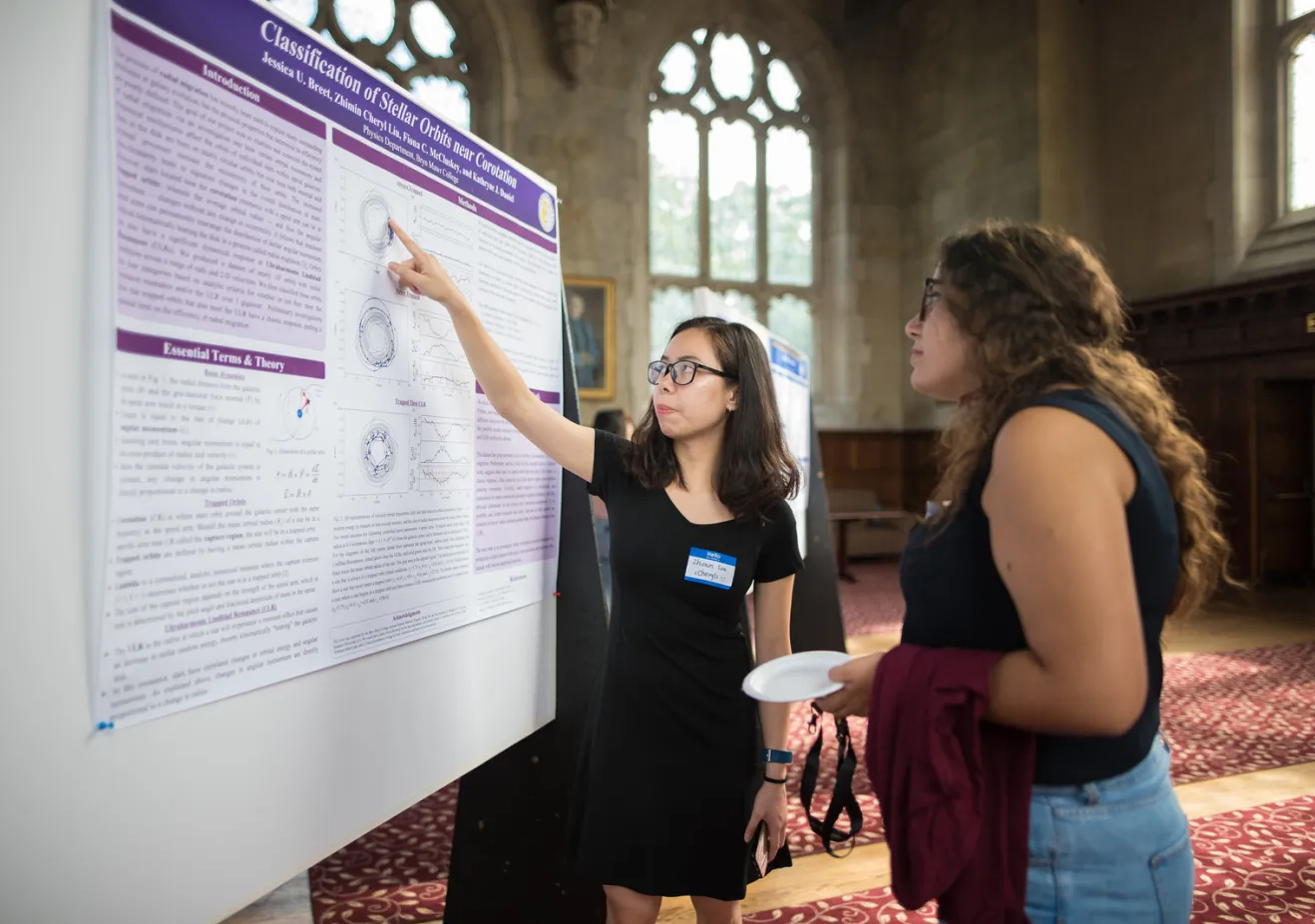
You have the opportunity to do research alongside professors during the school year or to do supervised research over the summer. Professors at both Bryn Mawr and Haverford take on astrophysics student research assistants.

Internships
We encourage you to take on internships with different astrophysics and astronomy organizations over the longer breaks in the school year. In recent years, this has included research into stellar archaeology in Kashiwa, Japan.

Study Abroad
If you're feeling the pull of adventure, you can study abroad! Astrophysics and astronomy majors can take courses abroad as long as the program is approved by their advisor.
Astrophysics and Astronomy FAQ
Here are some common questions about majoring in astrophysics and majoring and minoring in astronomy.
Yes! Bryn Mawr students can major in astronomy or astrophysics at Haverford, and Haverford students may major at Bryn Mawr if their program is not offered at Haverford.
No. The physics department at Bryn Mawr College offers numerous classes that fulfill degree requirements for the astronomy and astrophysics majors at Haverford. Bryn Mawr students often find it enriching to take some of their major courses in a woman-centered scientific community that supports them as they move into a male-dominated field.
Astrophysics is a physics major with a focus on astronomical phenomena. It looks at the universe and the physics underneath. Astrophysics is a good major if you're planning to pursue graduate school in either astronomy or astrophysics.
Astronomy focuses on astronomical phenomena in and of themselves. Astronomy is a good major if you are looking for an in depth education in astronomy that you can apply to any number of other fields.
You can double major in astronomy and physics, but if you choose to do so, your advisor will likely encourage you to switch to a single astrophysics major instead.
Astrophysics majors cannot double major in either Physics or Astronomy, but may choose another field to double major in.
STEM News
Astronomy and Astrophysics are part of a wide STEM community in the Bi-Co. See what's new:



Contact Us
Astrophysics and Astronomy
Department of Physics
Park Science Building
Bryn Mawr College
101 N. Merion Avenue
Bryn Mawr, PA 19010-2899
Phone: 610-526-5358