Bi-Co Program is Leading Community College Students to Attend 4-Year Colleges
June 17, 2026
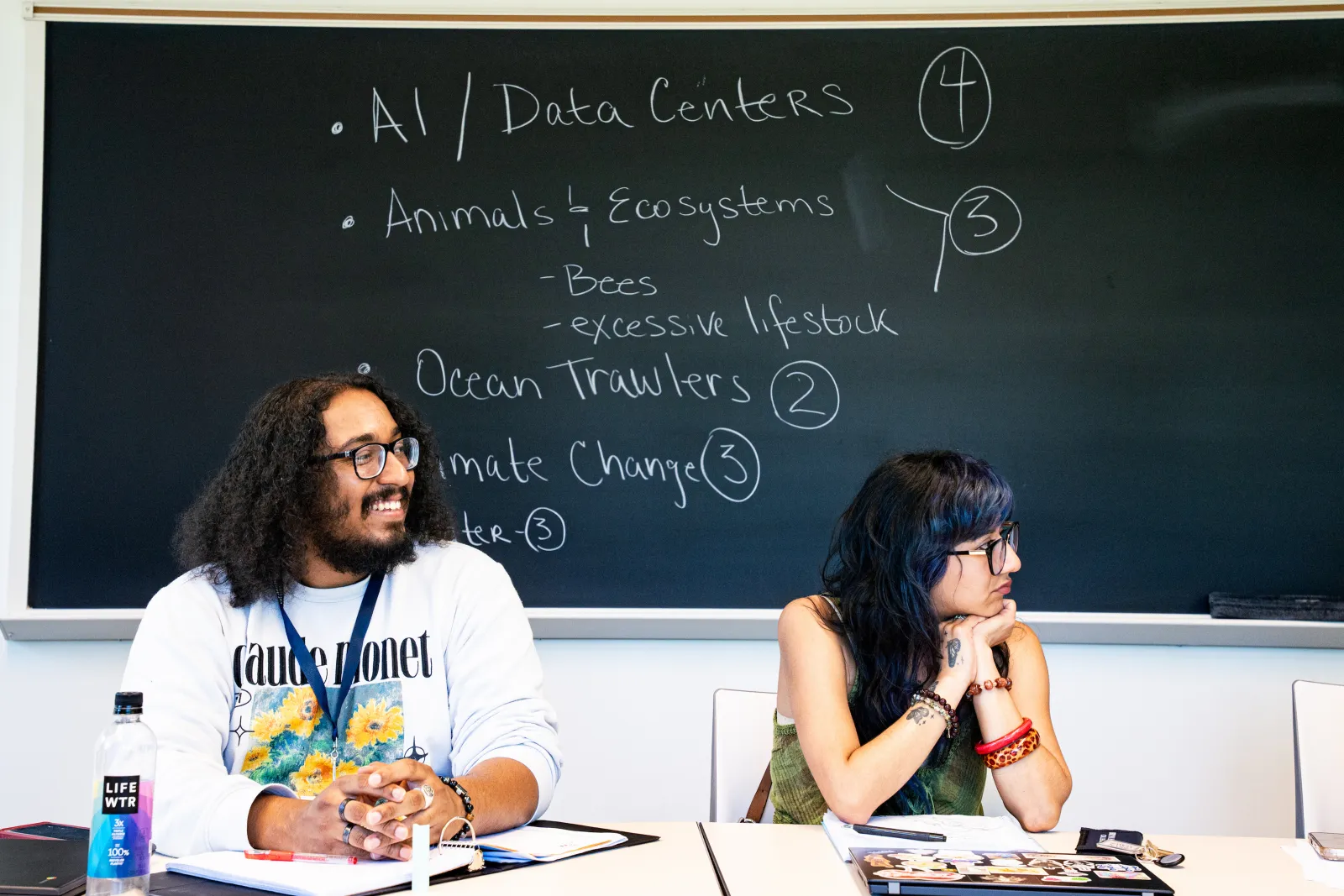
Logan Owens from Northampton Community College and Paulina Reyes take part in a classroom discussion.
Earlier this month, eight students from four different community colleges came to Bryn Mawr College to take part in the second offering of the Bi-Co Exploring Transfer Together Program.
The program is a coed, no-cost, residential program designed to prepare community college students for what lies ahead at a selective four-year institution. Applications for the program arrived from both in-state and out-of-state students. Selected participants represented a range of academic interests and backgrounds.
The impact of the inaugural program is already evident in where participants have enrolled.
Victoria Fisher, who attended York County Community College in Maine, will begin her studies at Bryn Mawr this fall as a McBride Scholar, Bryn Mawr's program for non-traditional-age students.
In addition to Bryn Mawr, participants in last year’s program will be attending Amherst College, Lehigh University, Temple University’s Tyler School of Art, and Penn State’s Harrisburg Campus.
"As an immigrant and first-generation student, I thought attending a highly selective institution was impossible, but the Bi-Co Exploring Transfer Together program proved me wrong," says Marcos Campos, who was part of the inaugural program and will attend Amherst College this fall on a full scholarship. "Beyond teaching me about the transfer process, the residential experience helped me understand the value of a liberal arts education and see myself in those spaces."
Marcos Campos on a campus tour during last year's program.
This year, the program has been extended from five to 12 days, with much of the extra time spent on helping participants better understand financial aid, the application process, how to maximize transfer credits, and more of the nuts-and-bolts information needed to transition from a community college to a bachelor's degree-granting institution.
The additional time also allowed participants to visit neighboring colleges and hear from transfer advisors, financial aid professionals, and current students.
"We’re really pleased and excited by the success of our first group, and it gives this second group even more reinforcement that this is something they can do," says Cheryl Horsey, who created the program during her tenure as Bryn Mawr's chief enrollment officer and continues to oversee it. "For the first cohort, we did a great job of introducing them to the academic rigor they’d experience at a liberal arts college. We’ve retained that but added more of the pragmatic information students need to take that next step."
Program participants lived in Bryn Mawr residence halls and took part in a wide range of academic and experiential learning opportunities while on campus. Through a course centered on environmental issues, communication, and community engagement, students explored topics such as environmental justice, media literacy, and public art while working collaboratively on projects and presentations.
Outside the classroom, they participated in workshops on financial aid, transfer credits, admissions, and other aspects of the transfer process while building relationships with faculty, staff, current students, and fellow transfer students.
"This program is about helping students understand what a liberal arts college offers; how it’s often a much more affordable option than they think; and the personal and professional values they’ll build," says Horsey.
Kakakdar Lim, a student at Community College of Philadelphia interested in economics who took part in this year’s program, says the program opened his eyes to the ways a liberal arts education can prepare students to look more broadly at the world and the challenges we all face.
"Studying economics alone will only allow me to understand the foundation of what can make the economy develop,” he says. “But not the solution to actually solving economic issues. This program helped me see how I can deepen my understanding by connecting other dots in other subjects."