

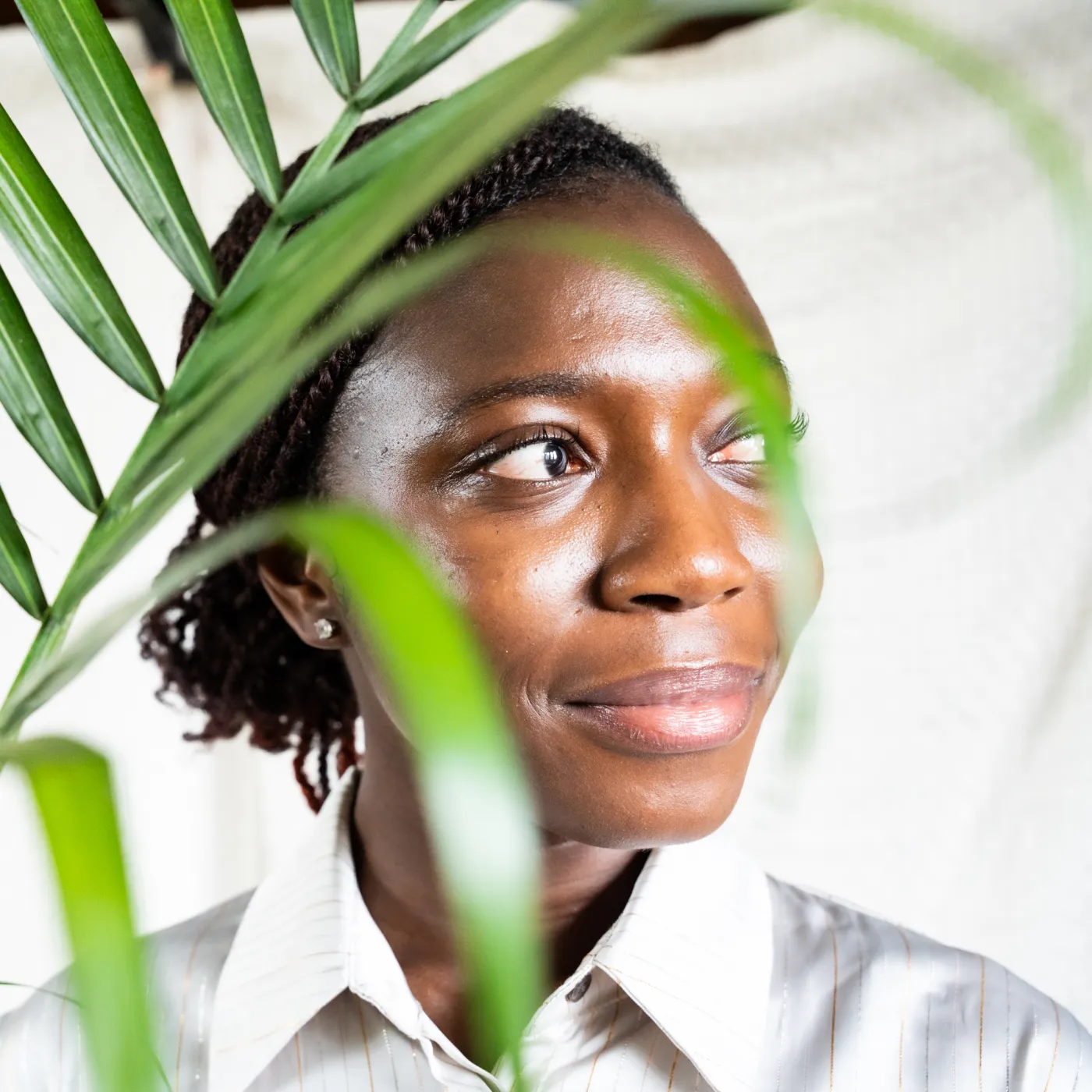
Like thousands of women in Ghana, Cynthia Amoaba’s cousins are part of a shea butter economy shaped by hard work and slim margins.
Far from the country’s urban centers, they rely on middlemen to get the product to larger markets, receiving only a fraction of the value of the time they spent working by hand to clean, dry, husk, roast, and grind shea nuts into the butter used in cosmetics, soaps, and foods around the world.
Armed with an economics degree and a $30,000 Samuel Huntington Award for Public Service, Amoaba, who is part of Bryn Mawr’s class of 2026, hopes to help change that equation by creating fairer pathways to market for women producers like her cousins.
Amoaba, who is the first Bryn Mawr student to receive a Huntington Award, plans to use money from the fellowship to help women in northern Ghana make capital purchases, including sustainable alternatives to the wood most used in the processing of shea butter; build direct connections to larger markets; deliver financial literacy training; and mentor adolescent girls in the communities.
Growing up, Amoaba was an excellent student and did well on the test required to attend university in Ghana, but several barriers made that outcome less than certain.
It wasn’t until hearing from Ferdinand Quayson, founder of Young Achievers Foundation of Ghana, at Ghana's National Science and Math Quiz Competition, that she started to think about attending college in the United States.
Quayson, who grew up in poverty in Ghana and went to Wesleyan University, saw the potential in Amoaba and encouraged her to take the SAT.
“I went to a small public school, and my counselors didn’t really know anything about the SAT. It was new to them,” she recalls.
Amoaba did well on the test, and, her curiosity piqued, she reached out to a Ghanaian student at Swarthmore College she found on LinkedIn. He put her in touch with Lisa Adanye ’23, a Ghanaian student he knew at Bryn Mawr who sold Amoaba on the school and convinced her to apply.
Bryn Mawr accepted Amoaba with a generous financial aid package, but it still wasn’t enough. Two weeks before the start of the fall semester, Amoaba had her visa, but she didn’t have the money for a plane ticket.
Luckily, Quayson had been in touch with Amoaba and was able to connect her with board members of his foundation who could pay for her flight.
“If they hadn’t helped me, I don’t think I would have made it here,” she recalls.
Celebrating the Class of 2026
Cynthia Amoaba
“College is about saying yes to possibilities. Once you have people around who are willing to lend a helping hand, that’s all you need. We can do anything together.”
Amoaba came to Bryn Mawr intending to major in computer science but was also interested in business. When she registered for her first semester of classes, her dean convinced her to try an economics course, and she was hooked.
In the summer between her first and second year, Amoaba returned to Ghana as part of a fellowship program in which faculty and students from Bryn Mawr and Haverford colleges partner with educators in Dalun, Ghana.
While there, she talked to women who produced shea butter and faced the same challenges as her family. It was at that point that she first seriously considered how she could apply what she was learning in her classes to help the women of Ghana.
“That was when I really started to think about how I could develop market access for these women,” she says.
Amaoba decided to major in economics and minor in data science. She has taken courses with nearly every faculty member of Bryn Mawr’s economics faculty on topics including the U.S. health care system, the economics of the developing world, the role of labor, and more.
She has also done internships with Schreiber Foods in Wisconsin, MFS Investment Management in Boston, and a brief externship with Polly Stephens ’87, a breast cancer surgeon in Virginia, to learn more about the business of healthcare.

“The alumni network has been so supportive of me,” says Amoaba. “I was only able to spend a little bit of time with Dr. Stephens, but then she invited me to her house at Christmas, and she’s become like my family.”
For students considering which college to apply to, especially those from outside the United States, Amoaba recommends looking at what liberal arts colleges like Bryn Mawr have to offer.
“Everybody is accessible and supportive here,” she says. “I didn’t really think I could get the Huntington Award, but Eleanor Stanford, who oversees the fellowships office, and Betsy Horner, who is the director of the Quantitative Program and a lecturer, pushed me to do it. It was the last day to submit my materials, and they were texting me at 10 o’clock to make sure I did it.”
“College is about saying yes to possibilities. Once you have people around who are willing to lend a helping hand, that’s all you need. We can do anything together.”
Amoaba has crafted her Huntington project for long-term community ownership rather than dependency on external funding.
The equipment provided is durable and will be shared. The machines are simple, and a hired technician will train women on routine maintenance during the project year. A small maintenance fund, contributed by producers from their increased earnings, will cover any professional repairs needed. The market connections established during the project year are relationships, not one-time transactions. And the mentorship component creates a generational pipeline.
“By engaging adolescent girls now, the project ensures that the next generation of women sees shea butter production as a viable livelihood worth staying for, not a trap to escape,” she says.
After her fellowship, Amoaba plans to pursue law school with a focus on international development law. She intends to continue to advocate for policy reforms that protect artisanal producers like her mother and to seek partnerships with development organizations to replicate the model she’s working on with other shea-producing communities across Northern Ghana and West Africa.
“The goal is not a single year of impact but the beginning of a sustainable transformation in how women’s labor is valued, supported, and rewarded,” says Amoaba.
Look for more coverage of members of the Class of 2026 leading up to Bryn Mawr’s undergraduate commencement ceremony on Saturday, May 16.