

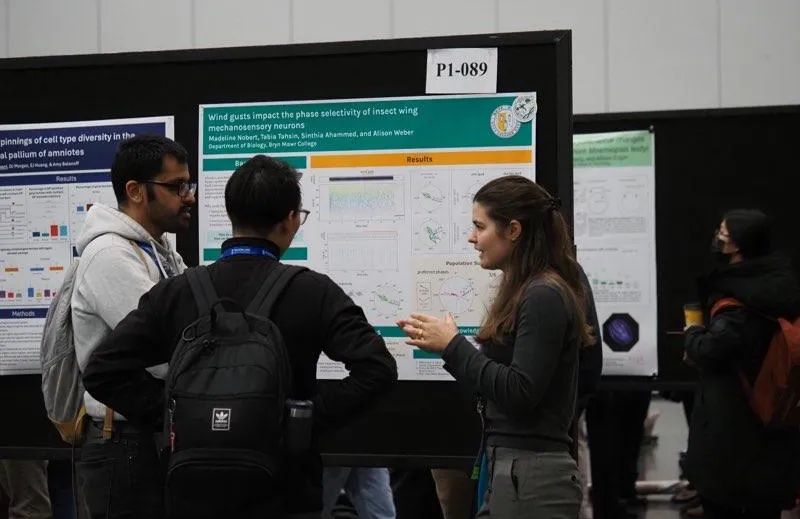
Senior biology major Madeline Nobert won Best Undergraduate Student Poster at the Society for Integrative and Comparative Biology's annual conference in Portland, Oregon.
Presented in the Division of Neurobiology, Neuroethology, and Sensory Biology, Nobert's poster follows her thesis research investigating how wind gusts impact the phase selectivity of insect wing mechanosensory neurons.
Nobert researches in the lab of Assistant Professor of Biology Alison Weber, where she conducts electrophysiology experiments on the wing nerves of moths. Using tiny probes that detect changes in voltage when a neuron is activated, Nobert records how sensors on the wings' surfaces respond to flapping-like movements and disturbances, such as gusts of wind. She joined the lab last summer as a part of the Summer Science Research program and has been working with Weber since.
"Maddy has accomplished a lot in a short amount of time, including mastering several challenging and very different skills needed to conduct electrophysiology experiments," says Weber. "A lot of science is troubleshooting, and Maddy excels at logically thinking through problems and possible solutions. She’s also a natural communicator who finds clear ways to explain complex ideas. I’ve found myself jotting down some of her explanations to use myself when describing our work to a more general audience."
The Weber Lab
Ali Weber's students highlight the collaborative community that she curates in her lab. She currently has five students spread across three distinct projects, but Nobert noted how much she and her lab mates enjoy working together to solve issues that arise and bouncing ideas off each other. The lab investigates how animals gather the sensory information they need to move, make decisions, and survive in the world in the context of insect flight. Weber was recently awarded over $400,000 by the National Science Foundation to continue her research on flight sensory systems and to help unlock the secrets of the natural world.
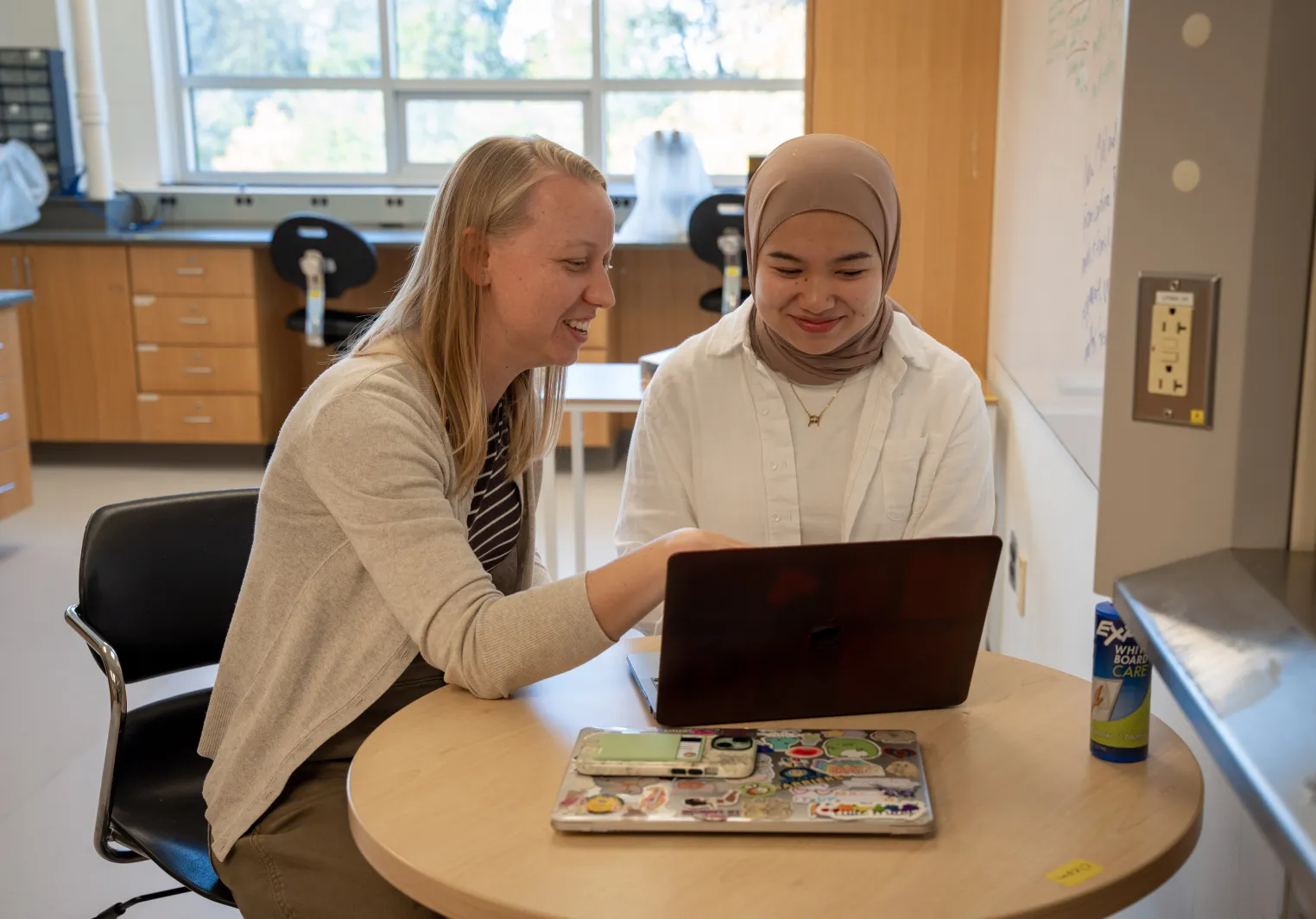
"Working in the Weber Lab has given me invaluable experience with multiple stages of a long-term experiment, and with effective communication about the activities in the lab," says Nobert. "Dr. Weber really emphasizes being able to engage with people from all backgrounds in conversations about the lab's work, and attending the conference allowed me to talk to people in many different positions in the scientific world. Working in a basic science lab has led me to appreciate the process of asking questions for the sake of furthering understanding."
Originally from New York City, Nobert minors in Spanish alongside her biology major. She is heavily involved with on-campus theater, working in costuming with the Theater Department and as a theater technician for the Shakespeare Performance Troupe (SPT). This spring, she is directing a production of As You Like It with SPT. Theater and science really go hand in hand, she says, with both processes grounded in problem-solving and communication across different groups.
Interdisciplinary Research at Bryn Mawr
There are many opportunities to undertake academic research at Bryn Mawr. Students refine their research skills after declaring a major, with many departments offering research methodology courses and senior thesis opportunities. Undergraduate research experiences are marked by close mentoring relationships with faculty and programming designed to enhance research skills.