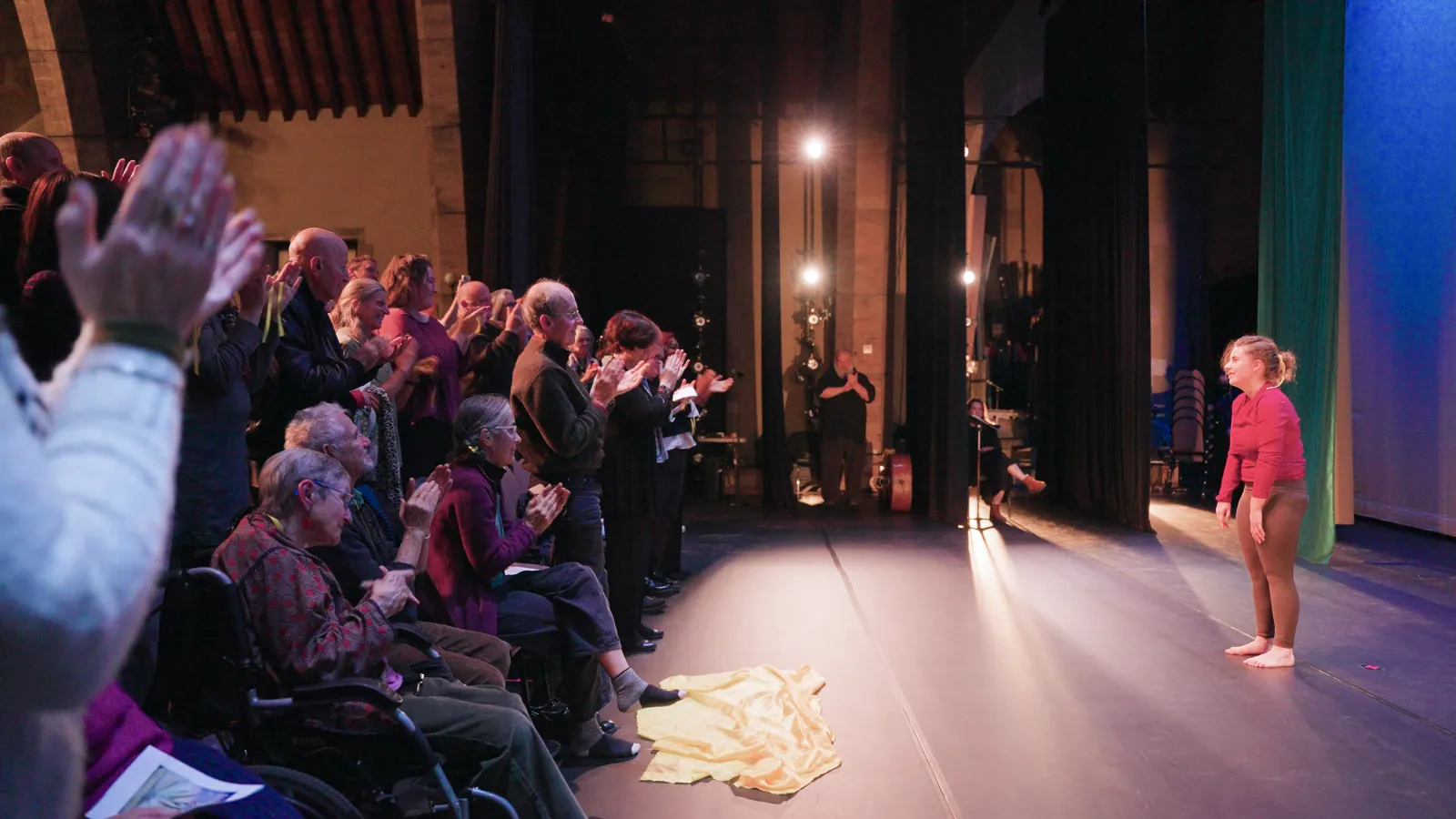
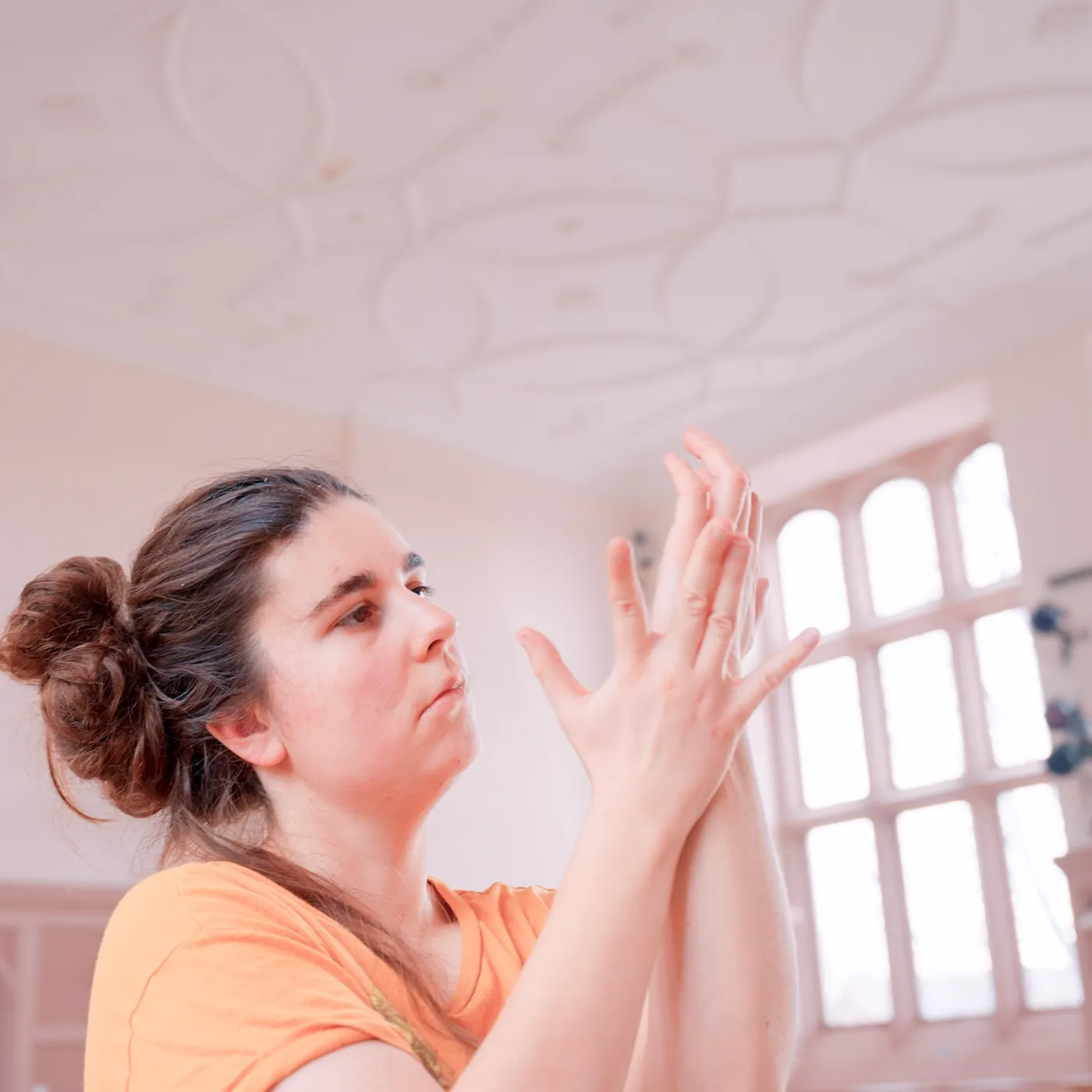
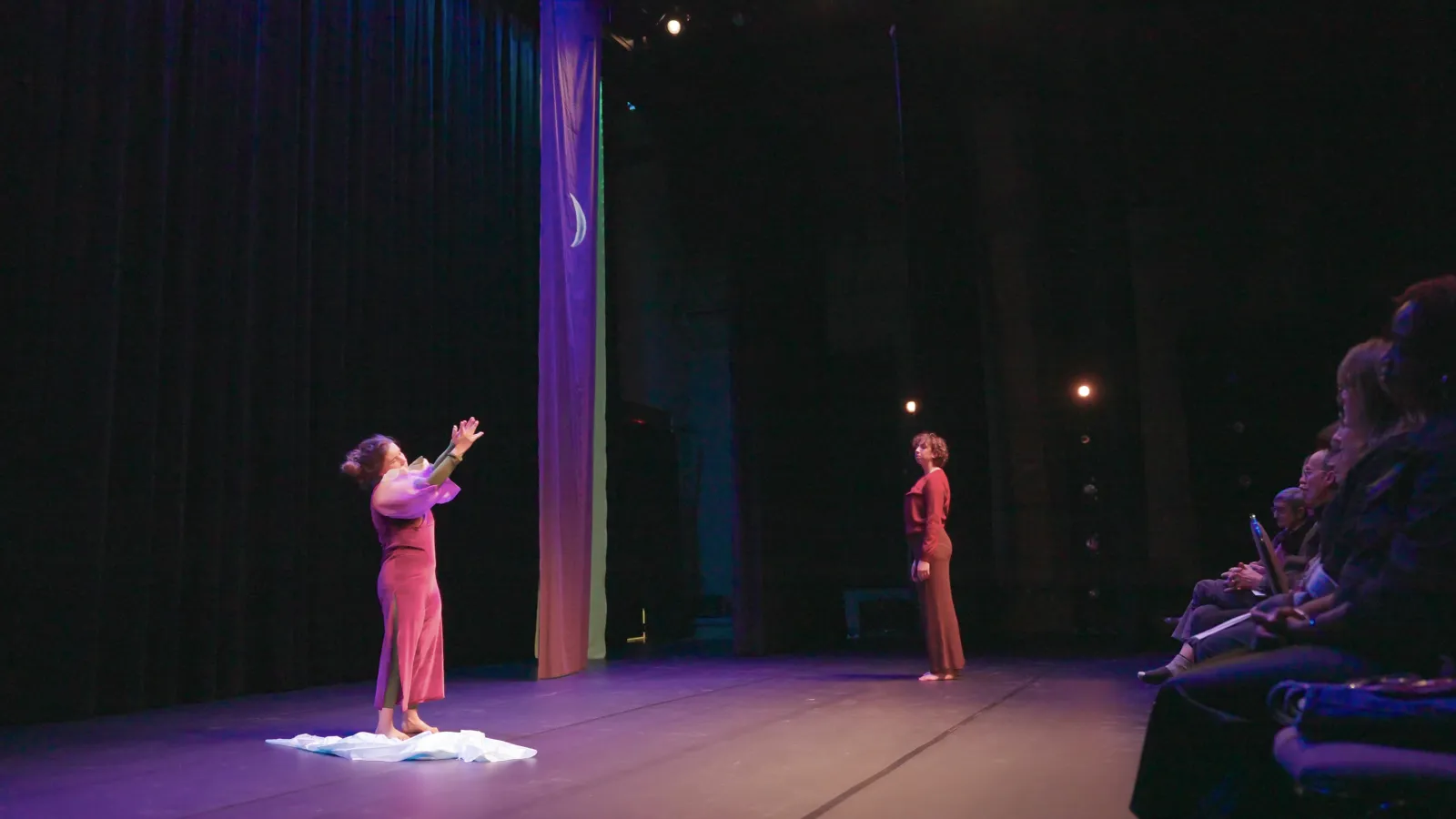
A teacher once told Sophonisba Jarka-Sellers ’26, “If you can move your eyes, you can dance.” Those words encouraged the aspiring dancer when she heard them and continued to ring true as she wrapped up her dance major at Bryn Mawr, practicing integrated dance, which brings together dancers with and without disabilities.
Video: See Sophy Perform and Hear Her Tell Her Story
“I have found my home in integrated dance,” says Jarka-Sellers. “I find it freeing because it says, ‘Come as you are. How you are is enough.’ Dance is possible for all, regardless of ability or disability.”
Jarka-Sellers has faced physical challenges since being in a severe car accident at the age of 18 months, which left her with right hemiparesis, a speech impediment, and an overall tremor, with the right side of her body significantly weaker than the left.
“This means that I often have to work hard at everyday activities that most people take for granted,” she says. “In the context of dance, it isn’t easy for me to train physically and do movements quickly. I also have a fatigue condition, which means I have to be careful not to take on too much. I’ve had to really work to find my own way of dancing, which is why I’ve focused on integrated dance.”
Navigating her disabilities has been hard, Jarka-Sellers says, and she has experienced times of profound unhappiness. Despite the difficulties, or maybe in part because of them, she sees her life’s goal as making people happy and giving them joy and hope. “My most fervent dream is to be magic in someone’s life,” she says. “If I can do that, I feel like I’ve done the thing that I’m on this earth to do.”
Jarka-Sellers’ dance journey began at Bryn Mawr, where she gravitated to composition classes — which focus on choreography rather than technique. “It’s about how you make and shape the dance rather than the physical technicalities of it, and finding out how you move,” she says.
Bryn Mawr Director of Dance Lela Aisha Jones says she was struck right away by Jarka-Sellers’ perseverance and how she “embraces whatever is offered to her and tries to take it to the next level.”
She remembers realizing in composition class that “time is a big factor with Sophy's process and progress.” Instead of her need for more time becoming a hindrance, though, “it became a vibrant part of the course. We asked ourselves what slowing down time provides us as choreographers, as dancers, as movers.”
Jones’ teaching grew, she says, through her work with Jarka-Sellers. “Everything that is teaching Sophy is also teaching all of us,” she says. “Something that really sits with me is the relationship between people who are considered more normalized and/or able-bodied in society and people who are living with disabilities. We tend to separate those experiences, but integrated dance levels out and balances any idea that someone has more than the other to offer.”
For the dance program, she says, her biggest takeaway has been moving toward a more flexible classroom and asking herself, “How do we create pedagogies that allow for a malleable learning experience where we have the ability to permeate each other's worlds of knowledge?”
Though integrated dance is not currently part of the dance department’s official curriculum, Jarka-Sellers hopes it will be one day. “They have taken the first step in this by welcoming me into the program,” she says.
Jarka-Sellers, who transferred to Bryn Mawr from Guilford College, says that growing up in the area, Bryn Mawr College was what always sprang to mind when she imagined college. “I thought that a women's college like Bryn Mawr would offer me a special kind of community, and it has.”
Because she began dancing only at 19, Jarka-Sellers has spent her vacations playing catch-up through dance programs such as Minneapolis’s Young Dance, Stopgap Dance Company in the UK, Atlanta’s Full Radius Dance, and the Axis Dance Company in Berkeley, CA. Currently, she is completing teacher training in the DanceAbility method of integrated dance. She is also the founder and leader of True Dance, an integrated dance collective in Philadelphia’s Mt. Airy neighborhood.