

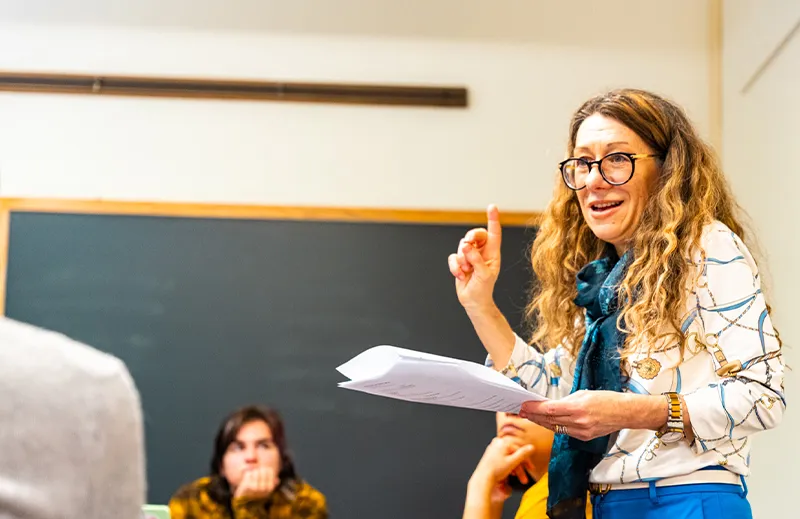
At Bryn Mawr College, the course Mafia and Organized Crimes, taught in Italian for majors and minors by Professor and Chair of Transnational Italian Studies Roberta Ricci, seeks to debunk students' stereotypical conceptions of organized crime and to address the socioeconomic and cultural issues associated with global criminal activity.
"The students thought they would jump into this class and talk about The Godfather and Sicily, and that's it," says Ricci, who also serves as the Andrew W. Mellon Foundation Chair in the Humanities. "They didn't realize we were looking, for example, at brands. I would ask, 'Have you ever bought this product?' And they would say, 'Yes.' And I would say, 'Well, you know, 10 years ago, certain brands made in Italy were associated with the Mafia and illegal activities, including exploitation of minors and women." Here's just one example from Roberto Saviano's 2016 book, Gomorrah: A Personal Journey into the Violent International Empire of Naples' Organized Crime System: The white suit worn by Angelina Jolie at the 2001 Oscars was sewn by a tailor who worked illegally in a clandestine facility in Arzano that was associated with an organized crime network with a large international reach in construction, high fashion, illicit drugs, and toxic-waste disposal.
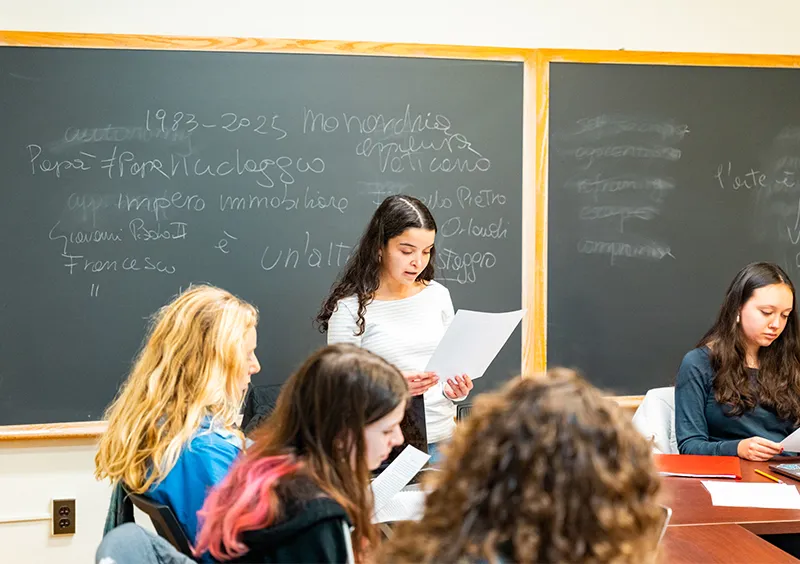
Italian writer, journalist, and screenwriter Saviano's book, and award-winning photojournalist Letizia Battaglia's 2019 documentary Shooting the Mafia, led students to reflect more deeply on the startling realities of organized criminal associations centered on the Naples region of Italy. Battaglia powerfully speaks about what she once called her "archive of blood" in reference to her photography.
This advanced-level course examines the three major Mafia organizations: the Cosa Nostra in Sicily, the 'Ndrangheta in Calabria, and the Camorra in Campania. The course begins in 1861 with the unification of Italy, when the Mafia developed into a hierarchical organization. It continues through the ventennio, or 20 years of Fascist rule from 1922 to 1943, to the present day, exploring its assimilation into — and affiliation with — legal economic activities.
Students study the complexity of the Mafia as a global phenomenon engaged in labor racketeering, illegal factories, and illegal disposal of toxic waste through interdisciplinary and textual lenses such as history, anthropology, journalism, and the use of multimedia — including photography, television, and cinema.
"By watching Italian movies and reading journalism on organized crime, I've seen the ways in which fictionalized stories are romanticized by Hollywood and inaccurate in pop culture," says Sabina Farney '28, an Italian and archaeology double major. "I appreciate that Professor Ricci has highlighted the roles women play as heads of organized crime families, exercising near-absolute control over illegal activities like gambling, extortion, and racketeering, as well as women born and raised in Mafia families who become victims of violence and decide to become collaboratrici di giustizia (justice collaborators) working with legal authorities to push against the patriarchal culture of the Mafia based on corruption, gender abuse, and brutality."
"We are talking about real life," Ricci says. "We are not talking about fictional characters. We are talking about real people, real episodes, real situations, real geography, and real deaths."
Throughout the semester, students attended events reinforcing what they were learning in the classroom. In November, Visiting Assistant Professor Federico Sessolo gave a lecture on "Fascism: The View from America" reflecting on the relation between Fascism(s) and Mafia; and in December, guest lecturer Professor Stephanie Jed from the University of San Diego gave a talk on "The Riace Model against the Mafia: Key Words for Creating a Welcoming World." This lecture addressed how Riace, a small village in the south of Italy, fought the power of the Mafia by becoming a sanctuary for immigrants and victims of the Mafia.

Roberta Ricci
Professor and Chair of Transnational Italian Studies
"We are not talking about fictional characters. We are talking about real people, real episodes, real situations, real geography, and real deaths."
The class also attended the New Italian Cinema Film Festival at the University of Pennsylvania, where in December they saw a screening of 2025 Ciao Bambino, depicting the story of a teenage boy in Naples whose family is involved with the Mafia, and participated in a Q&A session in Italian with the director of the film, Edgardo Pistone.
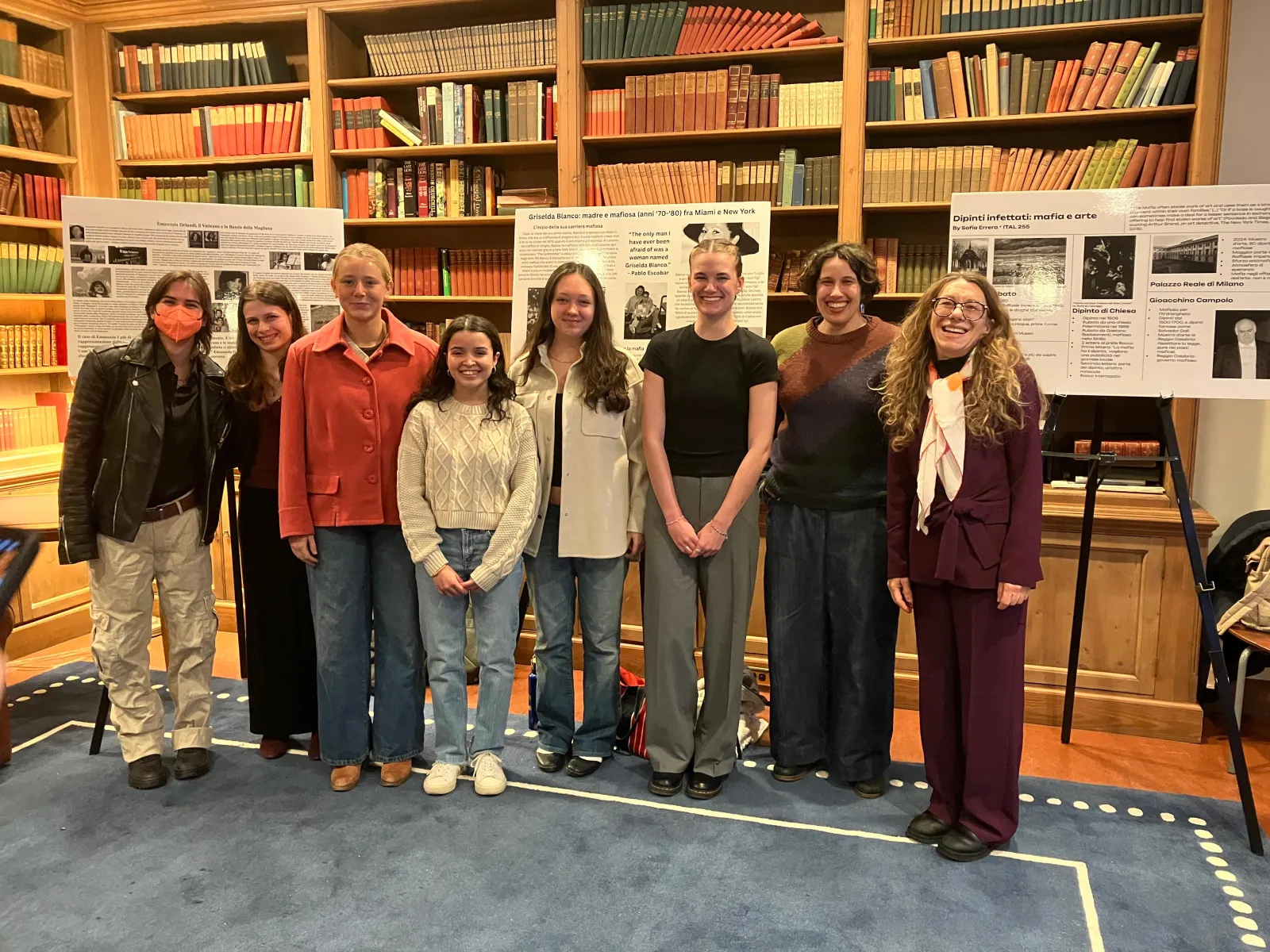
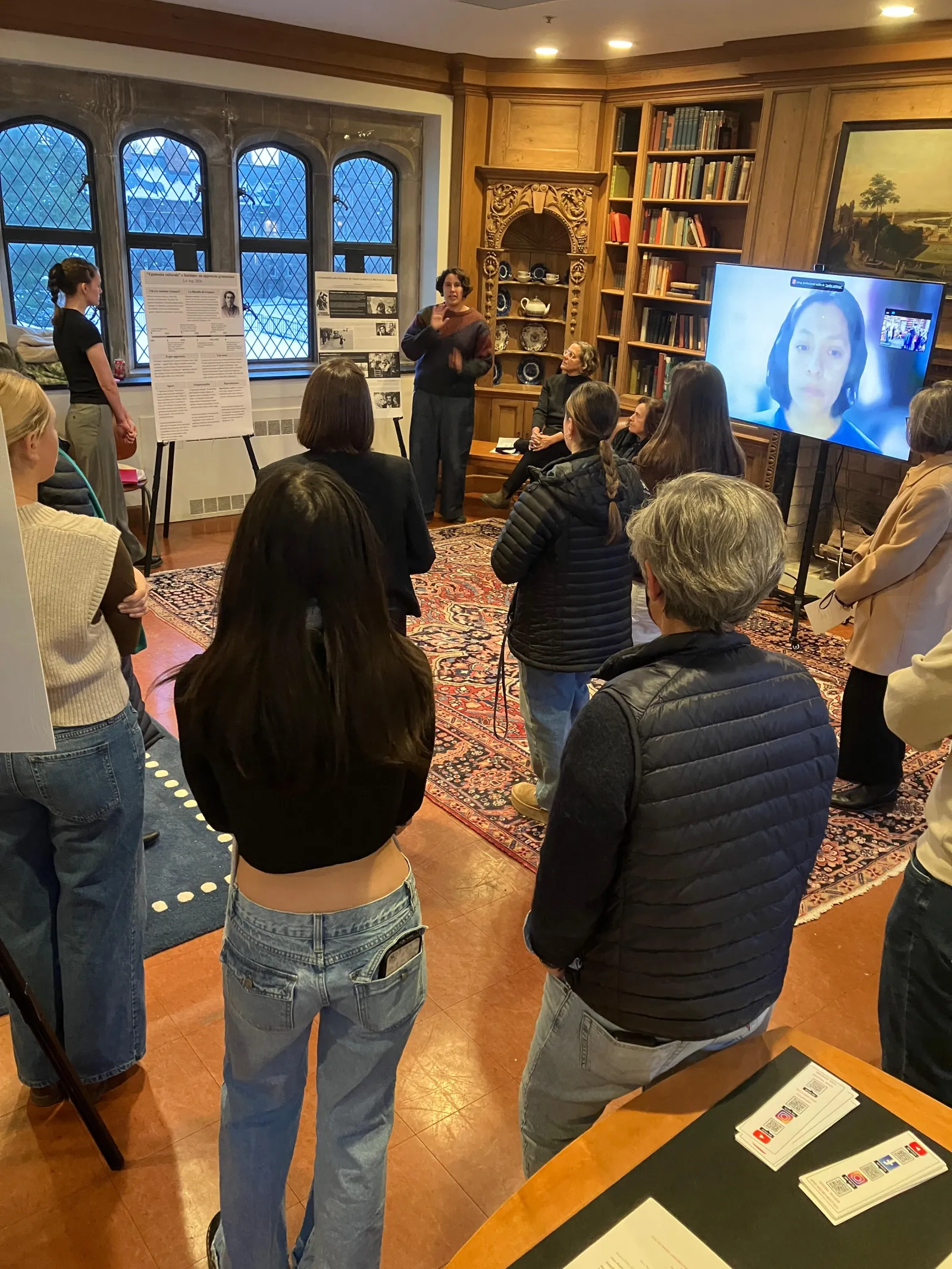
The course concluded with the students completing an independent research project on a topic of their choosing, approaching a certain aspect of the Mafia and then sharing (In Italian) their findings at a poster presentation open to the campus community, including alumnae/i. Students' research topics included: the 1983 mysterious (and still unsolved) disappearance of Emanuela Orlandi, a Vatican citizen, at the hand of the Mafia in collusion with political and religious authorities while returning home from music school in Rome on 22 June 1983 (see the Netflix miniseries about Orlandi titled The Vatican Girl); the infiltration of the Mafia into the financial and corporate worlds; and social and artistic activism (murals).
Farney's final project centered around the Colombian-American Mafia boss, Griselda Blanco, prominent in the cocaine-based drug trade and underworld of Miami, during the 1970s through the early 2000s. A Netflix miniseries about Griselda starred Sofia Vergara in the lead role. "I chose this topic because there is a stereotype that women in the Mafia are only the wives or daughters of Mafiosi with little to no agency, and only cater to the men around them, and Griselda completely shatters this stereotype by being a powerful and ruthless Mafia boss," Farney says.
Today, the Mafia is an "invisible organization" as Ricci calls it, that continues its illegal operations with fine connections to politics, religion, businesses, economics, and finance. "The question I have been raising in class during the semester is: how can modern society establish or reestablish a rule of law and social justice in an area occupied by a criminal organization?" says Ricci. "I hope for the students to leave the course understanding that the fight against organized crime is not only the fight against violence, but it's really a fight for social justice, better policies, and democracy, and it concerns all of us – here and now."
ITALB255 Mafia and Organized Crimes is cross listed with Gender and Sexuality Studies and Film Studies, and fulfills the Power, Inequity, and Justice requirement.

Transnational Italian Studies at Bryn Mawr
The Transnational Italian Studies Department at Bryn Mawr offers an interdisciplinary and transnational course of study that explores the works of canonical Italian authors alongside traditionally marginalized voices, bringing together issues of gender and sexuality, language and class, race and ethnicity. Students may complete a major or minor in Transnational Italian Studies.