

Certificate in Pedagogy for Graduate Students
Students in the Graduate School of Arts and Sciences as well as the Graduate School of Social Work and Social Research who look to develop their pedagogical knowledge and skills are invited to pursue the Teaching and Learning Institute's Certificate in Pedagogy.
Pedagogical preparation at Bryn Mawr College focuses on supporting prospective and new faculty in “‘self-authoring’ a professional identity as an educator” (Gunersel, Barnett, & Etienne, 2013, p. 35). Through both required and optional components, the Teaching and Learning Institute (TLI) /Collaboratory for the Lifecycle of Learning supports graduate students who plan to teach in reflection and dialogue with teachers and learners at multiple stages of their educational development. The goal is to support GSAS students in formulating teaching philosophies, developing new teaching practices, exercising autonomy, building confidence, and experiencing a sense of psychological safety while doing this work (Camarao & Din, 2023).
Camarao, J., & Din, C. (2023). “A group of people to lean on and learn from”: Graduate teaching assistant experiences in a pedagogy-focused community of practice. Teaching and Learning Inquiry, 11.
Gunersel, A. B., Barnett, P., & Etienne, M. (2013). Promoting self-authorship of college educators: Exploring the impact of a faculty development program. Journal of Faculty Development, 27, 1, 35–44.
Expanded Descriptions of Components to be Completed for Teaching Certificate
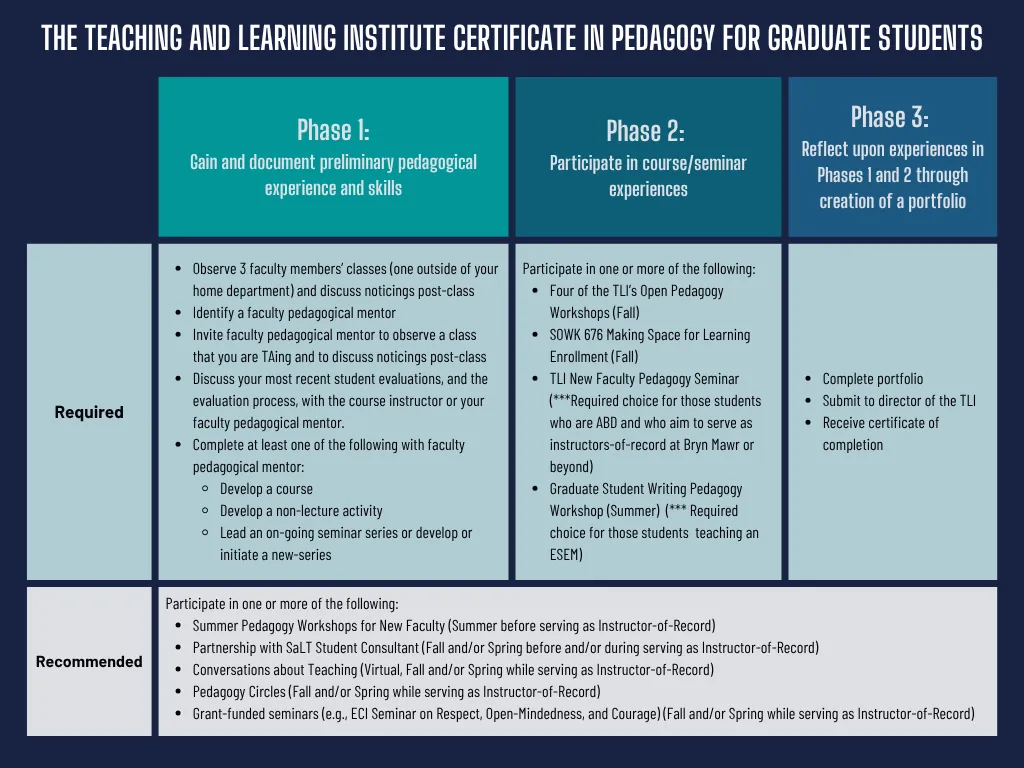
Phase 1 (required)—Gain and document preliminary pedagogical experience
This discipline-based, pedagogical exploration, reflection, and dialogue is the first step toward the certificate. It is ongoing during TAing experiences.
Assessment
- Arrange a total of three visits to classrooms and/or labs of three different faculty members, one of whom should be from outside your home department. Confer with the faculty member prior to the visit regarding what you want to focus on/learn from their teaching. Take observation notes on that focus and meet with the faculty member afterwards to discuss your notes.
- Arrange to have a faculty member observe a class session for which you are serving as a TA and give feedback on style and content.
- Discuss your student evaluations, and the evaluation process, with the course instructor or your advisor. Use your most recent teaching activity as a basis for this discussion.
Skills (select one or two activities to be completed with your advisor)
- Develop a course (choose readings, devise assignments, draft syllabus).
- Develop an activity that engages students actively. For example, design a laboratory exercise, a language drill section, a conversation section, or a web-based exhibit.
- Lead an ongoing seminar or conversation series, or develop and initiate a new series. These could be modeled, for instance, on the Pedagogy Circles.
Phase 2—(optional and required components) Participate in course/seminar experiences
This phase builds on the discipline-specific exploration, reflection, and dialogue to begin to dig deeper into pedagogical principles and prepare for practice.
Participate in one or more of the following:
- Four of the TLI’s Open Pedagogy Workshops (Fall)
- Enrollment in SOWK 676 Making Space for Learning: Pedagogical Planning and Facilitation in Higher Education Contexts (fall)—best to take prior to teaching (Fall). Facilitated by Kelly Gavin Zuckerman.
- TLI New Faculty Pedagogy Seminar (***Required choice for those students who are ABD and who aim to serve as instructors-of-record at Bryn Mawr or beyond) (Fall or Spring). Facilitated by Alison Cook-Sather.
- If teaching an ESEM, complete Graduate Student Writing Pedagogy Workshop (August). Facilitated by Jen Callaghan, Acting Director of the Writing Program and The Emily Balch (ESEM) Seminars, Director of the Writing Center, and Lecturer in English.
Phase 3—(required) —Complete portfolio, submit to director of the TLI, and receive certificate of completion
Required—portfolio that documents and reflects on your teaching experiences. You must include an artifact representing your completion of each of the requirements for the Certificate in Pedagogy. All artifacts except the teaching philosophy and the self-assessment must be paired with a critical reflection in which you discuss the significance of the experience the artifact represents and the implications for you as a teacher. One possible set of entries might be:
- A personal teaching philosophy
- Excerpts from assignments completed in SOWK676 that demonstrate early reflection on teaching
- A selection of responses to prompts from the new faculty pedagogy seminar that demonstrate growth in thinking about and planning for teaching
- Samples of insights gained from observing and talking with faculty
- Syllabus of a course developed
- Representative assignments and evaluations
- Course evaluations
- Self-assessment: Reflection and projection
Optional at multiple points
- “Preparing to Teach in the Bi-Co: Critical Reflection, Co-creation, and Community” Summer Pedagogy Workshops (Summer before serving as Instructor-of-Record)
- Partnership with a SaLT student consultant either to prepare for teaching or to reflect while teaching (Fall and/or Spring before and/or during serving as Instructor-of-Record)
- Conversations on Teaching (weekly, virtual forum for interim faculty at BMC and HC) (Fall and/or Spring while serving as Instructor-of-Record)
- Open Pedagogy Workshops (Fall)
- Enrollment in SOWK676: Making Space for Learning: Pedagogical Planning and Facilitation in Higher Education Contexts (Fall)
- Pedagogy Circles (forum for faculty) (Fall and/or Spring while serving as Instructor-of-Record)
- Grant-funded seminars (e.g., ECI seminar on Respect, Open-mindedness, and Courage)
Questions?
Contact the Director of the TLI, Alison Cook-Sather (acooksat@brynmawr.edu) or the Assistant Director of the TLI, Kelly Gavin Zuckerman (kzuckerman@brynmawr.edu).