


Mellon Mays Undergraduate Fellowship
The Mellon Mays Undergraduate Fellowship—funded by the Mellon Foundation—provides Bryn Mawr students with mentorship, research support, and a strong academic community geared toward graduate study and future scholarship.
Mellon Mays Undergraduate Fellowship at a Glance
To date, the program has produced more than 1,200 PhDs, more than 800 of whom are currently college professors. Numerous others have taken their valuable humanities training into venues ranging from museums and nonprofit organizations to publishing houses and government positions. At any given time, about 800 MMUF fellows are enrolled in PhD programs, while the fellowship supports approximately 500 undergraduate students each year.
1,200+PhDs Earned | 850+College and University Faculty and Instructors | 500+Tenured and Tenure-track Professors |
| Through most MMUF PhDs go on to teach at the university level, our fellows are also employed in higher ed administration, nonprofits, museums and libraries, publishing, government, medicine and law. | A critical mass of MMUF PhDs is now transforming teaching and scholarship in the humanities and social sciences. | Over 500 MMUF PhDs now hold positions as tenure-track, tenured or full professors. |
MMUF at Bryn Mawr College
Bryn Mawr College has participated in the MMUF program as one of its founding member institutions. In any given year, there are ten MMUF students at the College: five seniors and five juniors. Through a pipeline process that emphasizes mentoring, research support, programming, and student cohort building, Bryn Mawr partners with the Mellon Foundation to identify and support students of great promise and to help them become scholars and professionals of the highest distinction.
In addition, the criteria for eligibility include:
- Interest in pursuing a Ph.D. and an academic career in one of the designated fields.
- Commitment to participating fully in all aspects of the program.
- Willingness to work with a faculty mentor on a Mellon-approved research project during the junior and senior years.
- Interest in pursuing a Ph.D. and an academic career in one of the designated fields of study.
Research and Support

Research and Support
Guided research is the foundation of MMUF, and it is intended to prepare the student for graduate study. Each fellow conducts an individual research project under the guidance of a faculty mentor during the junior and senior years. Each fellow will choose and develop a relationship with faculty mentor(s) and meet with them on a regular basis. Mentors also guide the fellows as they develop their research presentations for the annual MMUF Undergraduate Regional Conference. Faculty mentors must be an active scholar and professor in one of the Mellon-designated fields.

Cohort Engagement
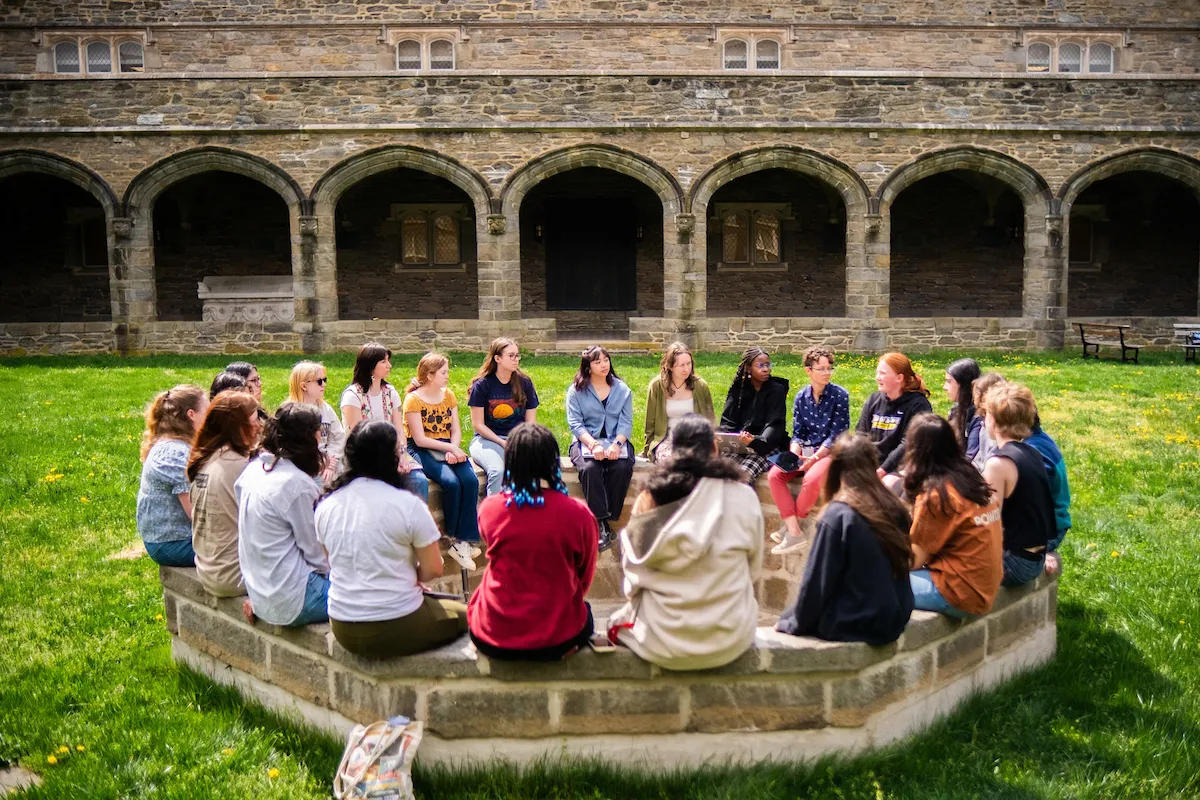
Building a supportive and collaborative intellectual community is at the heart of MMUF. Students gather weekly to present their research, exchange and critique ideas, participate in professional development workshops, learn about graduate school, and meet with graduate students.
About the Mellon Mays Undergraduate Fellowship
The Mellon Mays Undergraduate Fellowship (MMUF) Program is committed to broadening the range of scholarly perspectives in the US academy, with a focus on the humanities and the humanistic social sciences. Through activities that emphasize mentoring, research support, and student-cohort building, the MMUF Program identifies and supports students of great promise and helps them become scholars and professionals of the highest distinction. The Mellon Foundation is proud of its legacy of leading scholars whose perspectives greatly enrich research and teaching in their fields
- Anthropology and Archaeology
- Area/Cultural/Ethnic/Gender Studies
- Art History
- Classics
- Geography and Population Studies
- English
- Film, Cinema and Media Studies (theoretical focus)
- Foreign Languages and Literatures
- History
- Linguistics
- Literature
- Musicology and Ethnomusicology
- Performance Studies (theoretical focus)
- Philosophy and Political Theory
- Religion and Theology
- Sociology
- Theater
Fellows gather weekly to discuss their research, exchange and critique ideas, participate in professional development workshops, and learn about and prepare for graduate school.
Each year, fellows present their research at the annual MMUF Undergraduate Regional Conference and network with other MMUF fellows and mentors in our regional consortium (these institutions include Haverford College, Swarthmore College, the University of Pennsylvania, Princeton University, and Cornell University). Travel to the regional conference is paid for by MMUF.
Fellows are also encouraged to attend other academic lectures and relevant intellectual and cultural events.
- Academic Year: Each fellow is awarded a stipend during the academic year that is disbursed in regular monthly payments. This stipend is intended to facilitate opportunities to engage in research with a faculty mentor by alleviating or eliminating the need to engage in additional paid employment. In exchange for the stipend, the Mellon Foundation expects fellows to conduct research for several hours per week during the academic year.
- About Financial Aid: Students who receive federal and/or College financial aid should be aware that MMUF stipends may affect their financial aid package. In most cases, the impact will be minimal, but fellows should be in frequent contact with Mellon coordinators and BMC financial aid officers to avoid any problems.
- Contact Information: Both the Mellon Foundation and the Bryn Mawr coordinators must have up-to-date contact information for all fellows — even after graduation. Because the Foundation is making a long-term investment in its fellows, and collecting information to assess the effectiveness of the program, it is essential that accurate and up-to-date records be maintained on each fellow. Periodically, fellows will receive reporting forms via email that they are expected to return promptly.
- Summer Stipend: The fellowship funding includes a summer stipend to allow fellows to participate, for a minimum of six weeks, in a meaningful research or learning experience that will enhance and complement studies in their major and advance their Mellon research project. The stipend can support attending summer institutes such as those offered by MMUF programs at the University of California-Los Angles, the University of Chicago, and the University of New Mexico or by the Institute for the Recruitment of Teachers, as well as pursuing relevant internships, intensive language courses, or a carefully developed individual research program under the guidance of a mentor.
- Scholarly Development Funds: Scholarly development funds are available to cover fellows’ research expenses and materials, as well as support fellows’ participation in academic conferences and other activities that benefit their research or career directions.
- Loan Repayment: Fellows are eligible for up to $10,000 for the repayment of undergraduate loans, provided they enroll in full-time doctoral study within 39 months of graduating from college.
- Graduate School Grants: Once fellows are enrolled in a doctoral program in a Mellon-approved field, they may apply to present at conferences and participate in workshops and seminars with other MMUF alums, and they also become eligible to apply for grants for conference travel and research expenses.
Both the Mellon Foundation and the Bryn Mawr coordinators must have up-to-date contact information for all fellows — even after graduation. Because the Foundation is making a long-term investment in its fellows, and collecting information to assess the effectiveness of the program, it is essential that accurate and up-to-date records be maintained on each fellow. Periodically, fellows will receive reporting forms via email that they are expected to return promptly.

Fellowship Expectation and Timeline
- Regular meetings with their mentor
- Weekly meetings with the other fellows and coordinators during the academic year
- Periodic one-on-one meetings with coordinators
- Regional/national gatherings of MMUF Fellows
- Workshops (topics have included the graduate school application process, writing and research skills, presentations, the structure of academia, etc.), assignments (e.g., reading articles or writing brief progress reports), and special programs and events (e.g., lectures, cultural events, dinners, etc.)
Fellows are also expected to participate in and be open to feedback and evaluation regarding overall performance.
If fellows miss more than one activity per semester, their stipend may be withheld. Repeated absences or general lack of participation and engagement in MMUF activities may result in being asked to leave the program.
Fellows must demonstrate a serious effort toward academic excellence and continued academic progress. Although there is no established minimum GPA for participation in the program, fellows must maintain a solid academic record.
Fellows must also give evidence of attending to the achievement of postgraduate career goals. If at any time during their junior or senior years, a fellow realizes that a postgraduate career in one of the designated fields is not for them, they should consider leaving the program so that someone else whose goals truly match those of the program may benefit from it.
Mid-April to May:
- Mid-April: Fellows must confirm with coordinators via email (1) who their mentor is; and (2) that they have had a conversation with their mentor about the IRB.
- Early May: Fellows should (1) provide their mentor with a transcript and discuss coursework for the next semester (including the possibility of taking relevant classes in theory, methodology, and the literature; as well as independent studies to facilitate writing and research activities); and (2) discuss any summer plans—mentors should provide guidance on what programs or internships will best benefit the fellow and her research project. If the fellow plans on pursuing a summer institute, the mentor should work with us to discuss securing course credit for it.
- Mid-May: New Fellows Orientation (during which fellows will create and submit a budget for summer funding, as well as a picture and a brief biographical profile for the website)
- At the first meeting of the semester: Fellows will provide both oral (~5 minute) and written (~3-5 page) reports on their summer activities (research, internships, summer institutes, travel abroad, etc.) and how these activities contribute to her MMUF project.
- At the meeting before Fall Break: Fellows will submit a MMUF project proposal (3-5 pages), which includes (1) research questions and/or hypotheses, (2) a preliminary bibliography, at least partially annotated; (3) a brief section on methodology; (4) a tentative timeline for their research during the next two academic years, which also makes note of meetings with their mentors.
- After Fall Break: Fellows will meet with coordinators in order to discuss their MMUF project proposals.
- End of the semester: Fellows will provide their mentor with a transcript and discuss coursework for the next semester (including the possibility of taking relevant classes in theory, methodology, and the literature; as well as independent studies to facilitate writing and research activities).
- Beginning of the semester: Fellows will meet with coordinators to talk about their projects, their coursework, and prospective summer plans (applications for internships, research and travel plans, etc.).
- End of the semester
- End-of-year report: Fellows will submit a written report (~3-5 pages) that includes (1) a discussion of the status of their projects, including any changes to the topic, research question(s), hypotheses, mentor, timeline, or methodology; (2) an annotated bibliography; and (3) their relationship and meeting frequency with their mentor.
- End-of-year meeting with mentor: Fellows should (1) provide their mentor with a transcript and discuss coursework for the next semester (including the possibility of taking relevant classes in theory, methodology, and the literature; as well as independent studies to facilitate writing and research activities); and (2) discuss any summer plans—mentors should provide guidance on what programs or internships will best benefit the fellow and her research project. If the fellow plans on pursuing a summer institute, the mentor should work with us to discuss securing course credit for it.
- End-of-year meeting with coordinators: Fellows will meet with coordinators before they depart for the summer in order to discuss (1) their status report; (2) their summer plans; (3) their planned coursework in the fall; (4) any plans to apply to graduate school; and (5) their mentor relationship.
- Summer funding proposal: Fellows will submit their budgets for summer funding to coordinators as soon as their summer plans are confirmed, by mid-May at the very latest.
- The advisory committee will meet to recommend continuation in the program for the second year.
- At the first meeting of the semester: Fellows will provide both oral (~5 minute) and written (~3-5 page) reports on their summer activities (research, internships, summer institutes, travel abroad, etc.) and how these activities contribute to her MMUF project.
- After Fall Break: Fellows will meet with coordinators to discuss (1) the status of their project; (2) their relationship with their mentor; (3) any help they need regarding the graduate school application process; and (4) any help with the senior thesis research and writing processes.
- At the meeting before Thanksgiving: Fellows will be required to prepare a statement for graduate school, pursuant to a meeting in which they participate in a workshop on how to do so, regardless of whether or not they are applying to graduate school during that application cycle.
- End of the semester
- End-of-semester report: Fellows will submit a written report (3-5 pages) detailing the status of their project, including (1) any changes to the topic, research question(s), hypotheses, mentor, timeline, or methodology; (2) an updated annotated bibliography; (3) their relationship and meeting frequency with their mentor; (4) any writing done for the senior thesis.
- End-of-semester meeting with mentor: Fellows will provide their mentor with a transcript and discuss coursework for the next semester (including the possibility of taking relevant classes in theory, methodology, and the literature; as well as independent studies to facilitate writing and research activities).
- Beginning of the semester: Fellows will meet with coordinators to talk about (1) their projects and (2) their postgraduation plans.
- End of the semester
- Final Project: Fellows will turn in either (a) a 10-15 page paper that is a distillation of their MMUF project/Senior Thesis, or (b) the senior thesis with a brief description of how the Mellon program contributed to development of the topic.
- Final Presentations: Fellows will make a public presentation (10-20 minutes) of their MMUF project with the other Bryn Mawr fellows.
- Exit interviews: Students will participate in a 45-minute exit interview with coordinators during Senior Week.
Specific dates for proposals and reports will be posted on the MMUF calendar page.