
Colloquia and Events 2026/2027
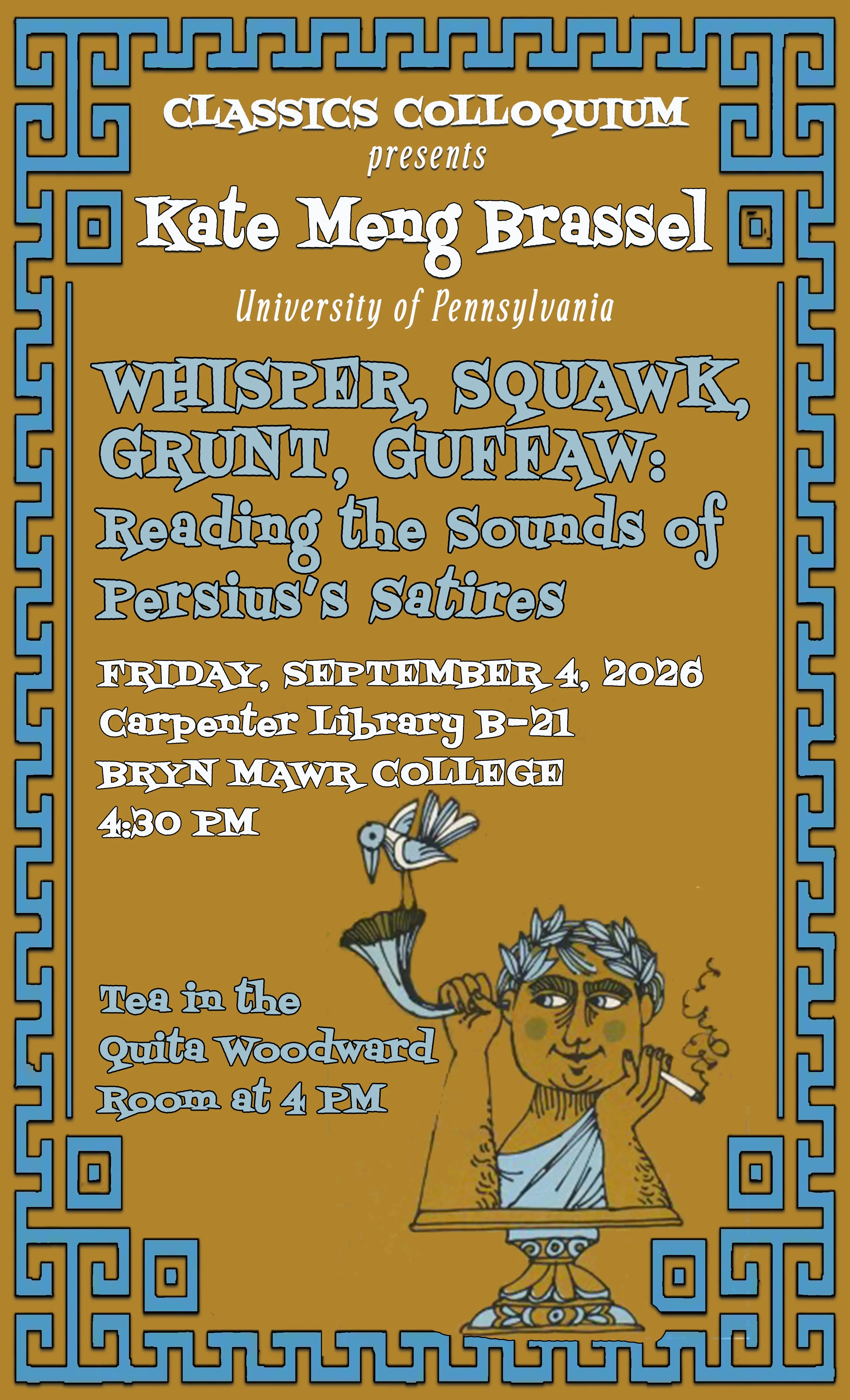
FRIDAY, SEPTEMBER 4
Kate Meng Brassel (University of Pennsylvania)
Whisper, Squawk, Grunt, Guffaw: Reading the sounds of Persius’s Satires
Often thought of as a “good kid” but a bad writer, Persius left behind a small collection of poetry upon his death at the age of 28. Satires has puzzled readers with its highly negative, discomfiting, and even disjunctive style—leaving many to wonder whether we should consider Satires a book at all. Persius challenges his readers to look at Rome’s sorry state themselves and to read his words with both their eyes and, importantly, their ears as he launches a cradle-to-grave critique of literary culture at Rome—from its producers to its audiences, from sources of inspiration to its aspirations to immortality, from its methods of education to its dissemination in performance and publication. In this talk, I pursue the significance of Persius’s sounds and argue that the verses’ brays, squawks, whispers, and guffaws structure Satires intelligibly as a Roman poetry book (libelle, 1.120) to go toe-to-toe with any Eclogues or Sermones.
SEPTEMBER 11
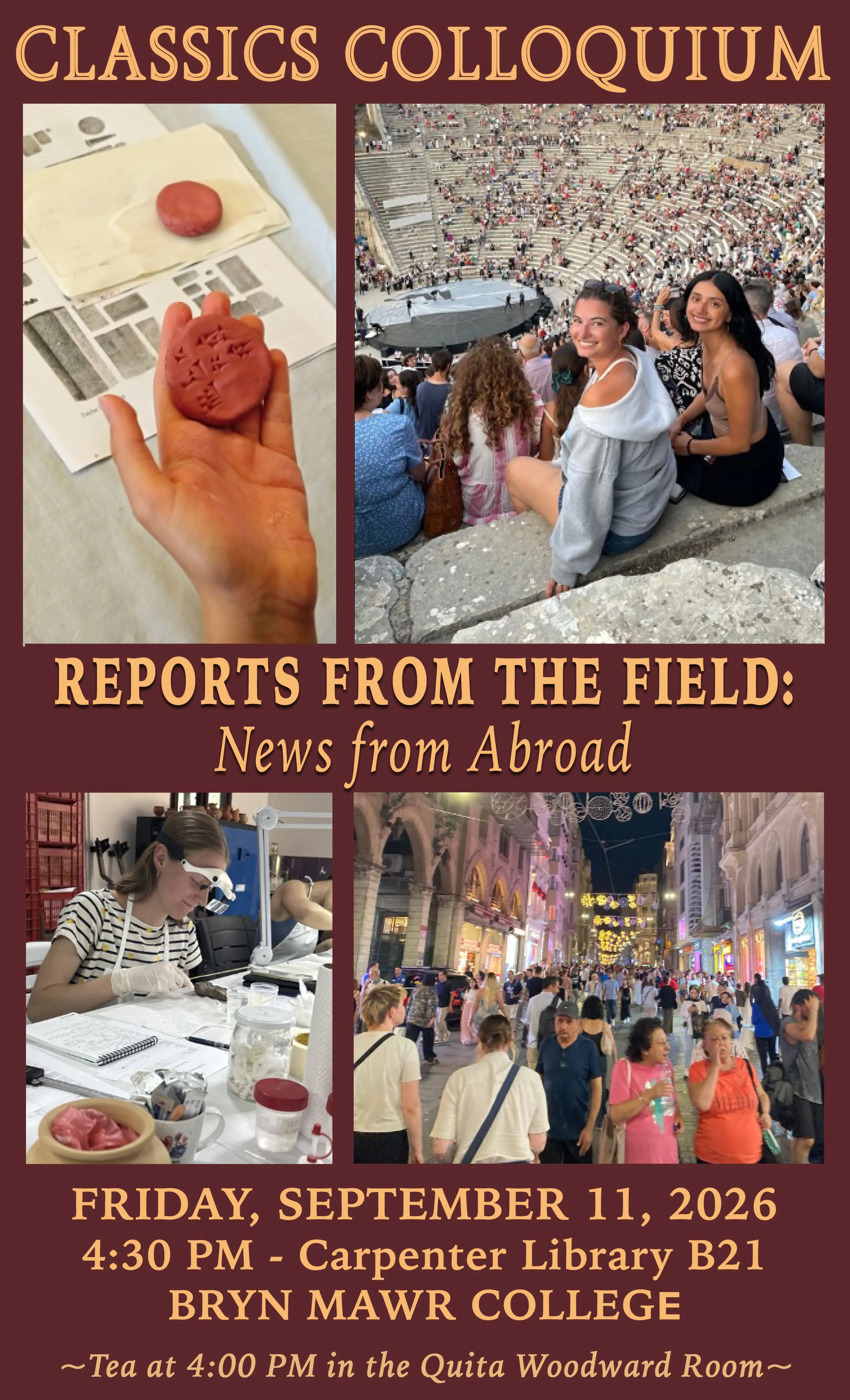
Reports from the Field
Each fall, we feature a brief presentation from the students who have studied abroad in the past year, done summer courses or research fellowships, taken part in archaeological fieldwork, or engaged in some academic activity outside the bounds of the normal classwork of the Bi-College curriculum. This Reports from the Field Colloquium provides a great opportunity to survey the vast range of resources and opportunities for students in Classics and Archaeology.
THURSDAY, SEPTEMBER 17
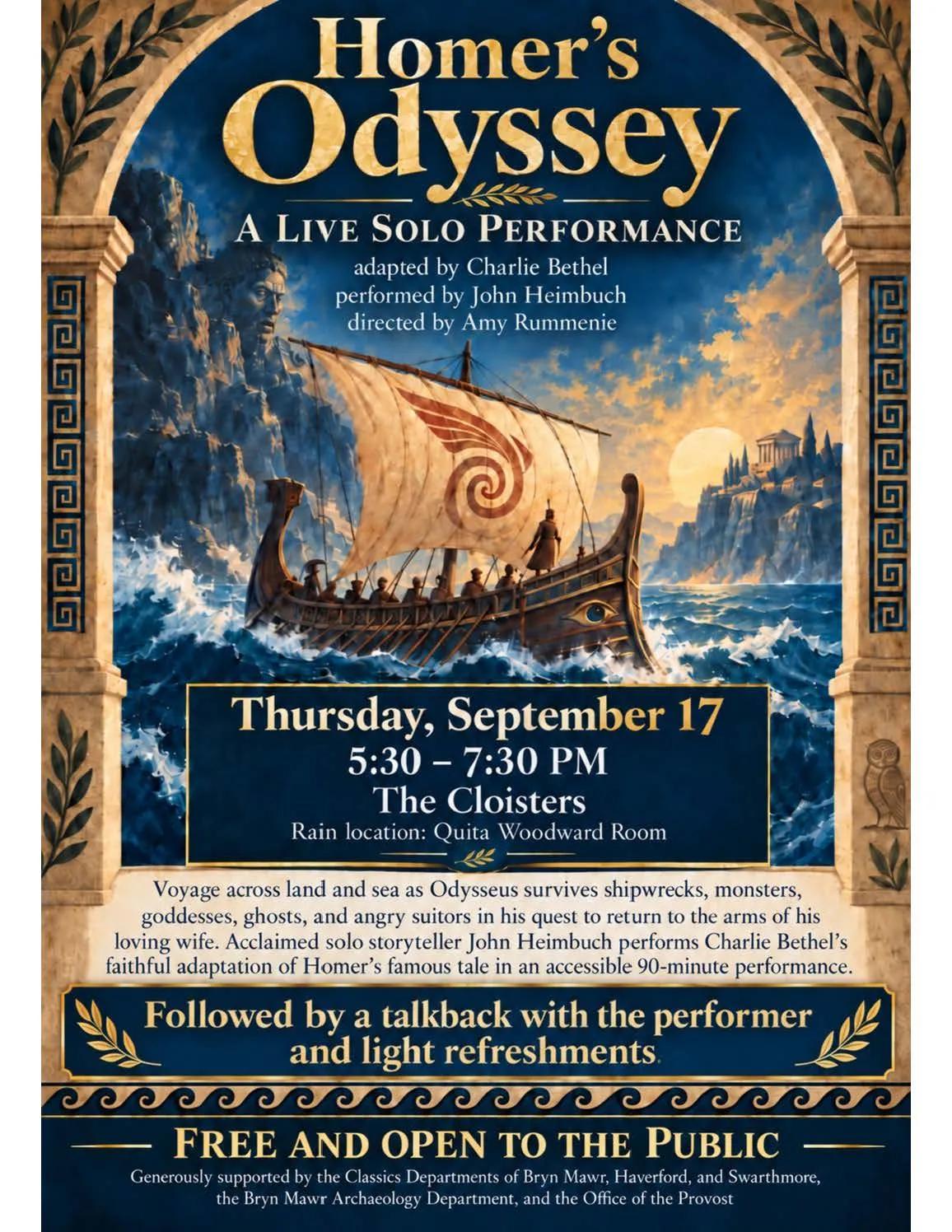
"Homer's Odyssey"
A Live Solo Performance
by John Heimbuch
5:30 - 7:30 PM
The Cloisters
Rain location: Quita Woodward Room
Voyage across land and sea as Odysseus survives shipwrecks, monsters, goddesses, ghosts, and angry suitors in his quest to return to the arms of his loving wife. Acclaimed solo storyteller John Heimbuch
performs Charlie Bethel's faithful adaptation of Homer's famous tale in an accessible 90-minute performance.
Followed by a talkback with the performer and light refreshments.
FREE AND OPEN TO THE PUBLIC
Generously supported by the Classics Departments of Bryn Mawr, Haverford, and Swarthmore, the Bryn Mawr Archaeology Department, and the Office of the Provost
FRIDAY, SEPTEMBER 18
Malina Buturovic (Yale University)
"The Transmission of Fault: Heredity between Medicine and Theology"
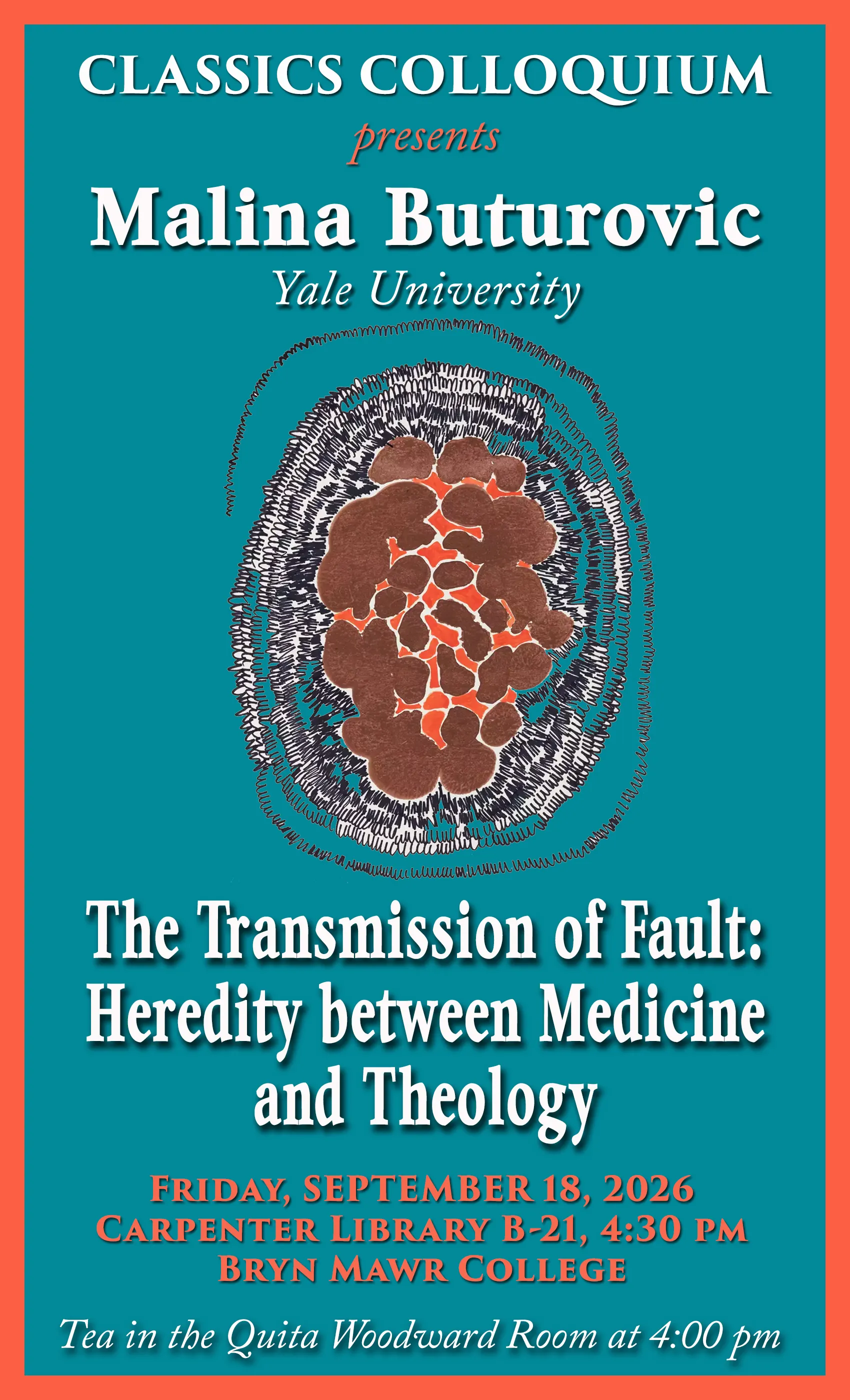
What place does the principle of ‘family resemblance’ have in a just and well-ordered natural world? Why should bad characteristics persist from generation to generation? This talk sets out the unusual solution to these questions found in the works of the second century CE doctor and philosopher Galen of Pergamon. At the heart of Galen’s solution is a move that is likely to come as a surprise to a modern reader accustomed to imagining ‘hereditary’ resemblance as a mechanical principle governing the natural world. Picking up a set of anxieties from his broader cultural milieu over the phenomenon of bad ‘heredity,’ Galen reinterprets these instead as cases of errant human agency. Their regular recurrence reflects human beings’ systematic tendency toward misbehavior and wrongdoing as thinking, moral agents, rather than the material structure of the natural world. Galen’s efforts to grapple with heredity as a problem of theodicy indicate the central role that theological questions play in shaping medical and biological understandings of ‘hereditary’ resemblance.
SEPTEMBER 25
Christopher Atkins (Baylor University)
"Plato among the People: The Case of Magic"
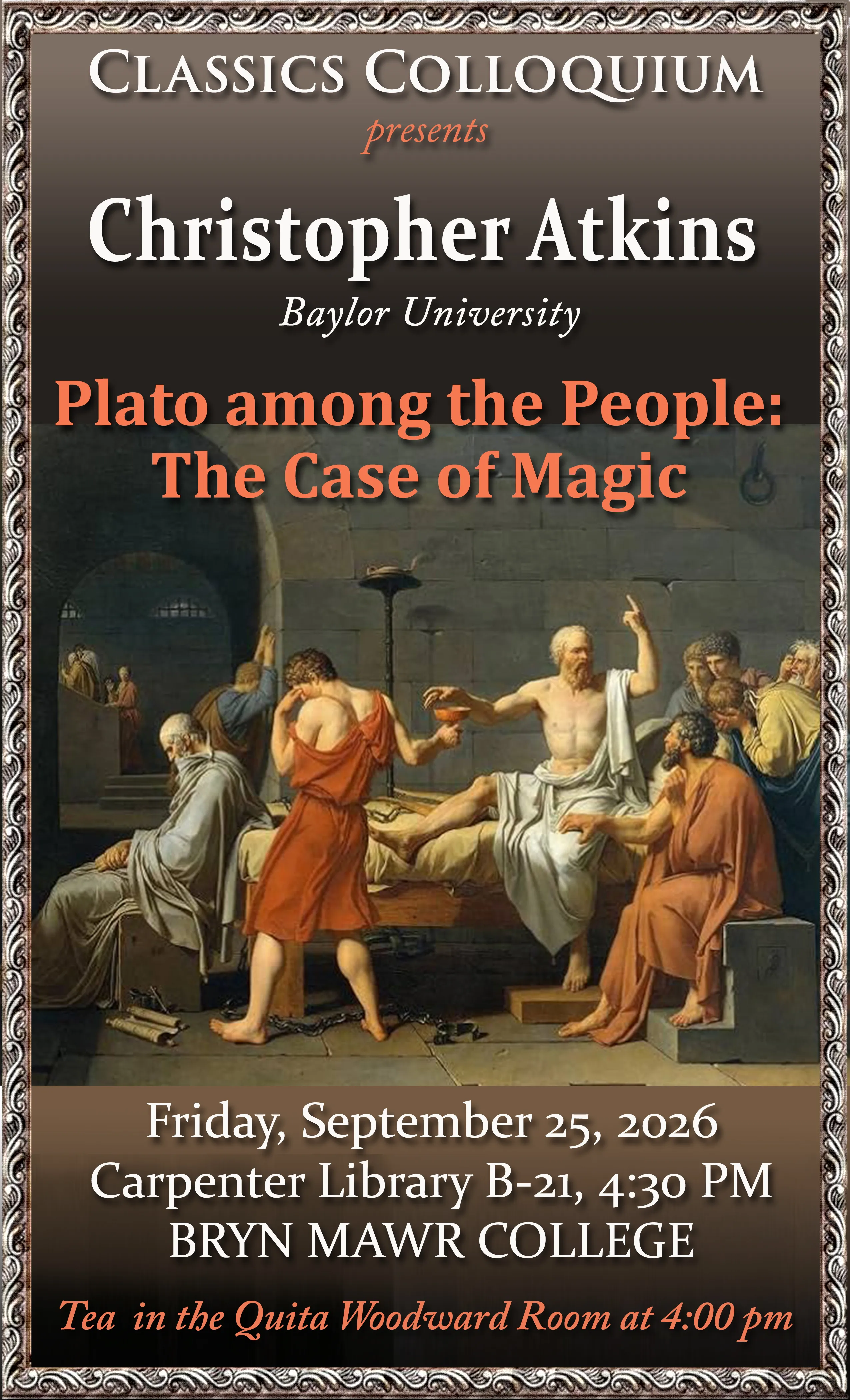
Plato is often invoked for his critique of practices deemed “magical.” However, his polemics obscure as much as they unveil, as his dialogues are also infused with reflection about divinity and the uncanny, and appeals to inspiration and enchantment. These facets of Plato’s writings have been profitably studied in relation to early Greek ideas about the power of the spoken word. This approach nevertheless risks abstracting elite writers such as Plato from their social context and their lived realities of religious experience. In this talk, I adopt a different method. There is an abundance of material evidence for everyday religious and “magical” practice in fourth-century Athens that can help us more concretely contextualize Plato in his world. Approaching Plato from the vantage point of the archaeological remains of ancient Greek “private” ritual practices such as curses, spells, and incantations, I suggest that the “magical” in Plato’s dialogues should not merely be viewed as a metaphor for the power of logos or philosophical inquiry, but rather, that it was also a reality of everyday experience in Plato’s Athens that the philosopher both diagnosed and sought to transform.
OCTOBER 2
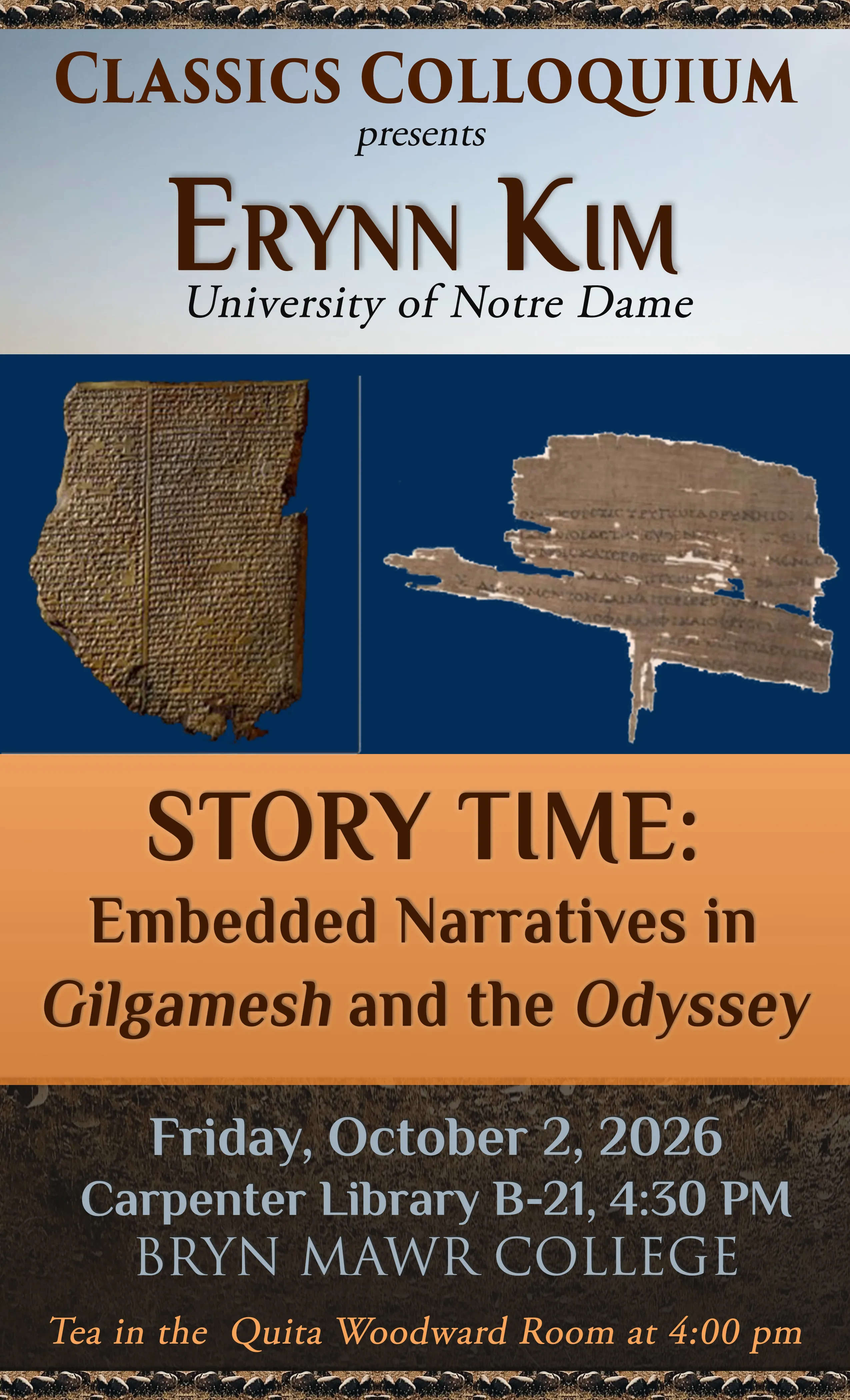
Erynn Kim (University of Notre Dame)
"Story Time: Embedded Narratives in Gilgamesh and the Odyssey"
This lecture examines the two most prominent embedded narratives in the Standard Babylonian Epic of Gilgamesh and Homer’s Odyssey: Atrahasis, the legendary Utanapishti’s story of the dream that saved him from the Flood, and the Apologoi, Odysseus’ narration of the events following the Trojan War. Each story-within-the-story is told at a climactic moment of the primary narrative that determines whether the hero’s quest will be a success or a failure. By comparing the poetic strategies that the epic storytellers employ to facilitate audience engagement, this lecture aims to elucidate the narratological purpose of the embedded narratives as we consider the question, why do we tell stories?
Monday, OCTOBER 19
Sofía Torallas Tovar (Institute for Advanced Study, Princeton)
"The Tools of the Magician"
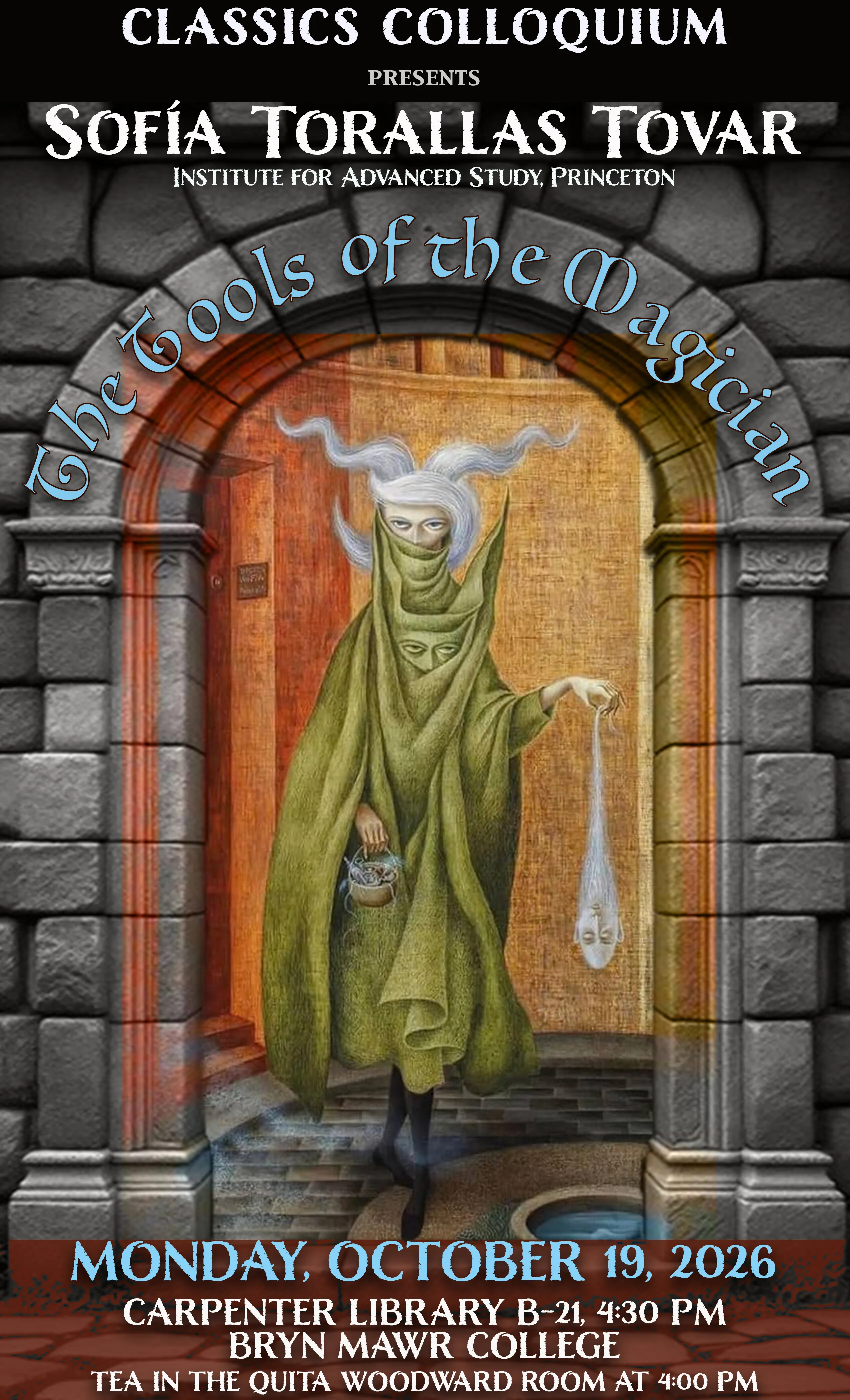
Lecture in Carpenter Library B-21 at 4:30pm; Tea in the Quita Woodward Room at 4pm
The figure of the magician, sorcerer or practitioner who wrote, owned and used the magical formularies is difficult to portray. Discussions around whether they were priests, commoners, wandering healers or men or women have been a focal point within academic discourse in past decades. An alternative perspective on these individuals can be gained by examining their possessions and the paraphernalia they are described as using. In order to execute their feats, magicians required not only a certain set of skills/powers but also a range of stuffs and instruments. This paper will discuss the tools, both material and immaterial, employed by sorcerers in their practice. Such tools included herbs for the creation of potions, pots, clay, wax, writing implements, and other accoutrements. However, sorcerers were also believed to possess other immaterial abilities, such as memory, invisibility, and the capacity to invoke a spiritual assistant.
OCTOBER 23
C. Densmore Curtis Lecture
Matthew P. Canepa (University of California, Irvine)
"Rhyta and the Imperial Gryllus: Elite Identities and Material Intra-action between the post-Achaemenid Mediterranean and Iranian Worlds"
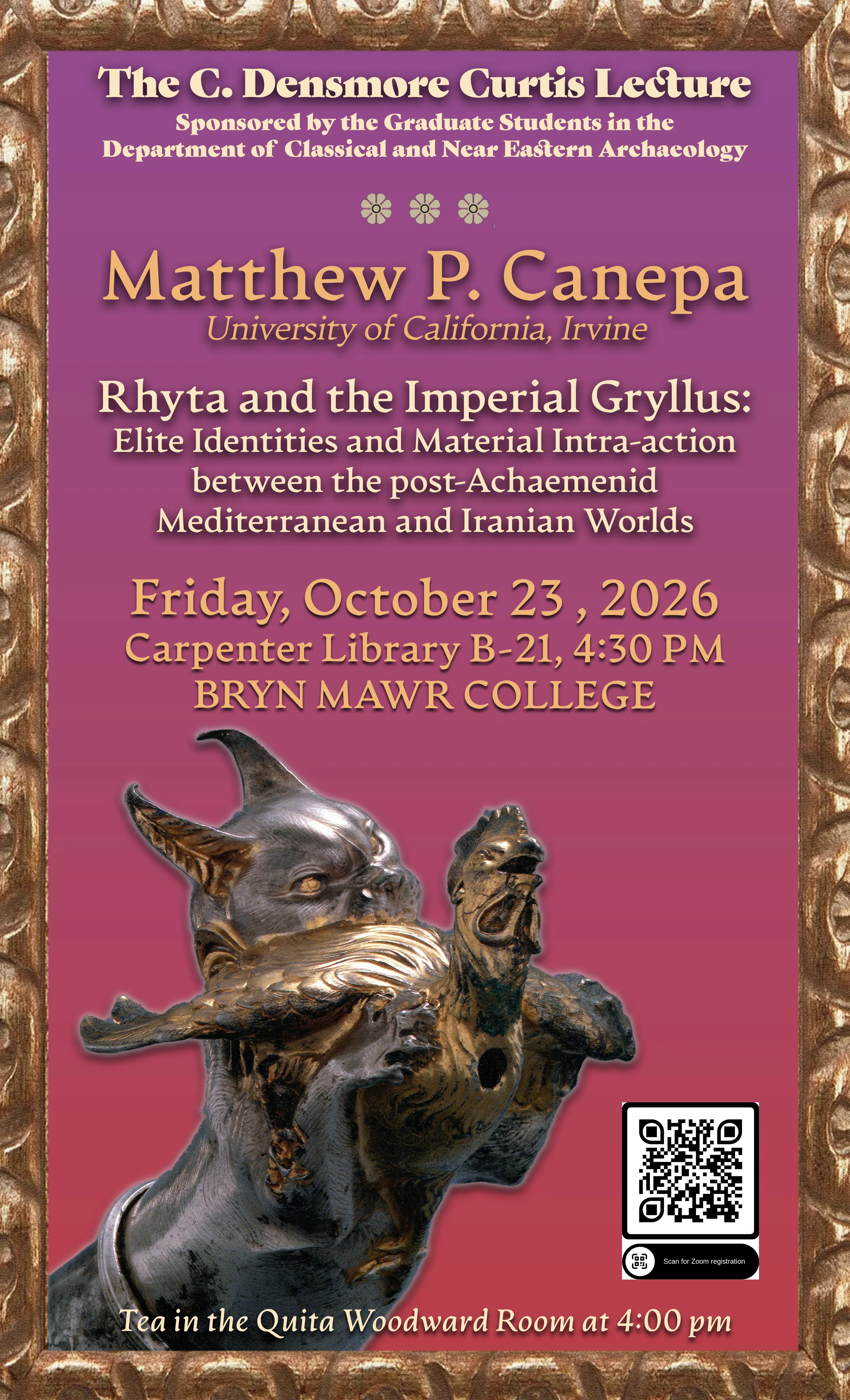
Luxury drinking vessels were not simply utensils nor can they be reduced to simply their precious materials: they were instruments of statecraft, ritual implements, and marks of distinction
that articulated relationships of power, status, and identity. They played a special role within system of extraction and redistribution of wealth and symbolic capital in the entangled courts of the Iranian and Hellenistic worlds. Deployed in commensal liturgies, or as objects of display in palace and temple treasuries, or paraded with armies and weaponry in urban spectacles, they served as one of the premier loci of competition in inter-imperial rivalry. It is a commonplace in scholarship to observe that the material cultures of the Seleucid, Greco-Bactrian, Indo-Greek, Arsacid, or for that matter, Ptolemaic courts were entangled. The goals of this lecture are to explore how objects shaped political identities and the parallel processes by which these highly charismatic objects were created. With regards to the latter goal, with a few notable exceptions, most scholarship on Hellenistic Asian metalwork have repeated attributions to regions or workshops without systematically defining what they mean, let alone theorizing how these workshops were constituted and the processes by which individual or groups of artisans produced the material and encountered or shared ideas, a lacuna this study and the larger project from which it derives seeks to address.
Thursday, OCTOBER 29
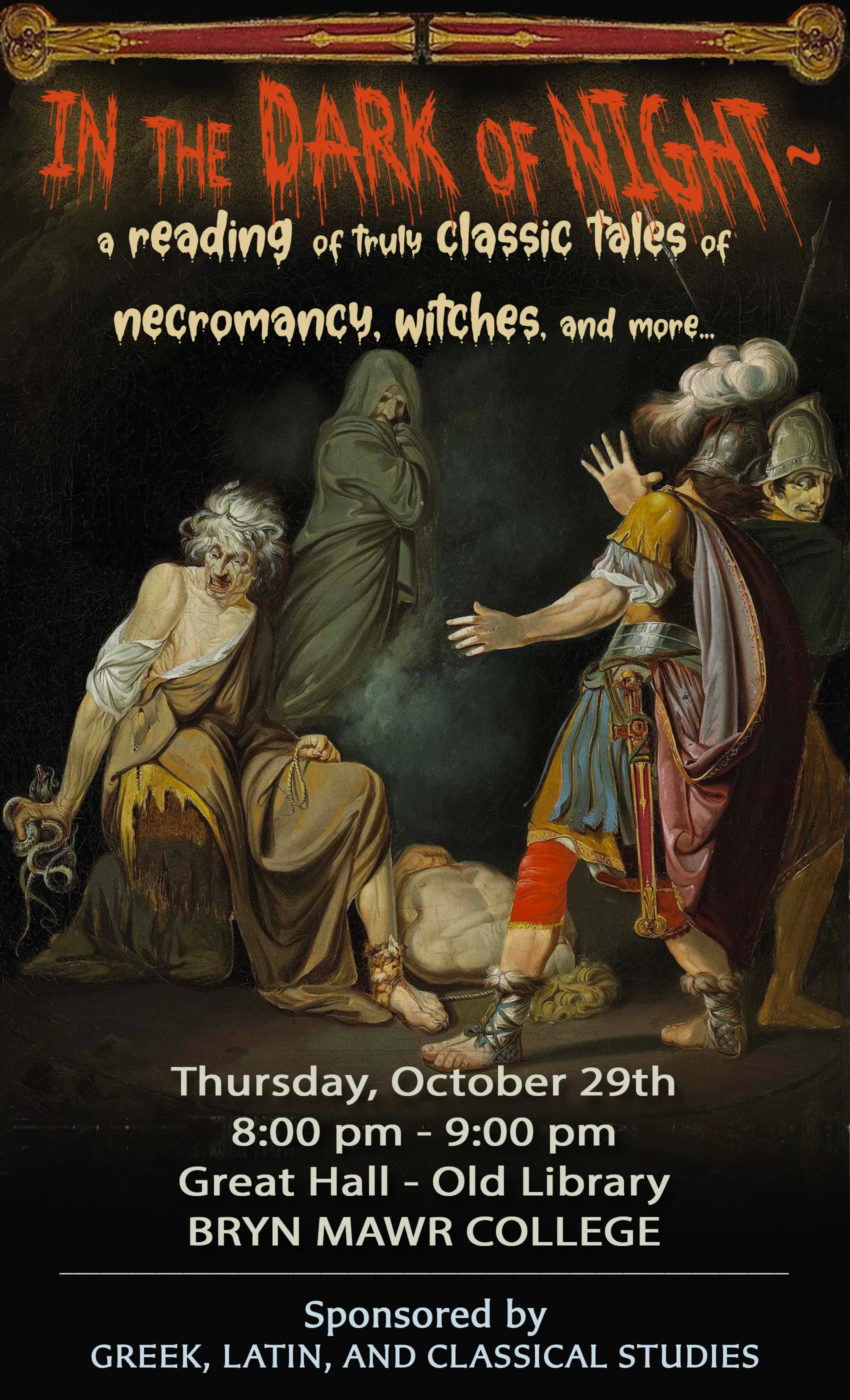
"In the Dark of Night: A reading of truly classic tales
of necromancy, witches and more"
8:00 - 9:00 PM in The Great Hall
OCTOBER 30
Jan Sienkiewicz (University of Cambridge)
"Late Bronze Age symposia? Prehistoric Roots of Ancient Greek Cultural Institutions"
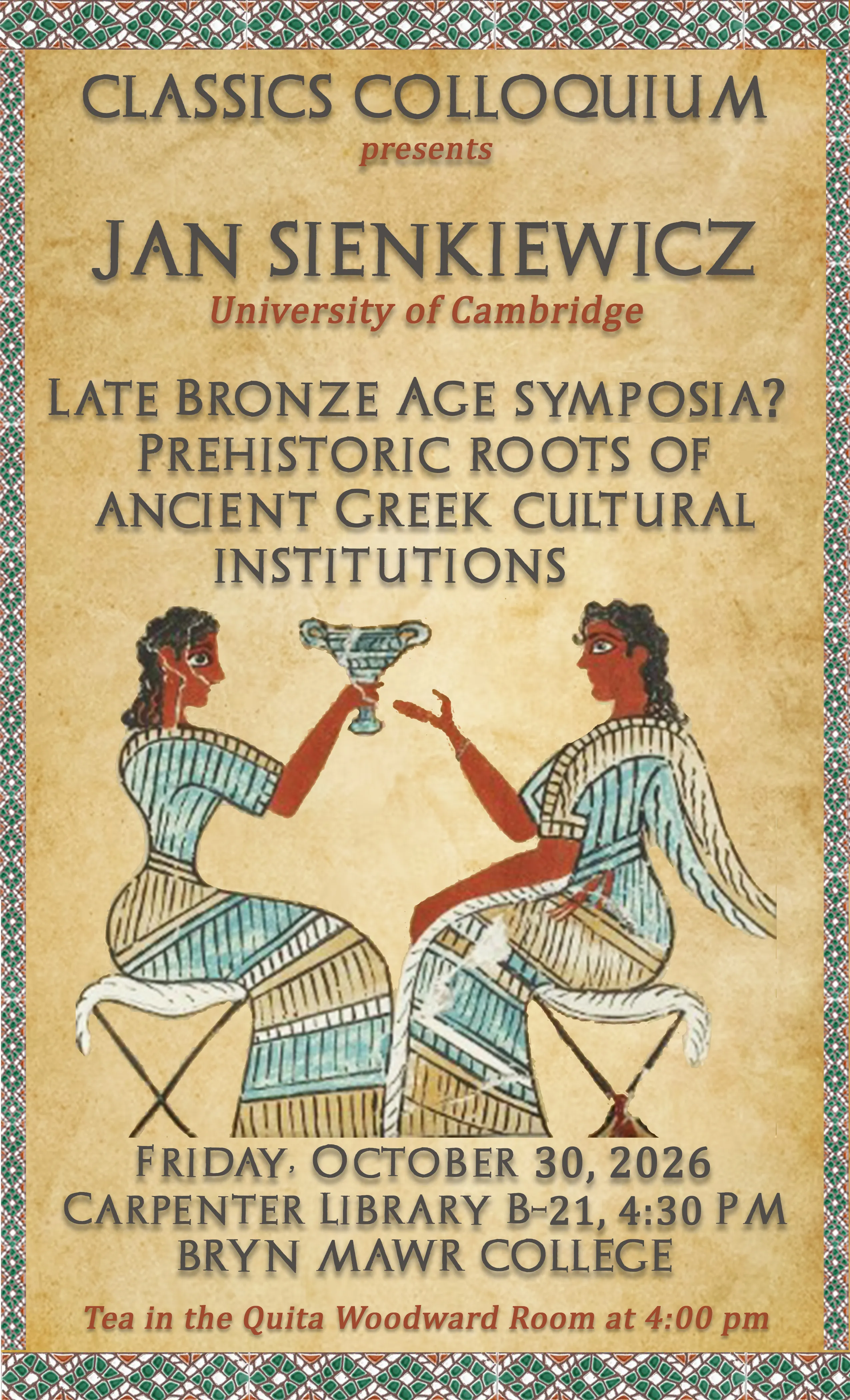
This paper argues that the symposion – a ritualised form of drinking and socialising in small, all-male groups –emerged around the mid-2nd millennium BCE, some 700 years earlier than it is currently believed. By revising the origins of the symposion the paper aims not only to highlight the continuity in certain practices across the Bronze Age–Iron Age divide, but also to throw into relief our overreliance on textual evidence in writing cultural histories. The paper then zooms out to other aspects of ancient Greek culture, to suggest their connection to the Bronze Age societies, either through direct continuity or through conscious revival.
Monday, NOVEMBER 2
Alex Gottesman (Temple University)
"The Exaltation of Saturn(inus): An Astrological Riddle and its Solution"
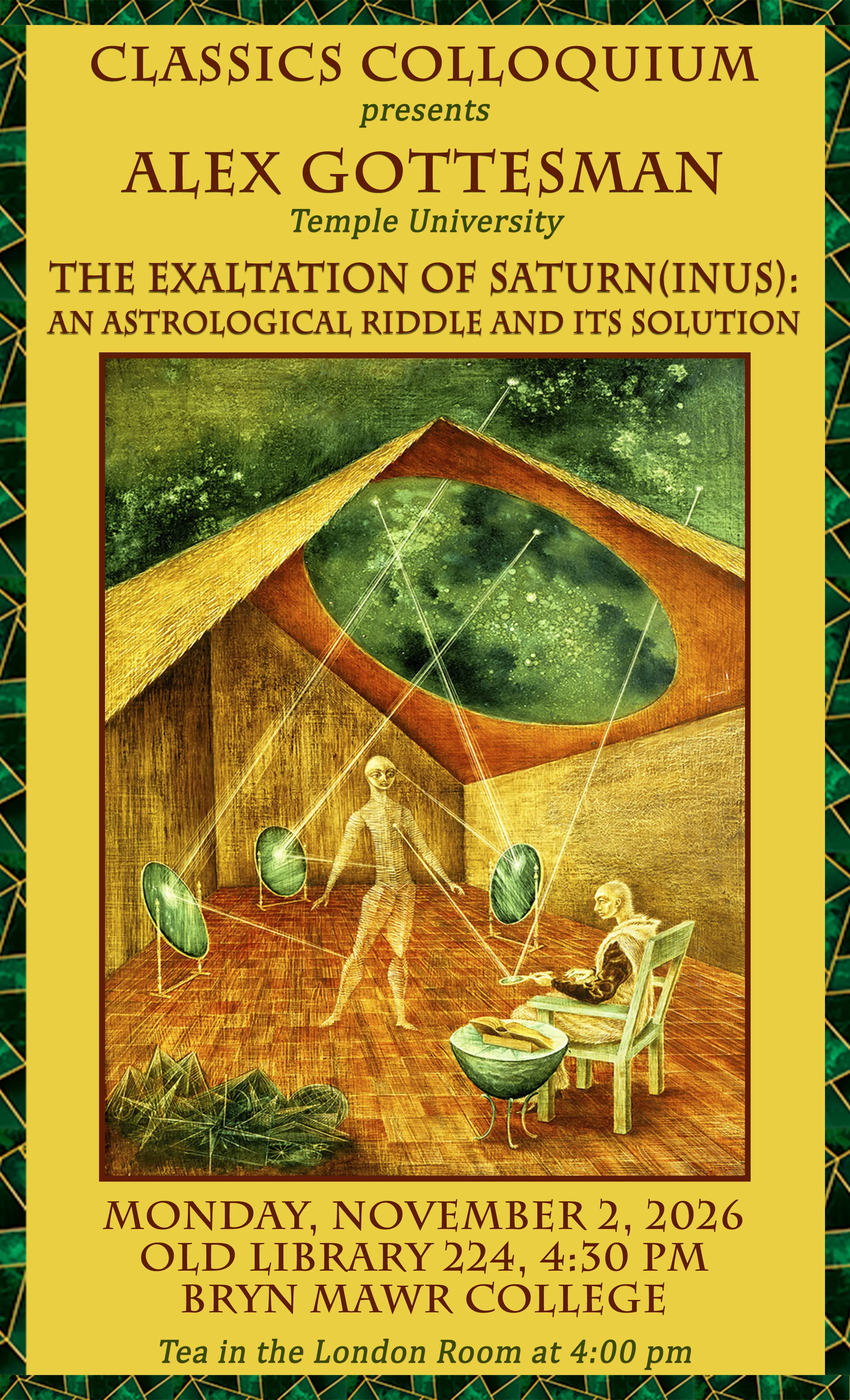
Ancient historians have long neglected astrological lore, despite its importance for their subjects. This paper argues that keeping an open mind about it can lead to unexpected historical insight. It argues that the unattributed Greek epigram Anthologia Palatina IX. 436 (traditionally ascribed to Theocritus) is an astrological riddle. By comparing the work to the genre conventions of ancient riddles, I show that the numerical sequences in the text function as deliberate clues designed to be solved through astrological interpretation. A solution is proposed that would date the poem to the third year of the reign of Nero, 56 CE, and identify its occasion as the funerary honors for L. Volusius Saturninus.
Lecture in Old Library 224 at 4:30pm; Tea in the London Room at 4pm
NOVEMBER 6
The Call of Kinnaru
"Ancient Music, Old and New"
John Franklin (UVM), Rachel Fickes (Middlebury), Jamie Levis (UVM)
and Abigail Bradford (UVA)
Performance at the Haverford Jaharis Performance Center
NOVEMBER 13
Ostwald Lecture at Swarthmore
Jeremy McInerney (University of Pennsylvania)
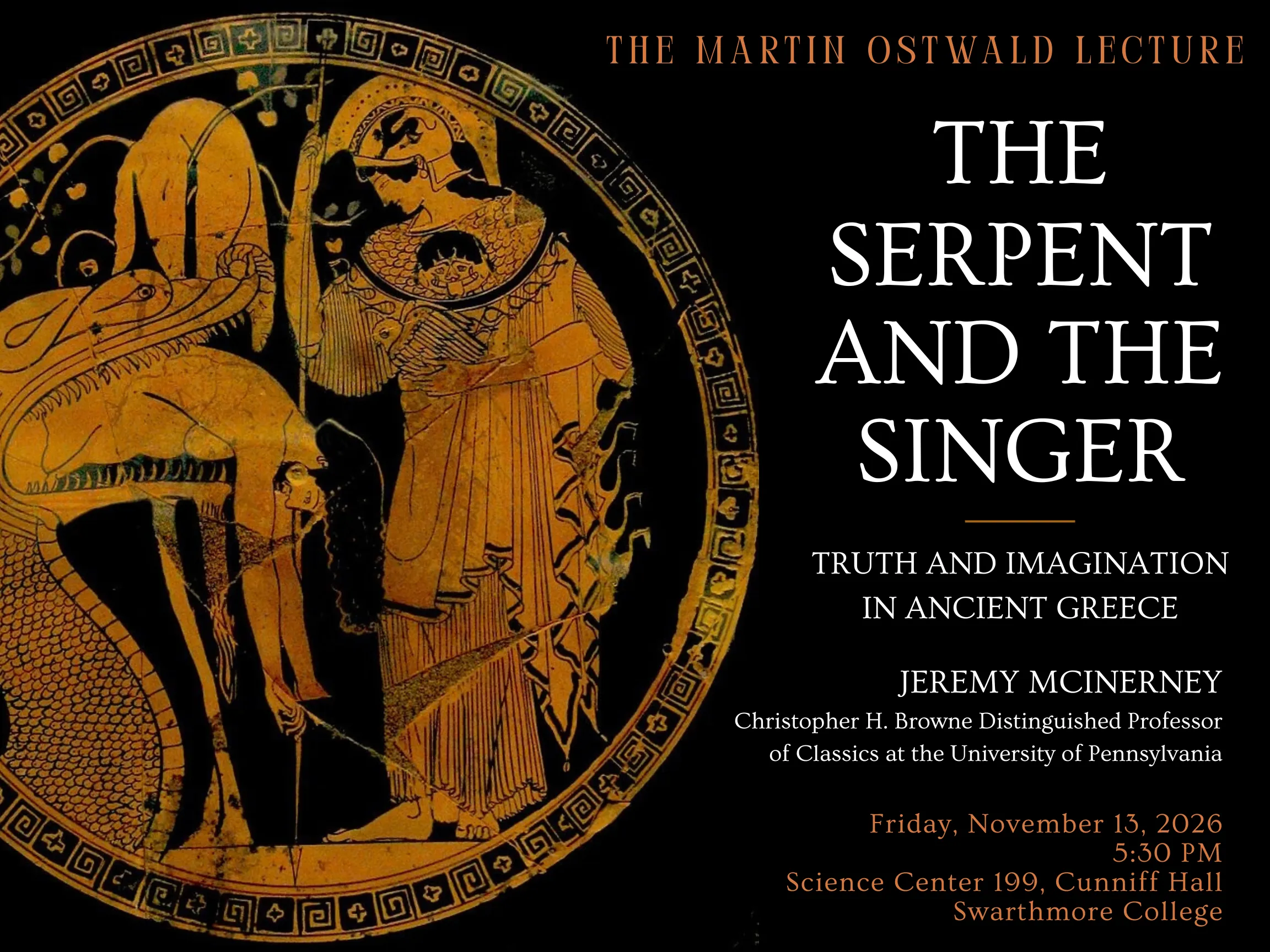
"The Serpent and the Singer. Truth and Imagination in Ancient Greece"
NOVEMBER 20
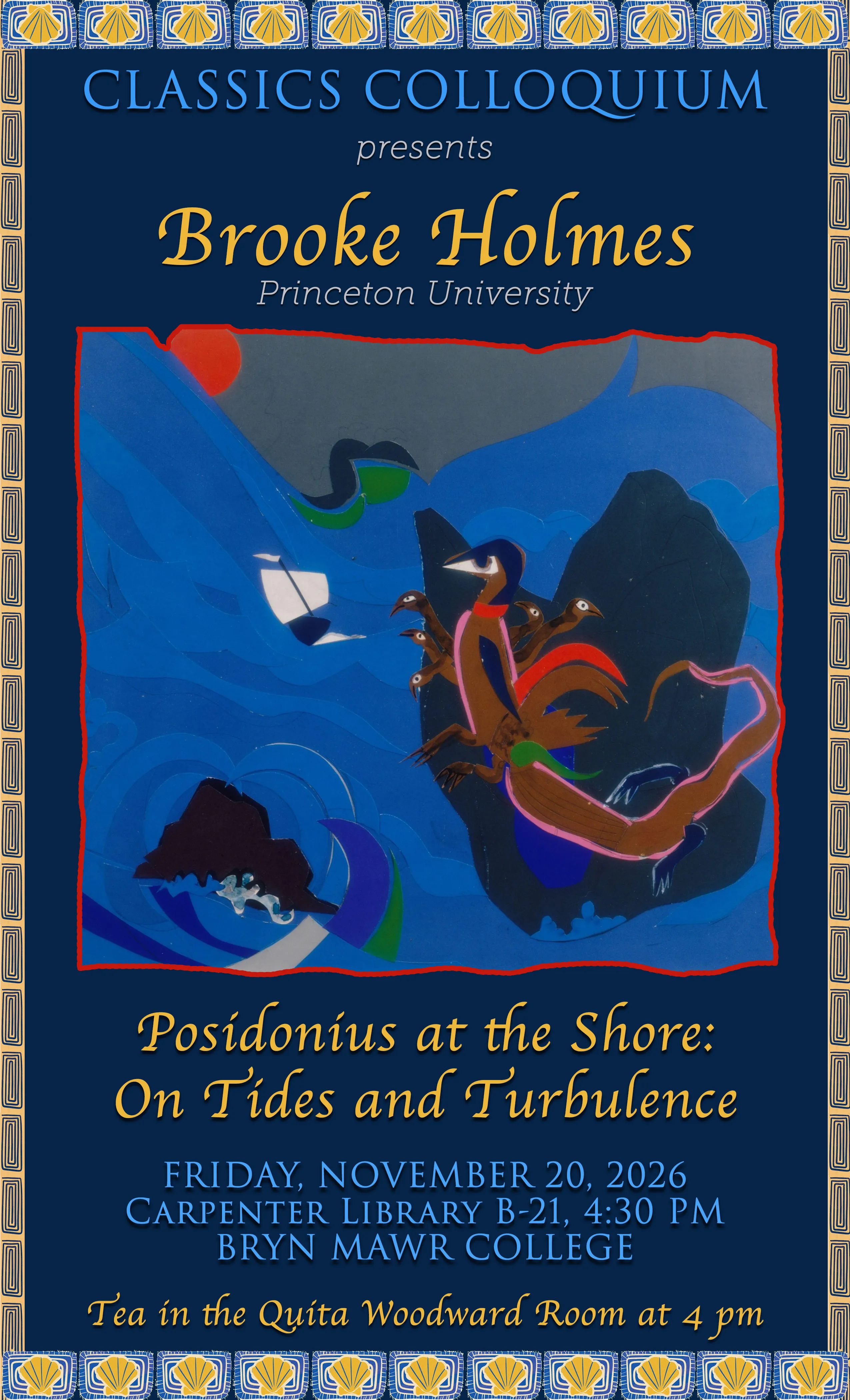
Brooke Holmes (Princeton University)
“Posidonius at the Shore: On Tides and Turbulence”
According to Strabo, Posidonius came to observe the tides at Gadir in southwestern Iberia, where he noted that the tides moved “sympathetically” with the moon. The tides’ “sympathy” with the moon is soon invoked in Stoic arguments for the idea that the cosmos is a unified body whose parts “sympathize.” I read this scene, on the one hand, as Posidonius’ reception of earlier texts and authors who had focused his attention on cyclical oceanic fluctuation through an encounter with the ocean at the temple of Melqart–Herakles–Hercules in Gadir. On the other hand, I read it as an opening towards theorizing the diasporic reception of a Greek-identified cosmo-anthropologies of nature within differently scaled communities that are at once transgenerational, culturally hybrid, and more-than-human. Drawing on the work of modern and contemporary artists and theorists, I reread Posidonius’ tides to make space in classical reception studies for densities of affective relation that invite us to conceptualize reception, and “antiquity” itself, in terms of turbulence.
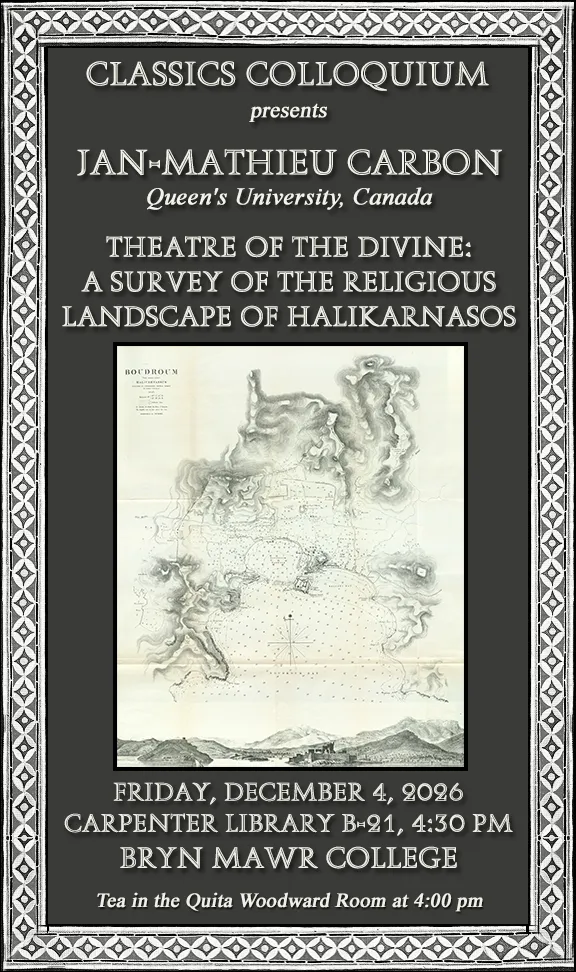
DECEMBER 4
Jan-Mathieu Carbon (Queen’s University, Canada)
"Theatre of the Divine: A Survey of the Religious Landscape of Halikarnassos"
This talk will provide an overview of the religious topography of the ancient city of Halikarnassos, home of Herodotus and the Mausoleum. While not dwelling extensively on those two famous highlights, our journey will take us from the Salmakis promontory to the Zephyrion peninsula. After gauging these two fundamental pillars of the community, it will lead into the "cavea" of the city, where much of the terrain remains to be charted. Athena, Demeter, Zeus, and many others found their place here, alongside several popular figures imported from the wider region during the Hellenistic period (Artemis Leukophryene, Artemis Pergaia, Hekate Laginitis, etc.). The diverse and complex pantheon of Halikarnassos gave shape to a landscape teeming with gods, as one might expect, yet one whose historical fabric is distinct and inextricably tied with a sense of the place.
Contact Us
Greek, Latin, and Classical Studies
Old Library 103
Bryn Mawr College
101 N. Merion Avenue
Bryn Mawr, PA 19010-2899
Phone: 610-526-5083
Radcliffe Edmonds, Chair redmonds@brynmawr.edu